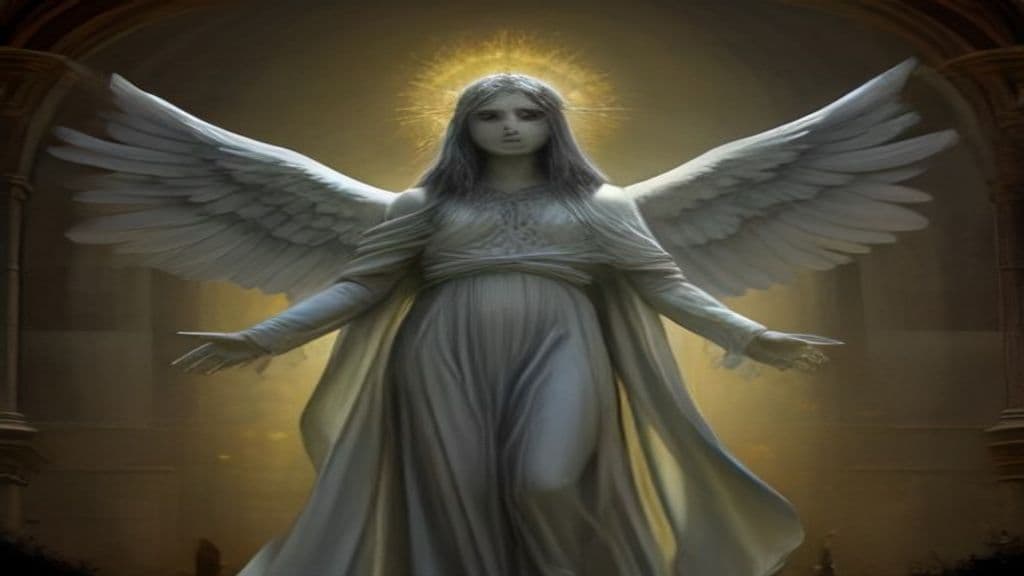
The classification of Dominions is grounded in Christian scriptural and angelological sources cited in the dataset. The New Testament passage Colossians 1:16 (as referenced in the sources) lists 'thrones, dominions, principalities, powers' among created invisible beings, situating Dominions among created orders. Pseudo‑Dionysius the Areopagite systematized later medieval Christian angelology by ranking Dominions fourth in a multi‑tiered celestial hierarchy, framing them as an intermediate order with an office‑like function. Earlier visionary literature such as the Second Book of Enoch (also cited) places Dominions among the orders seen in the Seventh Heaven, embedding them within layered heavenly cosmology rather than originating as folkloric household spirits or demons.
The provided sources do not supply detailed or consistent visionary descriptions of Dominions. Traditional theological treatments (as reflected in the cited material) discuss them as ranks or offices within the angelic hierarchy rather than as individuated visual figures; consequently specific physical attributes are not attested in the cited texts. Medieval and later iconographic traditions portray angels in various ways generally, but the supplied sources do not record particular iconography for Dominions themselves.
The cited materials do not enumerate concrete, enumerated powers for Dominions. Their names in Latin (dominatio) and Greek (kyriotētes) carry the semantic field of lordship, rule, or governance, and Pseudo‑Dionysius' placement of them in a ranked hierarchy implies a functional association with ordering or delegated authority in the divine economy. Beyond this associative role and their listing among other angelic orders in Colossians 1:16 and in the Second Book of Enoch's heavenly vision, no specific actions, miraculous capabilities, or behaviors are described in the provided sources.
Camael
Camael is presented in mainstream Christian angelology as an archangel associated with love, peace, and harmony. Separately, an archival excerpt uses the same name for a spirit described as a 'demon' who appears in dreams and to those who summon him and who instructs humans in violent and sexualized acts; these are distinct, conflicting portrayals in the supplied sources.
Haniel
Haniel is an angelic figure in Jewish and later Western angelology, traditionally counted among the seven archangels. The figure is associated with the planet Venus and is described as the governing archangel of the Kabbalistic sephirah Netzach, embodying qualities of grace, charm, and joy and appearing in later Renaissance esoteric apparatus such as John Dee's Sigillum Dei Aemeth.
Seraph (seraphim)
A seraph (Hebrew: saraph; plural seraphim) is a class of heavenly, non‑human beings in ancient Jewish scripture and later Jewish, Christian, and Islamic angelologies, associated with proximity to the divine throne, perpetual liturgical praise, and a burning or purifying quality tied to the root meaning of their name.
Zadkiel
Zadkiel (Hebrew: צִדְקִיאֵל, Ṣīḏqīʾēl, 'God is my Righteousness'), also called Hasdiel in some sources, is an archangel in Jewish and Christian angelology associated primarily with kindness, benevolence, mercy, and forgiveness. In mystical systems Zadkiel is linked to the sephirah Chesed (the fourth sephirah) and the planet Jupiter; some texts identify him with the unnamed 'Angel of the Lord' who restrains Abraham in the Binding of Isaac, though this identification is disputed.
Dolon
Dolon (Greek: Δόλων) is a mortal Trojan figure in Homeric epic who volunteers to spy on the Greek camp during the Trojan War, is captured by Diomedes and Odysseus, gives information under interrogation, and is executed. He is presented in the sources as a minor human participant in the Iliad's narrative world rather than a supernatural being.
Dolops
Dolops (Ancient Greek Δόλοψ) is a personal name borne by several distinct figures in Greek mythic texts rather than a single recurring supernatural being. Bearers of the name appear as mortal combatants in Homeric epic, a funerary figure visited by the Argonauts in Apollonius Rhodius, and in at least one genealogical listing as a semidivine child of Cronus and Philyra.
Domalde (Dómaldi)
Domalde (Old Norse Dómaldi/Dómaldr) is a legendary Swedish king of the Yngling dynasty whose reign is associated with prolonged famine. In Old Norse sources his personal ill‑luck (ósgæssa), said to be caused by a curse from his stepmother, is presented as coterminous with the land's fertility; communal cultic escalation culminates in the king's sacrificial killing and the restoration of good harvests.
Domar (Dómarr)
Domar (Old Norse Dómarr, 'Judge') is a legendary Swedish king of the Yngling dynasty attested in medieval Scandinavian genealogical sources. He is presented as a mytho-historical ancestral ruler whose long and peaceful reign follows the sacrificial death of his father Domalde and whose own death was marked by cremation at Fyrisvellir and erection of a memorial stone at Uppsala.
Domovoi
The house spirit of Slavic tradition — a small, invisible guardian of the home bound to a specific dwelling and its family. Protective when respected; dangerous when insulted or forgotten.
Domovoy
A Slavic household spirit bound to a particular kin/household, the Domovoy is an immanent domestic guardian and ancestral presence who protects the family's wellbeing, monitors moral conduct, and participates in domestic life; it is placated by regular offerings and specific household rites.
Dongti (Divine Punishment)
A manifestation of divine retribution in Korean mythology, serving as a concept rather than a specific supernatural being. (Note: * Power tier should be Lesser, not Greater, as it's a concept rather than a specific supernatural being. * Abilities description should reflect that the Dongti is an agent of retribution, but doesn't )
Dongui Bogam (동의보감)
The Dongui Bogam (東醫寶鑑) is a seminal 17th‑century Korean compendium of traditional Korean medicine compiled by the royal physician Heo Jun and first published in 1613 during the Joseon period. It is treated in modern Korea as an important cultural and scientific heritage item and has been issued in various modern media formats, including commercial CD editions.
Community Record
- [1]Dominion (angel) — Wikipedia. Wikipedia contributors, 'Dominion (angel)', Wikipedia, The Free Encyclopedia, https://en.wikipedia.org/wiki/Dominion_(angel) (accessed via provided research notes)wiki
- [2]Second Book of Enoch (as cited in sources). Second Book of Enoch referenced within the Wikipedia article summarizing angelic orders and noting Dominions in the Seventh Heaven (as cited in the provided notes)literary
- [3]Pseudo‑Dionysius the Areopagite — angelic hierarchy (as cited). Pseudo‑Dionysius' classification of the angelic hierarchy placing Dominions fourth, cited in the Wikipedia article summarized in the provided notesacademic