
The name and concept derive from the Proto-Indo-European root *dom (cognate with Latin domus), yielding native forms meaning 'of the house' or 'house-one' and indexing an entity intrinsic to domestic space and kinship. Folklorists frame the Domovoy as the microcosmic personification of the kin/house principle (a household-level personification of Rod), an ancestral or tutelary presence that arises from and belongs to a particular household and the continuity of that family line.
In most sources the Domovoy is described as an old, grey-haired man with flashing eyes and a grandfatherly aspect; many dialectal names (Děd, Děduška) literally mean 'grandfather.' Folk testimony and accounts also report variable manifestations: it may appear as household animals (cats, dogs, bears), as a small gnome-like creature, as a departed ancestor or as the master of the house. Some traditions attribute attributes such as a tail, small horns, or a snake-shaped variant in particular local forms. These descriptions coexist in the folklore, so physical appearance is commonly fluid and tied to local imagery and the Domovoy's role in a given household.
The Domovoy functions primarily as protector and caretaker of a kin's wellbeing: watching over children and animals, sharing the family's joys and sorrows, and participating in the household's fortunes. It is credited with foreboding and warning of future events—reports include omens of imminent death, plagues, wars, or other calamities. The spirit also acts as a moral regulator, reacting negatively to household 'bad behaviour and language' and potentially revealing a dangerous or demonic aspect when offended. Domovoys of different families may be imagined as competitive or territorial, with narratives of fights where the victor's spirit takes possession of the loser's household. The entity commonly accepts food offerings and can change form among humanlike, ancestral, or animal manifestations; it is embedded in a complex of related household spirits (Dvorovoy, Bannik, Ovinnik, etc.) that specialize by domestic locus.
Weaknesses
- conditionloss of goodwill through household immoral behaviour or offensive language (provokes anger and withdrawal)
Wards
- ritualregular food offerings (evening meal remains)
- ritualslice of bread with salt wrapped in white cloth (placed in hall or courtyard while prayers are recited)
- ritualmoving‑in invitation rites (hen and first slice of bread buried in the courtyard; recited formula inviting the supporter)
- ritualappeasement sacrifice (cock sacrificed at midnight and blood sprinkled in nooks and corners in cases of great anger)
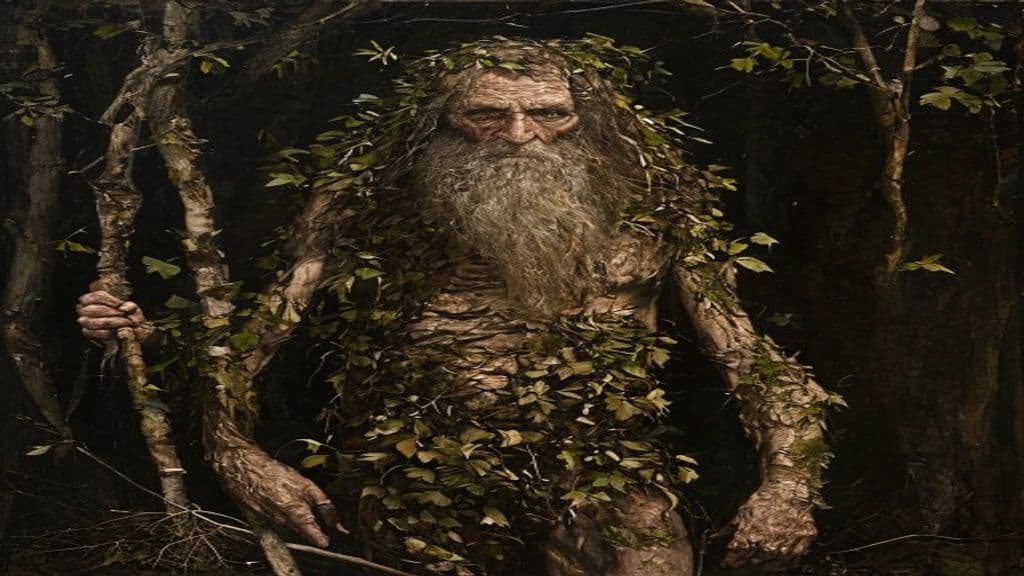
Bannik
A place-bound spirit of the Slavic banya (bathhouse) that inhabits the steam room and related spaces; he mediates divination, presides over births within the banya, and must be appeased by offerings or he may harm or otherwise vex users and the building.
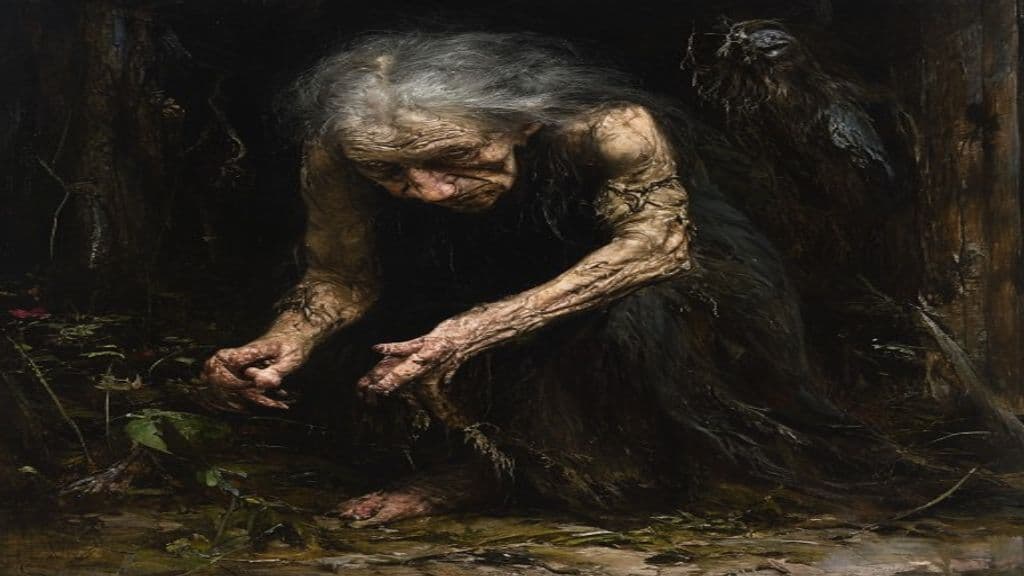
Kikimora
A female house spirit in Slavic folklore that functions as a domestic agent: helpful in well-kept homes and disruptive or dangerous where household morals or order fail. Variants include a domestic (house) kikimora paired with the domovoy and a swamp (bolotnaya) kikimora associated with marshland spirits.
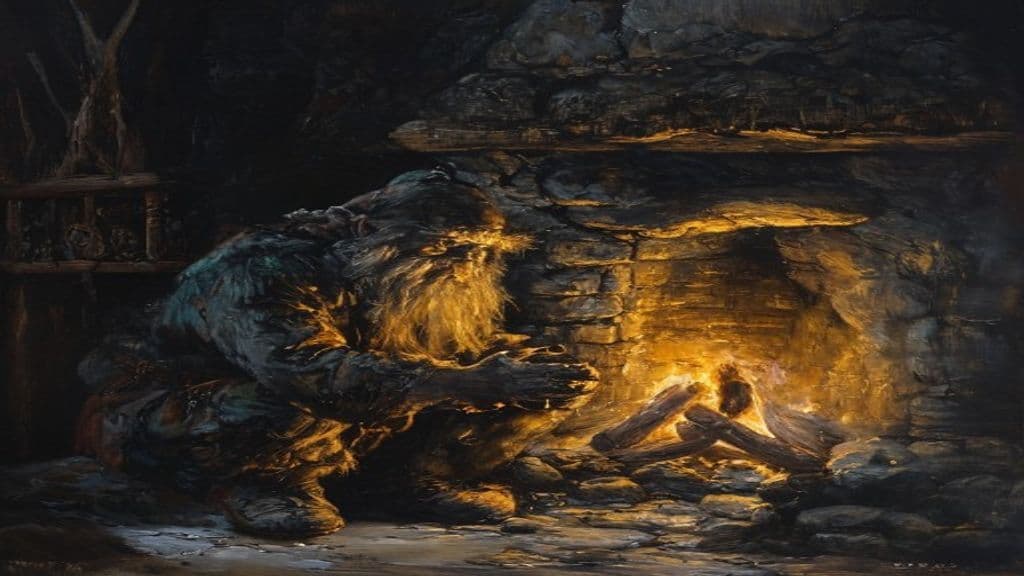
Domovoi
The house spirit of Slavic tradition — a small, invisible guardian of the home bound to a specific dwelling and its family. Protective when respected; dangerous when insulted or forgotten.
Chort
A chort is an anthropomorphic malign spirit figure in Slavic folk tradition that occupies a liminal space between older Slavic demonology and Christian notions of the devil. Depending on region and narrative function it appears as numerous lesser malignant spirits, a trickster antagonist who tempts or is tricked by humans, or as a cover-term for 'unclean forces' credited with various negative creations in the world.
Marzanna
Marzanna (Polish form of Morana/Morė/Mara) is a pre-Christian Slavic seasonal goddess/personification representing winter, decay, and the death-aspect of the vegetation cycle. Her ritual 'death'—commonly enacted by destroying a humanlike effigy—marks the communal transition from winter to spring and is paired in tradition with separate spring figures (e.g., Vesna, Lada, Kostroma).
Morana (seasonal goddess)
A pan-Slavic female figure personifying the death of winter whose ritual demise at winter's end is linked to the rebirth of spring goddesses such as Kostroma, Lada, or Vesna. Sources treat her as an ancient goddess associated with seasonal rites and with dreams.
Dolops
Dolops (Ancient Greek Δόλοψ) is a personal name borne by several distinct figures in Greek mythic texts rather than a single recurring supernatural being. Bearers of the name appear as mortal combatants in Homeric epic, a funerary figure visited by the Argonauts in Apollonius Rhodius, and in at least one genealogical listing as a semidivine child of Cronus and Philyra.
Domalde (Dómaldi)
Domalde (Old Norse Dómaldi/Dómaldr) is a legendary Swedish king of the Yngling dynasty whose reign is associated with prolonged famine. In Old Norse sources his personal ill‑luck (ósgæssa), said to be caused by a curse from his stepmother, is presented as coterminous with the land's fertility; communal cultic escalation culminates in the king's sacrificial killing and the restoration of good harvests.
Domar (Dómarr)
Domar (Old Norse Dómarr, 'Judge') is a legendary Swedish king of the Yngling dynasty attested in medieval Scandinavian genealogical sources. He is presented as a mytho-historical ancestral ruler whose long and peaceful reign follows the sacrificial death of his father Domalde and whose own death was marked by cremation at Fyrisvellir and erection of a memorial stone at Uppsala.
Dominion (angel)
In Christian angelology, Dominions (also Dominations or Lordships; Greek kyriotētes) are an order of created heavenly beings listed among categories such as thrones, principalities, and powers. Major theological sources (Colossians 1:16 as cited, Pseudo‑Dionysius the Areopagite, and the Second Book of Enoch) treat them as a ranked class within a hierarchical cosmos rather than as individual personalities encountered in folklore.
Domovoi
The house spirit of Slavic tradition — a small, invisible guardian of the home bound to a specific dwelling and its family. Protective when respected; dangerous when insulted or forgotten.
Dongti (Divine Punishment)
A manifestation of divine retribution in Korean mythology, serving as a concept rather than a specific supernatural being. (Note: * Power tier should be Lesser, not Greater, as it's a concept rather than a specific supernatural being. * Abilities description should reflect that the Dongti is an agent of retribution, but doesn't )
Dongui Bogam (동의보감)
The Dongui Bogam (東醫寶鑑) is a seminal 17th‑century Korean compendium of traditional Korean medicine compiled by the royal physician Heo Jun and first published in 1613 during the Joseon period. It is treated in modern Korea as an important cultural and scientific heritage item and has been issued in various modern media formats, including commercial CD editions.
Donn
Donn is an Irish otherworld figure linked to the dead and to a specific western locus, Tech Duinn ('house of Donn'). In medieval literature he functions as an ancestral host to whom the Gaels come after death; in later folk tradition he appears as a local otherworld lord and as a portentous nocturnal horseman.
Donn Cúailnge
Donn Cúailnge, the Brown Bull of Cooley, is the extraordinarily fertile stud bull at the center of the Ulster Cycle narrative Táin Bó Cúailnge (the Cattle Raid of Cooley). Originating in medieval Irish saga material, he functions as an agent within a tale that mixes otherworld transformation, social prestige in cattle, and widescale human conflict.
Community Record
- [1]Domovoy (Wikipedia). Wikipedia, 'Domovoy' article (summary of Slavic folklore and ethnographic material)wiki
- [2]Domovoy | USC Digital Folklore Archives. USC Digital Folklore Archives, oral testimony and archive entry on Domovoyfolk
- [3]Domovoy | ADF: Ár nDraíocht Féin. Ár nDraíocht Féin article summarizing Slavic comparative context for Domovoyother
- [4]The Ethnograph 2024 65 (article on Domovoy). Scholarly article discussing Domovoy in contemporary and historical perspective (downloaded PDF)academic
- [5]Domovoy film (2019) — cultural reference. Wikipedia entry for modern cultural adaptation 'Domovoy' (film)other
- [6]Russian Spirit | USC Digital Folklore Archives. USC Digital Folklore Archives page with related oral materials and contextfolk