
Influenced by Greek and Roman mythology, the Etruscan supernatural entities are thought to have been worshipped by the Etruscan civilization. The specifics of their origins and pantheon are unclear.
No specific physical descriptions of individual Etruscan supernatural entities are provided in source material. Their appearance is often assumed to be similar to that of Greek or Roman deities, given the heavy influence of these traditions on Etruscan mythology.
Assuming powers similar to those attributed to gods and goddesses in other ancient mythologies, such as control over nature and influence over human affairs. The specifics of their abilities are unclear due to a lack of source material.
Weaknesses
- otherAssimilation into Roman Culture
Wards
None recorded.

Zeus
Zeus (Ancient Greek: Ζεύς) is the supreme deity of the classical Greek pantheon, a sky-and-thunder god who rules as king of the gods on Mount Olympus and functions as a sky‑father who assigns roles among the immortals.
Hera
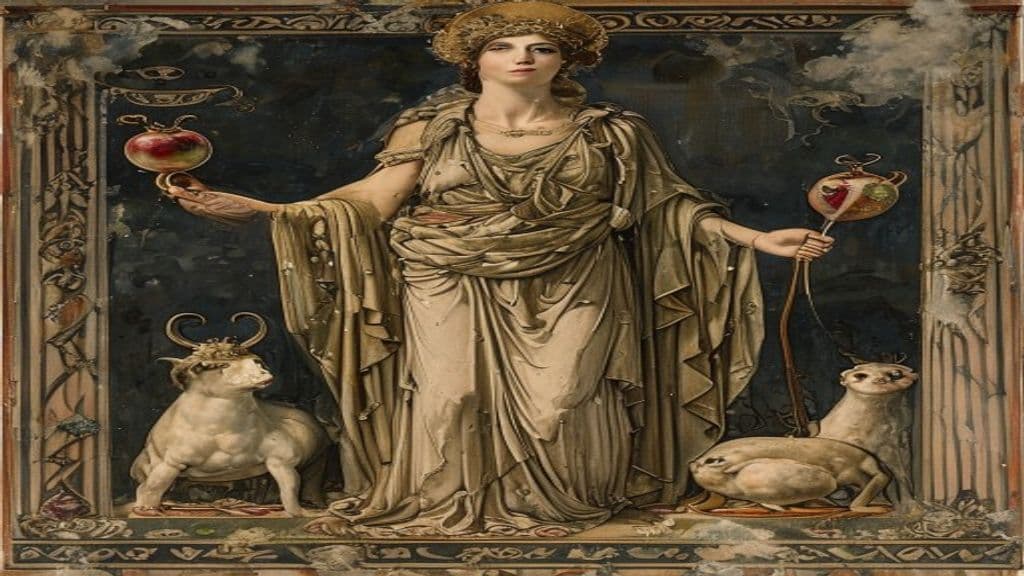
Hera is an ancient Greek goddess, queen of the Olympian gods, and a principal tutelary deity of marriage, women, and family. She functions in myth and cult as protector of lawful marriage and women in childbirth, a civic tutelary figure (notably of Argos), and a sometimes-jealous consort of Zeus with archaic fertility associations in certain local rites.
Palladium (Roman Tradition)
A cult image of Pallas Athena, holding great significance for the safety and prosperity of Troy and Rome. (Note: 1. Power tier: Greater (its protection significance was tied to city-wide prosperity) 2. Add sensory cues: A physical presence and an aura of calm in the city 3. Weaknesses: Loss or damage would be a )
Pyrene (Celtic Tradition)
Figure from Greek and Roman mythology with possible associations to Celtic tradition, associated with the Iberian region. (Note: - The article states that Pyrene's myth is "largely based on Greek and Roman sources", which contradicts the source material stating that her myth survives in Greek and Roman writings. - Power tier: B)
Ethiopian pegasus
A legendary monstrous animal attested in classical and medieval bestiary summaries: a breed of winged, two-horned horse said to come from Aithiopia (ancient 'Ethiopia') and reportedly located on an island in the Red Sea off the coast of Eritrea. It appears in the corpus of Greco‑Roman natural‑history marvels (Pliny is cited in secondary summaries) and later bestiary compilations rather than as a spirit or deity.
Ethniu
Ethniu (also Ethne, Ethliu, Eithne, Ethnea, etc.) is a figure of Irish myth, presented as the daughter of the Fomorian leader Balor and the mother of the hero Lugh. Her story centers on imprisonment to avert a prophecy and the clandestine conception and rescue of her child, motifs that link her to dynastic and prophetic conflicts in the mythic cycles.
Etinṣib Ziwa
Etinṣib Ziwa (also Ītinṣib Ziwa) is an uthra — a divine being or 'messenger of the light' — attested in the Mandaean Book of John (Chapter 3) where he initiates a battle with the figure Nbaṭ and fights with members of Yushamin's lineage.
Etiäinen
In Finnish folklore, an etiäinen is a harbinger that precedes a person, performing actions they will later undertake. (Note: 1. Factual claim in summary about "preceding a person" not explicitly supported by source material. 2. Power tier should be Primordial, as etiäinens are part of everyday life and associated with every)
Etrigan the Demon
A fictional infernal being from the DC Comics cosmology: a Hell-origin demon bound to the human Jason Blood by the wizard Merlin. Portrayed as a powerful, rhyming-speaking infernal warrior who alternately opposes and allies with Earth's heroes and participates in conflicts within Hell's hierarchy.
Etügen Eke
Etügen Eke (also Etügen, Itügen, Etügen Ekhe) is an earth-mother goddess in Turkic and Mongolic Tengrism traditions, personifying the earth, fertility, homeland and natural forces. She is described in the sources as occupying a high place in the cosmic order, subordinate only to Kök‑Tengri, and is propitiated with seasonal sacrifices tied to pastoral and agricultural cycles.
Euaechme
Euaechme (also Evaechme, Euaichme) is a personal name borne by mortal women in Greek mythic genealogies. The figures so named appear as princesses, wives, and mothers within dynastic narratives (not as supernatural beings) and are recorded primarily to establish lines of descent and marital alliances.
Euaemon (Euaimon)
Euaemon (Ancient Greek Εὐαίμων) is a recurring personal name and toponym in Greek literary and mythographic sources. It designates several distinct mythic persons — notably a son of Poseidon in Plato's Atlantis myth, one of the fifty sons of Lycaon in Arcadian tradition, and the father of the Homeric warrior Eurypylus — and once appears as a city-name in Stephanus of Byzantium.
Euboea
Euboea is primarily the name of a large Greek island (Ancient Greek: Εὔβοια) with longstanding geographic, historical, and mythic associations; it is also the personal name borne by several minor mythological women (notably an Argive naiad who, with her sisters, served as a nurse of Hera). The material does not present Euboea as a single coherent supernatural being.
Euboeus
Euboeus is not a folkloric supernatural being but a name attested in two distinct contexts in the supplied sources: (1) a Linnaean genus of Palaearctic darkling beetles (Euboeus Boieldieu, 1865) and (2) a fragmentary classical author, a comic/parodist poet (presumably Euboeus of Paros, fl. c. 359–336 BC) known from scant citations. No traditional myths, rituals, or cosmological roles attaching supernatural agency to the name are recorded in the provided material.
Community Record
- [1]