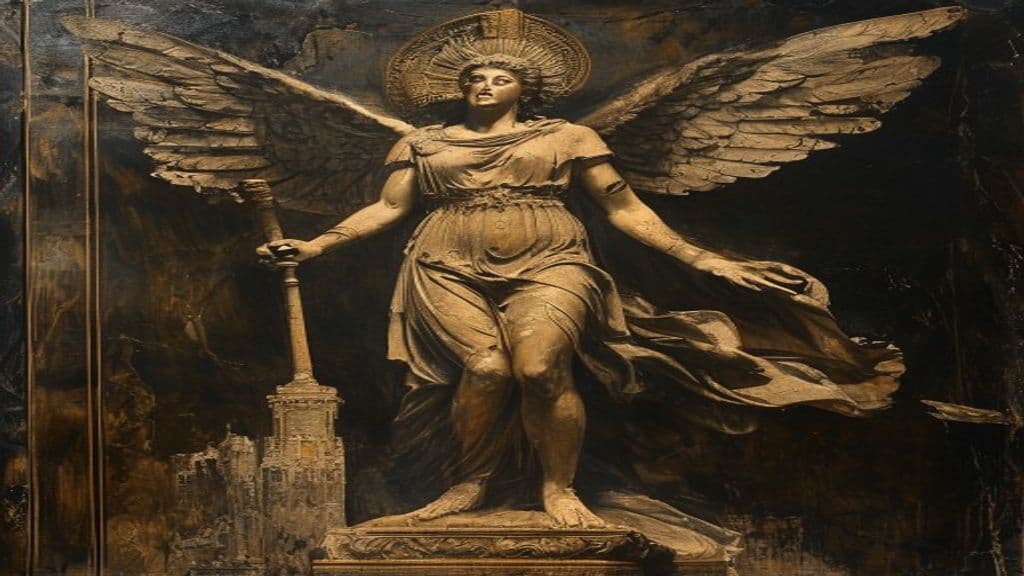
The Palladium was already present in Troy, and Aeneas took it to Rome.
A wooden statue (xoanon) of Pallas Athena.
Its significance lies in its symbolic power as a protector of cities, rather than direct actions or abilities.
Weaknesses
None recorded.
Wards
- RitualVestal Virgins' care
Etruscan Supernatural Entities
A pantheon of gods and goddesses heavily influenced by Greek and Roman mythology, worshipped by the Etruscan civilization. (Note: - Power tier: Primordial is not plausible given the described abilities (control over nature and influence over human affairs). A more accurate power tier would be Ancient, as these abilities are simi)
Pyrene (Celtic Tradition)
Figure from Greek and Roman mythology with possible associations to Celtic tradition, associated with the Iberian region. (Note: - The article states that Pyrene's myth is "largely based on Greek and Roman sources", which contradicts the source material stating that her myth survives in Greek and Roman writings. - Power tier: B)
Paikea
An important ancestor in Māori tradition, associated with a whale and significant to tribes such as Ngāti Porou and Ngāi Tahu. (Note: 1. Power tier: Reduce to Greater (powerful regional) as there's no indication of cosmic or deity-level powers. 2. Appearance: Add description from source material, e.g., "No specific appearance descri)
Paimon
Paimon is a high-ranking spirit from early-modern and medieval European grimoire traditions (notably the Ars Goetia and related compilations). He is depicted as a king who rules other spirits, teaches sciences and secret knowledge, and can be summoned and compelled by ceremonial operators within the ritual corpus.
Palaechthon
In classical Greek literary context Palaechthon (Παλαίχθονος) is an earth-linked eponymous ancestor invoked to mark indigenous origin; attested only in Aeschylus' The Suppliants and discussed by later commentators and modern reference works. The name combines elements meaning 'old/long' (palai-) and 'earth' (chthon-) and functions as an aetiological device legitimizing Pelasgian claims to the land.
Palaemon
Palaemon (Παλαίμων), in the best-attested Greek tradition, is the deified form of the youth Melicertes who becomes a youthful sea-protector associated with sailors and fishermen; he is commonly depicted as a boy riding a dolphin and received local cultic honours in some places (notably linked in some traditions to the Isthmian games).
Paliuli
In Hawaiian mythology, Paliuli is a legendary paradise and the home of Princess Laieikawai, equivalent to the Garden of Eden. It serves as a symbol of spiritual guidance and inspiration. (Note: 1. Power tier: Primordial is incorrect; based on its description as an idyllic realm and paradise, it's more likely to be Ancient (deity-level). 2. Abilities: Add more specific details from the source)
Pallas
Pallas is a name applied to multiple distinct figures in Greek myth (several mortal, semi-divine, and Titan personages) and functions as an epithet of the goddess Athena; in later usage the name is also applied to non-mythic objects such as the asteroid 2 Pallas and a genus name in biology. The sources do not treat Pallas as a single unified supernatural species but as a polyvalent label across genealogies and later nomenclature.
Pallas Athena
Pallas Athena (Athena or Athene) is an ancient Greek goddess associated with wisdom, strategic warfare, and handicraft; she functions as patron and protectress of cities—most notably Athens—and appears throughout art and myth from antiquity into later cultural traditions.
Pallas of Arcadia
Pallas of Arcadia is a mythic eponymous Arcadian prince and founder-ancestor credited with founding the town Pallantion/Pallantium in Arcadia. He appears in Greek legendary genealogies (sometimes cited as a son of Lycaon) and is used in later Roman tradition as an ancestor linked to Evander and the Italian Pallantium.
Pallas's cat (manul)
Pallas's cat (Otocolobus manul), commonly called manul in Mongolian, is a small wild felid of Central Asian montane and steppe ecosystems. Sources treat it as a biological species with distinctive long dense fur, a stocky build and specialized ecological adaptations to cold, rocky habitats; it is not presented in the provided materials as a supernatural being.
Palles
Palles is not attested in the supplied sources as a supernatural being. The term appears primarily as a surname (notably Anne Palles and Christopher Palles), as a toponym (Les Palles reef in France), and as titles of modern musical works. The only connection to supernatural topics is historical: Anne Palles (1619–1693) was an alleged witch and the last woman to be legally executed for sorcery in Denmark.
Community Record
- [1]