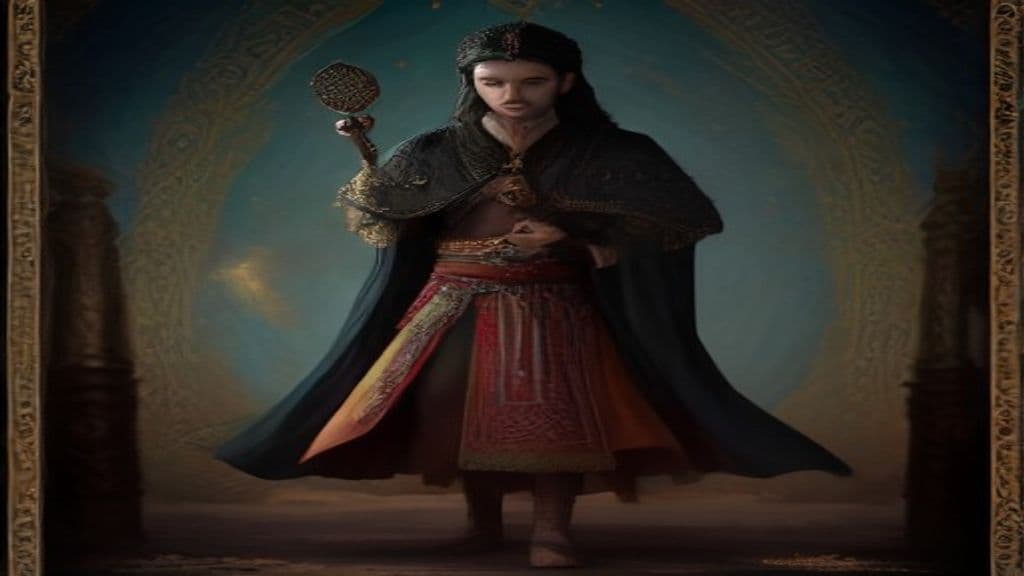
Within the Shahnameh narrative framework as presented in the source excerpt, Viseh is introduced by genealogy: he is named as the son of Zadashm and the grandson of Tur. His prominence in the epic derives from his dynastic position within the Turanian ruling elite and his service to the Turanian king Afrasiab, rather than from a mythic cosmogonic origin. The provided source frames him as an established Turanian noble and military leader whose role emerges from lineage and political-military service in the Iran–Turan saga.
The cited source excerpt provides no physical description of Viseh. The Shahnameh passage referenced in the source situates him in genealogical and political terms only; therefore details such as age, dress, stature, or distinguishing marks are not recorded in the provided material.
The source presents Viseh in secular, historical-epic terms: as a lieutenant general and political actor entrusted with counsel and military tasks. He is described as participating in consultations with the Iranians and, after a Turanian victory, being sent by Afrasiab to Pars to take over the royal family of Nowzar. No supernatural powers or magical abilities are attributed to him in the provided excerpt; his capabilities are political and military leadership, counsel, and execution of missions on behalf of Afrasiab.

Vināyaka / Ganapati (Ganesha in Buddhism)
A Buddhist tantric deity known variously as Vināyaka, Vighnāntaka, Gaṇapati, tshogs bdag (Tibetan) and Kangiten/Shōten (Japanese). Integrated into Mahāyāna and Esoteric Buddhist cosmologies, he functions as a remover and subjugator of obstacles, protector, and occasional wealth/pleasure‑granting figure and is often treated as an emanation of bodhisattvas such as Avalokiteśvara or of Vairocana.
Virabhadra
Virabhadra is a fierce martial emanation of the Hindu god Śiva, created in wrath to punish those responsible for the self-immolation of Śatī at the Dakṣa yajña. Presented in Purāṇic narratives as a powerful warrior commanding heterogeneous troops, he carries out destructive missions but is ultimately subordinate to Śiva and can be pacified.
Viracocha
Viracocha (Quechua Wiraqucha, Huiracocha) is the principal creator and civilizing deity in pre-Inca and Inca mythology, portrayed as the originator of the universe, time, and human society who emerges from watery places to bring light, order, and knowledge.
Virankannos
Virankannos is a figure in Finnish and Karelian runic-song tradition associated with fertility and the wellbeing of crops and is treated in sources as a sky-associated, culture-level divine actor. Attested in Mikael Agricola's 1551 list as a protector of oats and in Kalevala runes (20 and 50), he appears in saga-level scenes such as the attempt to slay the great ox and the baptism/naming of Marjatta's child.
Virgin Mary (Marian devotion and apparitional tradition)
A central historical and devotional figure — Mary of Nazareth — whose veneration across Christian communions and other religions has produced a widespread corpus of devotional practices, shrine cults, and reported apparitional phenomena. The sources treat her primarily as the first‑century Jewish mother of Jesus and as an object of liturgical and popular devotion rather than as a hostile supernatural monster.
Vis and Rāmin
Vis and Rāmin are the protagonists of a classical Persian romantic tale composed by Fakhruddin As'ad Gurgani in the 11th century. The narrative reflects the traditions and customs of ancient Persia. (Note: 1. Power tier should be "Minor Spirit" given that no supernatural abilities or behaviors are described. 2. Origin story is incorrect; source material states Parthian origin and not likely to have Part)
Vishala
A king in Hinduism, featured in the Ramayana epic poem, with administrative and martial abilities. (Note: 1. Power tier should be Lowered to Lesser (local spirit) as there is no indication of deity-level abilities. 2. Abilities: Add "However, the Ramayana does not explicitly state his martial or administr)
Vishap
The vishap (Armenian՝ վիշապ) is a draconic, water-associated being in Armenian tradition tied to mountains, storms, and fertility. It is depicted as a winged serpent or composite dragon that causes storms, whirlwinds, eclipses and is antagonized by the culture-hero Vahagn; it also appears in ritual and poetic contexts as a symbol of water, wealth and ambiguous power.
Vishnu in Buddhism
A deva and protector of the Dharma, revered as Upulvan in Sri Lankan Buddhism. (Note: - Power tier: Lesser (Vishnu's role is as a protector of the Dharma, but not described as cosmic or deity-level) - Appearance: The draft article correctly notes that Upulvan/Vishnu's physical descript)
Vision Serpent
Central figure in Pre-Columbian Maya mythology, symbolizing divine power and wisdom, often associated with visions or insights. (Note: - Power tier: downgrade to Ancient (deity-level) as Primordial implies a cosmic or world-shaping entity, which may be too powerful for this entity. - Appearance: add "usually depicted" to indicate tha)
Vist the giant
Vist the giant is attested in the provided source set only as a legendary giant-level figure; the sole direct attestation is a short Wikidata description labeling the entity "giant according to legend." Other documents in the source set (a Wikipedia article on sculptor Calle Örnemark and three unrelated archive items) do not provide information about the figure and cannot corroborate details.
Vittra
A type of wight (supernatural spirit) from northern Swedish folk belief associated with herding and the rural environment. Vittror were believed to live among humans and only revealed a supernatural nature if their livestock were mistreated; they are also linked in sources to motifs of longing and seduction.
Community Record
- [1]Viseh. Wikipedia: Viseh (accessed source excerpt provided)wiki