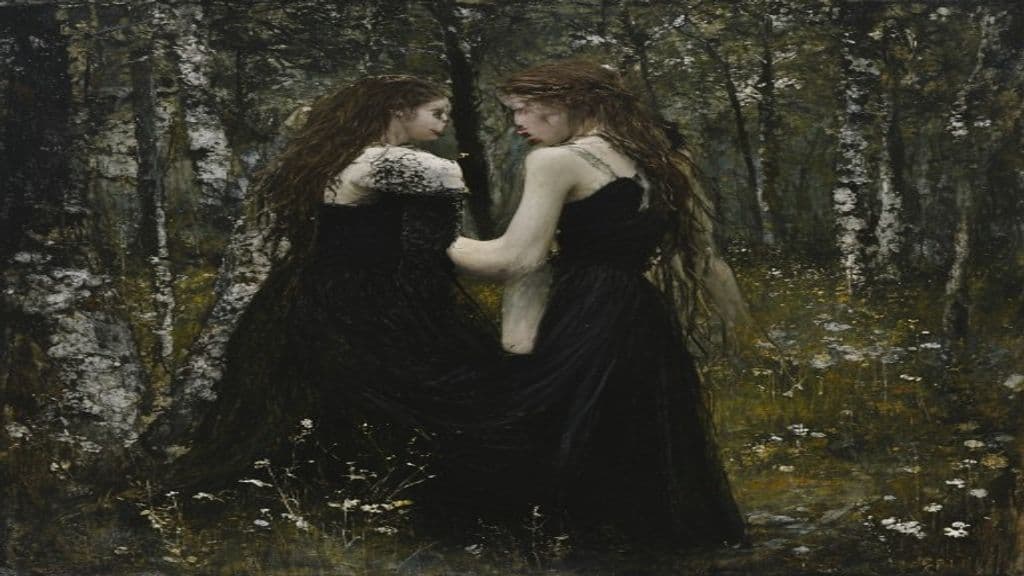
The sources do not provide a creation or cosmogonic origin for vittror. Instead, vittror are presented as an established category of land- and nature-associated spirits within northern Swedish folk taxonomy, listed alongside other household and landscape spirits such as hulder, skogsrå, landvættir, moss people, aos sí, and huldufólk.
Descriptions in the supplied material are limited. One attested motif presents the vittra as a beautiful, female wight who seduces men in the forest. Beyond this recurring motif of a female seductress, the sources give few consistent physical details about size, clothing, or distinguishing marks.
Attested associations emphasize vittror's connection to herding—either cattle or reindeer—and their embedded role in human livelihoods. Sources report that vittror were believed to live among humans and would reveal a supernatural nature if their livestock were mistreated, implying they were thought to observe and respond to human conduct regarding animals. They are also grouped with beings associated with longing and desire, and at least in one description are credited with seducing men in forest contexts. Specific powers (exact forms of reward or punishment, enchantment, or physical harm) are not detailed in the provided material.

Bäckahäst
A Scandinavian water-horse figure: a horse-shaped water spirit associated with streams, rivers, lochs and other watery edges. Presented in comparative folklore as a member of the wider water-spirit or ‘water-horse’ family that functions as a cautionary figure about the hazards of water and unknown horses at the water’s edge.
Deildegast
A Norwegian folkloric ghost bound to boundary stones as postmortem punishment for those who moved or tampered with property markers; compelled to attempt to restore displaced stones but never succeeding, it serves as a social deterrent against moving borders.
Einherjar
Warriors who died in battle and were brought to Valhalla by valkyries, playing a crucial role in the events leading up to Ragnarök. (Note: - Power tier should be Primordial since they are associated with a cosmic event (Ragnarök) and are not described as deities or regional powers. - Abilities: The einherjar don't actually engage in dail)
Flogdrake
A Scandinavian firedrake or "fly‑dragon" associated with evening streaks of light in the sky and with tunnelling mountain lairs that hide ore and treasure. Primarily attested in Swedish folklore, it participates in a pan‑European motif of fiery serpents and is sometimes linked with household or earth spirits in nearby traditions.
Freyja
Freyja is a major Vanir goddess in Norse mythology associated with love, beauty, fertility, gold, war, and the seiðr form of magic. She rules the field Fólkvangr and the hall Sessrúmnir, where she receives half of those slain in battle, and is attested across the Poetic Edda, the Prose Edda, skaldic poetry, and later Scandinavian folklore.
Mare (folklore)
A nocturnal malicious spirit from Germanic and neighboring Slavic popular belief that afflicts sleepers and animals by 'riding' or pressing on chests, producing nightmares, sleep‑suffocation, night‑sweats, and exhausted animals. The mare overlaps with related Germanic night‑beings (alp, Mahr, Trute/Drude) and appears in varied regional tale forms and household practices.
Nixie
A category of water spirit from Germanic and neighbouring European folklore associated with lakes, streams, ponds and waterfalls. Commonly described as shapeshifting and linked to enchanted music, nixies may be helpful or dangerous to humans depending on local tales.
Revenant
A revenant is a deceased human (corporeal corpse or spirit) that returns from death to appear among or assault the living. The category spans multiple cultures and historical periods and includes walking corpses, barrow-dwellers, and other postmortem returns addressed by communal funerary and ritual responses.
Troll cat
A witch-created familiar in Scandinavian folklore that steals milk and cream for its mistress. It appears in two main forms—ball-shaped yarn-like constructs (Norwegian trollnøste/trollnøa) and ordinary-looking cats—and is closely linked to accusations of witchcraft and rural dairy loss.
Vardøger
A spirit-predecessor in Scandinavian folklore whose sensory manifestations (footsteps, voice, scent, appearance) precede a living person, producing the impression that the person was present before arrival. Traditionally associated with attendant/guardian spirit concepts such as fylgja and vǫrð.
Vist the giant
Vist the giant is attested in the provided source set only as a legendary giant-level figure; the sole direct attestation is a short Wikidata description labeling the entity "giant according to legend." Other documents in the source set (a Wikipedia article on sculptor Calle Örnemark and three unrelated archive items) do not provide information about the figure and cannot corroborate details.
Vlastislav (mythological prince)
In Slavic mythology, Vlastislav is a mythological prince from Czech tradition with connections to broader Slavic royalty. (Note: 1. Power tier should be Ancient (deity-level) rather than Primordial (cosmic). 2. Abilities statement is incomplete; source material only mentions his royal position and parentage. 3. No sensory cues,)
Community Record
- [1]Vittra (folklore). Wikipedia, 'Vittra (folklore)'wiki
- [2]Vittra (folklore). Wikipedia, 'Vittra (folklore)' (alternate URL)wiki
- [3]Spirits, trolls, elves and ‘näcken’ – discover Sweden’s mythological …. Visit Sweden, overview of Swedish mythological creatures (referenced for contextual grouping of nature spirits)other