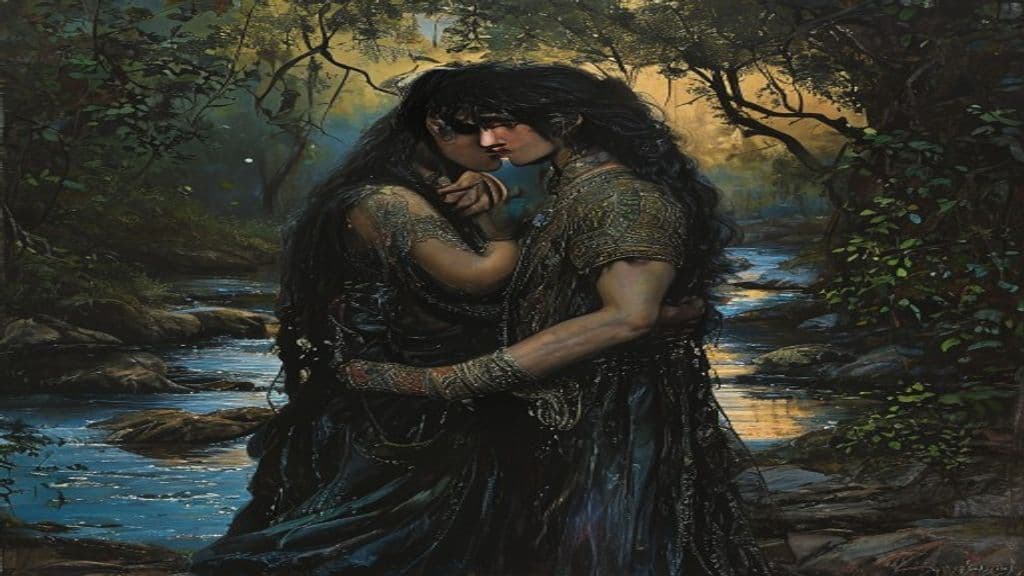
The story of Vis and Rāmin likely has Parthian origins, with Fakhruddin As'ad Gurgani's tale composed in the 11th century. The narrative blends ancient stories with contemporary themes.
Vis and Rāmin are depicted as romantic figures in Persian literature and artworks, but no physical description is given in the source material.
As a character, Vis' actions and interactions are part of the narrative; however, no supernatural abilities or behaviors are described. His role appears to be that of a romantic hero rather than an entity with powers beyond human capabilities.
Azadeh
Azadeh (Persian: آزاده) is a Persian female given name meaning broadly 'free' or 'free-minded'; some sources also gloss it as 'someone noble'. The name appears in modern Iranian usage (borne by several contemporary public figures) and as the name of a character in Ferdowsi's Shahnameh. It is a personal name rather than a supernatural being in the provided sources.
Darab-nama (Persian tradition)
Historical romance novel from 12th-century Persia, with possible references to supernatural entities in Persian folklore. (Note: - Power tier: Primordial (due to its historical significance and cultural impact) - Summary: Needs more specific information on supernatural entity references - Appearance: No information provided in )
Farhad (Persian literature)
In Persian literature and mythology, Farhad is a character associated with the love story of Khosrow and Shirin. (Note: 1. Power tier should be revised to "Minor Spirit" since Farhad's abilities are more related to his devotion and determination, rather than cosmic or deity-level powers. 2. Remove description of "Appea)
Huma Bird
In Persian tradition, the Huma bird is a mythical creature that inhabits the air, never touching down on the ground. (Note: - Power tier: Primordial (or not specified at all), as it has cosmic abilities - Appearance: Invisible entity (already correct) - Abilities: Add "existing solely as a concept rather than a tangible be)
Jinn
A class of supernatural beings from pre-Islamic Arabian religion later integrated into Islamic theology; jinn are created, morally accountable entities distinct from humans and angels, often unseen but capable of taking visible forms and interacting with people in varied ways.
Rohham
Loyal paladin and hero in the Persian epic Shahnameh, embodying values of loyalty and military prowess. (Note: * Power tier should be Primordial or Ancient, as Rohham is described as a hero in an epic that deals with "ancient Iranian history and mythology", implying a high level of power. Greater seems too low)
Tahmina
In Persian epic tradition, Tahmina is a human character in the Shahnameh, a 10th-century epic poem. She is Rostam's wife and Samanganshah's daughter, appearing in the story 'Rostam and Sohrab'. Tahmina serves as a figure illustrating themes relevant to 10th-century Persian society. (Note: 1. Power tier should be "Lesser" since Tahmina is a human character with no supernatural powers. 2. Origin story section is missing. 3. Appearance section needs to state that there is no physical desc)
Zafarnamah (Mustawfi)
Persian epic poem written by Hamdallah Mustawfi, exploring Iranian history and culture. (Note: 1. Power tier should be Ancient (deity-level) does not fit; Primordial is typically reserved for entities related to the creation of the world or fundamental forces. 2. Appearance section is missing 3)
Virankannos
Virankannos is a figure in Finnish and Karelian runic-song tradition associated with fertility and the wellbeing of crops and is treated in sources as a sky-associated, culture-level divine actor. Attested in Mikael Agricola's 1551 list as a protector of oats and in Kalevala runes (20 and 50), he appears in saga-level scenes such as the attempt to slay the great ox and the baptism/naming of Marjatta's child.
Virgin Mary (Marian devotion and apparitional tradition)
A central historical and devotional figure — Mary of Nazareth — whose veneration across Christian communions and other religions has produced a widespread corpus of devotional practices, shrine cults, and reported apparitional phenomena. The sources treat her primarily as the first‑century Jewish mother of Jesus and as an object of liturgical and popular devotion rather than as a hostile supernatural monster.
Viseh
Viseh is a Turanian nobleman in the Shahnameh tradition, presented in the cited source as son of Zadashm, grandson of Tur, father of Piran, and a high-ranking military-political leader who acted on behalf of Afrasiab in the Iran–Turan conflicts.
Vishala
A king in Hinduism, featured in the Ramayana epic poem, with administrative and martial abilities. (Note: 1. Power tier should be Lowered to Lesser (local spirit) as there is no indication of deity-level abilities. 2. Abilities: Add "However, the Ramayana does not explicitly state his martial or administr)
Community Record
- [1]