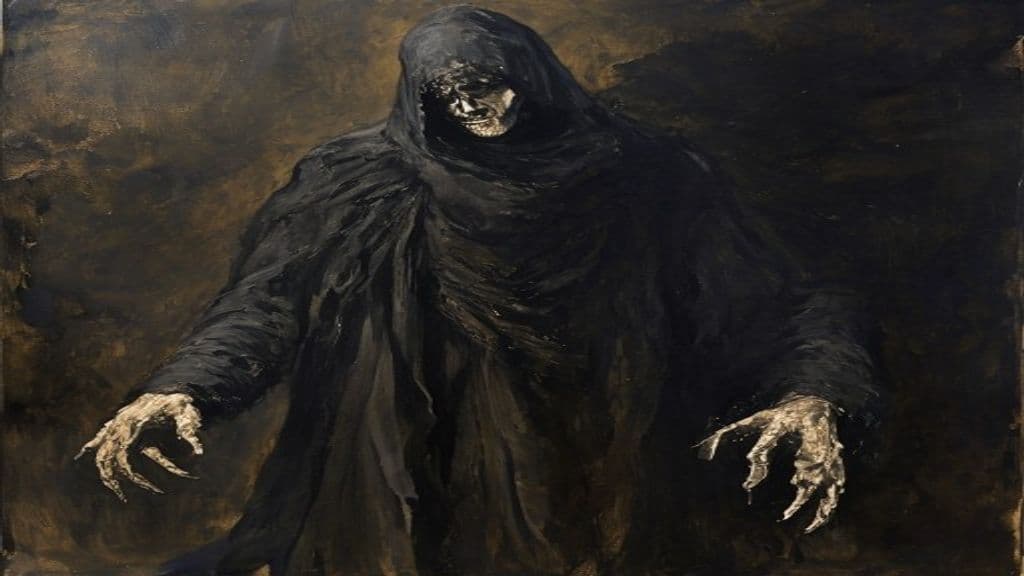
Modern summaries link the Fext motif to the terrors and cultural memory of the Thirty Years' War (17th century) in central Europe. The available secondary accounts present the Fext as emerging in that wartime context or at least becoming prominent in lore connected to that era of intense conflict; the supplied materials do not preserve an extended indigenous premodern origin myth or a native-language origin narrative for the term.
Primary source material available in the supplied documents does not give a consistent visual description of the Fext (no agreed size, clothing, or distinguishing facial traits). Secondary summaries treat it functionally as an undead or revenant combatant—implicitly envisaged as a martial or battlefield figure—and the label was also applied metaphorically to living military leaders perceived as exceptionally hard to kill. Beyond this combat-associated imagery, no stable physical portrait is recorded in the provided sources.
The core trait attested in the available sources is near-invulnerability to ordinary weapons and bullets; summaries state the Fext is 'invincible to bullets' except for the single noted exception that glass bullets can wound or kill it. No other consistent behaviors (feeding, haunt patterns, speech, alignment, or lifecycle) are documented in the supplied materials. The motif has also been used metaphorically to describe reputedly immortal or extremely hardy generals of the Thirty Years' War.
Weaknesses
- substanceglass bullets
Wards
- substanceglass bullets

Undead
A category of beings that were once dead or are corpses yet continue to behave as if alive; a broad catch-all used in myth, legend, and fiction for both reanimated bodies and incorporeal continuations of persons.

Draugr
In Nordic folklore the draugr (plural draugar; anglicized draug) is an archaic term for a malevolent revenant — a dead person who returns and remains active in the world of the living. Accounts emphasize variability: traits, behaviours, and descriptions change between stories and across regions, especially in early medieval Icelandic sagas and surviving Norwegian folklore.
Fenixmännlein
A class of small subterranean earth‑sprites or dwarf‑like beings from Silesian and Lusatian German folklore. They dwell beneath hills and in caves, bake and perform domestic crafts, sometimes exchange human infants for changelings, and are credited with steering a ship on subterranean waters that can abduct people.
Fenrir
The monstrous wolf son of Loki, bound by the gods with a magical ribbon until Ragnarök — when he will break free and swallow Odin, and the world.
Fenrisúlfr (Fenrir)
Fenrisúlfr, commonly called Fenrir or Fenris, is a singular monstrous wolf in Norse myth who is bound up with the eschatological events of Ragnarök; sources describe him as a world-altering agent who is foretold to kill the chief god Odin and take part in the destruction of the present order.
Feronia
Feronia is an ancient Italic goddess of central Italy associated with fertility, the wild/nature, and certain civic-economic functions such as trade. Originating with Sabine and Faliscan practice and later incorporated into Roman religious listings, she possessed sanctuaries and a visible cult presence in the archaic and Republican periods.
Fetket
Fetket is a minor ancient Egyptian deity attested in modern secondary compilations as an attendant of the sun god Ra, described in some sources with the functional label 'butler' or 'cupbearer' to Ra. Surviving references record the name and this occupational role but provide no primary-text evidence, iconography, or ritual material in the supplied sources.
Feuermann
A German-language folkloric luminous apparition described as a "fire man" or "fiery ghost," known in regional dialects by several synonymous names that emphasize burning, glowing, or flickering qualities. The Feuermann is presented in the supplied sources primarily as a named class of luminous phenomenon rather than through detailed narratives, rituals, or functions.
Fiacha Cennfinnán
Fiacha Cennfinnán (modern spelling Fiacha Ceannfhionnán, 'Fiacha of the little white head') is a legendary Fir Bolg figure recorded in medieval Irish regnal lists and annals as a High King of Ireland who overthrew his great‑uncle Sengann, ruled for five years, and was later overthrown and killed by Rinnal, son of Genann.
Fiacha mac Delbaíth
Fiacha mac Delbaíth is a legendary figure of early Irish tradition presented as a member of the Tuatha Dé Danann who served as a High King of Ireland. Medieval compilations record his accession, a ten-year reign, and his death in battle as part of the narrative sequence of prehistoric rulers.
Fictitious Kings in Korean Genealogies
Entities appearing in 15th-16th century genealogies of Cheongju Han, Haengju Gi, and Taewon Seonu descent groups. (Note: - Power tier is Minor Spirit (but no description of abilities implies they might be lower still) - Origin story lacks clear indication that association with Jizi is an "Early Modern fabrication", inst)
Ficus Ruminalis
In ancient Roman mythology, the Ficus Ruminalis is a wild fig tree associated with mythological events and protected by deities. (Note: * Power tier should be adjusted from Ancient to Lesser (due to lack of deity-level powers or abilities) * Origin story should be rephrased to clarify the Ficus Ruminalis is not an entity in itself, bu)
Fides
Fides is the Roman personification and goddess of trust, faithfulness, and good faith (bona fides). Treated both as an ethical virtue and a divine presence, she was cultivated in public religion through ceremonies and temples to uphold social and legal trust.
Fiery Flying Serpent
A metaphorical creature representing the Assyrian kingdom's power and destruction, used in Jewish tradition. (Note: * Power tier should be Greater, not Primordial, as it's a symbolic representation of a powerful regional entity (the Assyrian kingdom) rather than a cosmic or primordial force. * Abilities section nee)
Community Record
- [1]Fext — Wikipedia. Wikipedia contributors. "Fext." Wikipedia, The Free Encyclopedia. https://en.wikipedia.org/wiki/Fextwiki
- [2]Fext (Creature) — PathfinderWiki. PathfinderWiki. "Fext (Creature)." https://pathfinderwiki.com/wiki/Fextother
- [3]Why should glass harm a fext? — Mythology Stackexchange (discussion). "Why should glass harm a fext?" Mythology Stackexchange. https://mythology.stackexchange.com/questions/3200other