
In the ethnographic and folkloric accounts summarized by Mannhardt and later compilers, Fänggen belong to a wider class of 'wilde Leute' or forest-spirits. Mannhardt frames these beings as arising from an older conception in which individual trees were seen as ensouled; over time these tree-psychē were reimagined in many locales as independent forest-personalities whose lives remained tied to the trees. Folktales and regional reports thus present some Fänggen as personified tree-mothers whose existence depends on particular trees, while other variants preserve them as free-roaming wild women or smaller wood-dwellers.
Descriptions vary by region. In Tyrol and parts of the Bavarian Alps Fänggen are said to appear as hideous giantesses as tall as trees: wholly hairy or bristled bodies, coarse hair and beard-lichen in the hair, a gaping mouth described as reaching 'from ear to ear,' deep male-like voices, and black eyes sometimes said to flash like lightning. They are described wearing bark-like jackets or skirts/aprons of animal pelts and often moss- or lichen-covered. Swiss and Vorarlberg variants (Waldfänken, Waldfänken/Waldfänken mannli) are reported as thicker, shorter, hair-covered mannikins; Fankerl in some Upper Palatinate reports appears as a bearded dwarf with flashing red eyes.
Sources attribute to Fänggen a life-force tied to particular large or old trees such that felling or death of the tree causes the corresponding Fangga to die or vanish. They are portrayed as physically formidable—giant size or superhuman strength is explicitly noted in several regional accounts (Waldfänken described with superhuman strength). In behavior they are dangerous to humans: many accounts call them man-eaters with a particular preference for children; they are also reported to steal newborns (with unnamed newborns/unbaptized infants vulnerable to exchange for changelings) and to take women who have just given birth. Some traditions record that Fängge-daughters are farmed out as maids to human households but remain outside Christian rites and will return to the forest on hearing of kin deaths.
Weaknesses
- conditionLife bound to a particular tree (felling or death of that tree causes the corresponding Fangga to die or vanish)
- conditionIntegration of infants into Christian sacrament (baptism) reduces vulnerability to being exchanged as changelings (attested in Swiss German recensions)
Wards
- ritualBaptism (Christian)
- otherAvoidance behavior (keeping children indoors in the evening)
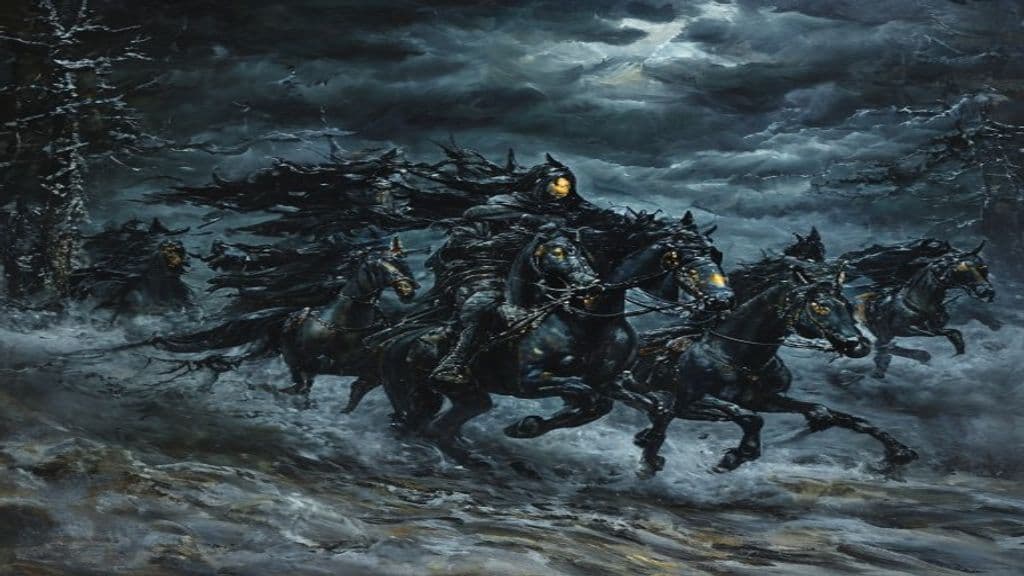
Wild Hunt
A fearsome spectral cavalcade of the dead sweeping through the winter sky — those who see it risk being carried off or killed, and its passage foretells war, plague, or catastrophe.
Wild Hunt
A fearsome spectral cavalcade of the dead sweeping through the winter sky — those who see it risk being carried off or killed, and its passage foretells war, plague, or catastrophe.
Futsu-no-mitama
A named sacred sword or charm in Japanese mythic and popular-culture references, presented in modern secondary sources as the weapon used by the kami Takemikazuchi to "quell the lands" and later associated in some summaries with transfer to Emperor Jimmu. In contemporary media it is frequently adapted as a named piece of equipment or charm that grants combat power or symbolic authority.
Fuxi
Fuxi (伏羲 / Fu Hsi) is a primordial culture-hero in Chinese myth credited in traditional accounts with establishing social institutions (marriage, family), teaching technologies (hunting, fishing, cooking, music), and originating systems of knowledge such as divination and the eight trigrams (ba gua). Frequently paired with Nüwa, he occupies a foundational role in prehistoric cosmology and ritual memory rather than a narrowly historical figure.
Fuṭrus
Fuṭrus (فطرس) is a fallen angel figure in legends associated with Ali ibn al‑Husayn (Zayn al‑Abidin). In the narrative he dawdles in carrying out a divine command, is punished by having his wings broken and being cast on an island, and is later forgiven and restored following an encounter involving the Prophet Muḥammad, the angel Gabriel, and the newborn Ali ibn al‑Husayn.
Fylgja
A supernatural accompanying spirit in Old Norse tradition tied to a person's or family's fate and fortune. The fylgja appears most often as a female human figure or as an animal, commonly in dreams, and functions as an omen-bearing presence connected to destiny rather than an agent that alters fate.
Fáfnir
In Old Norse heroic legend Fáfnir is a kin-figure who, after killing his father Hreiðmarr over a cursed hoard, withdraws into the wilderness and takes the hamr of a worm/dragon to brood over treasure; he is slain by the hero Sigurð (Sigurd).
Fárbauti
Fárbauti is a jötunn named in Old Norse sources as the father of Loki. He appears chiefly in genealogical attestations and as a poetic name-element (kenning) rather than as an active character in surviving narratives; some scholars have proposed interpretive readings of his name that link him to striking or lightning imagery.
Fénius Farsaid
Fénius Farsaid is a legendary ancestral king and culture-hero in medieval Irish tradition credited in literary sources with organizing or inventing learned forms of speech and script (notably the Goidelic tongue and Ogham) and placed in the Tower of Babel narrative as an ancestor of the Gaels.
Fëanor
Fëanor is a singular fictional Elf of the Noldor in J. R. R. Tolkien's legendarium, famed as the foremost craftsman and leader whose creation of the Silmarils, and the oath he and his sons swore over them, precipitated exile, kinslaying, and long-lasting calamities among the Elves.
Fódla
Fódla (also Fótla; modern Fódhla, Fodhla, Fóla) is an Irish tutelary goddess and land-personification of Ireland, one member of the triadic sovereignty figures Ériu, Banba, and Fódla within the Tuatha Dé Danann corpus. She appears in Milesian arrival narratives and in lists of rulers where her name is attached to the land and to queenship functions.
Fúamnach (Fuamnach)
Fúamnach is a named female member of the Tuatha Dé Danann in the medieval Irish tale Tochmarc Étaíne (The Wooing of Étaín). Presented as Midir's first wife and a learned sorceress fostered to the filidh Bresal Etarlám, she uses transmutative spells and wind-magic in a jealous campaign against Étaín and is ultimately tracked down and beheaded by Aengus (Mac Óc), who also kills her fosterfather.
Făt‑Frumos
Făt‑Frumos is the archetypal heroic youth in Romanian folktales: a princely, handsome knight-hero who undertakes superhuman trials, travels between the human world and the tarâmul celălalt, and restores order by defeating monstrous foes.
G'nort Esplanade G'neesmacher
G'nort is a fictional anthropomorphic-dog alien from DC Comics who served at times as a Green Lantern and a Darkstar and has appeared as a comic-relief but valorous supporting character across multiple storylines. Created by Keith Giffen and J. M. DeMatteis, he first appeared in Justice League International #10 (February 1988) and recurs in tales involving Corps-level conflicts and Justice League teams.
Community Record
- [1]Fänggen. Wikipedia, 'Fänggen' (accessed source material summarized in research notes)wiki
- [2]Die Waldgeister und ihre Sippe. Wilhelm Mannhardt, Die Waldgeister und ihre Sippe (archive.org edition), chapters and introduction discussing tree-spirits, 'Wildleute in Tirol: Fanggen' and 'Wildleute in Graubünden: Waldfänken'.academic