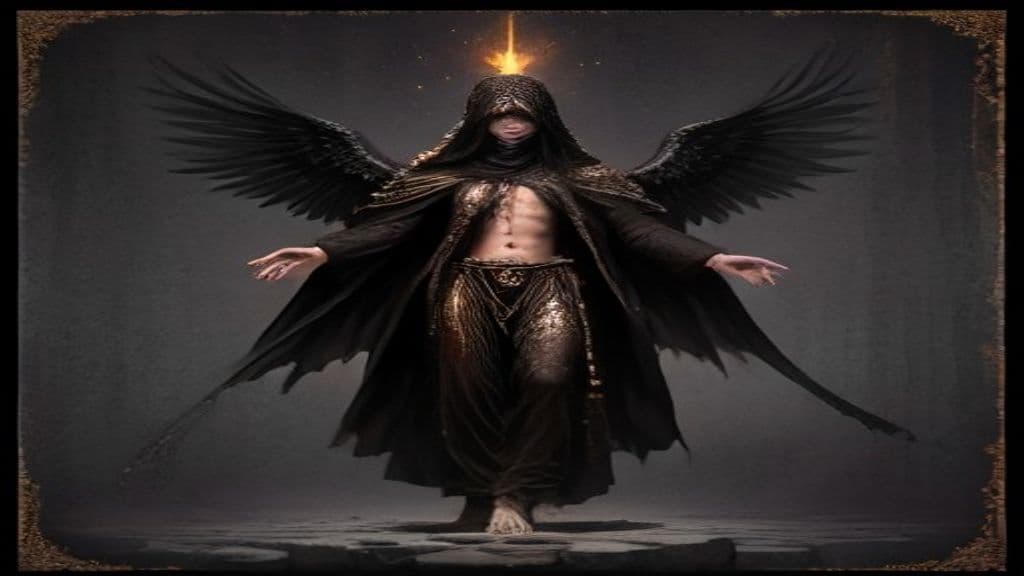
In the traditions cited, Fuṭrus is an angel who failed to execute a divine command within the appointed time; as a result God's watch lay upon him, his wings were broken off and he was cast upon an island as punishment. Later, while the Prophet Muḥammad and the angel Gabriel were en route to the newborn Ali ibn al‑Husayn, they met Fuṭrus. Muḥammad interceded for him, Fuṭrus accompanied Muḥammad and Gabriel to the infant's cradle, and upon touching the cradle forgiveness was accepted and his wings were restored. After restoration he returns with Gabriel to heaven. In a later narrative moment tied to the Battle of Karbala, the restored Fuṭrus offers Husayn an army of angels, an offer which Husayn refuses.
Sources provide minimal physical description. The legend explicitly records that Fuṭrus had his wings broken as punishment and later had them restored; beyond this detail, no further physical characteristics (size, color, facial features, or terrifying aspect) are described in the cited materials.
Narrative material attributes to Fuṭrus the role of an angel entrusted with carrying out divine orders and subject to divine discipline when negligent (dawdling). He can be punished (wings broken, exile) and can be forgiven and restored through prophetic intercession and contact with the righteous (the newborn Ali ibn al‑Husayn). In the Karbala-related episode he is described as offering Husayn an army of angels, indicating he is portrayed as able to propose supernatural aid within that story; sources do not describe other powers such as shapeshifting, possession, or knowledge of hidden things.
Weaknesses
- conditionsubject to divine judgment (wings broken, cast on an island)
Wards
- othernone attested in sources

Gabriel
A principal heavenly messenger in Jewish, Christian, and Islamic literatures, Gabriel is portrayed as an archangel who reveals and explains divine messages, announces births and divine intent, and executes certain divine judgments in apocalyptic texts.

Djinn
The class of supernatural beings created from smokeless fire in Islamic cosmology — a parallel civilization to humanity, capable of belief or unbelief, with their own prophets, society, and judgment before God.
Furutsubaki-no-rei
An old-camellia spirit (古椿の霊) in Japanese folklore said to develop from aged camellia trees. Attested in multiple regional tales, it appears as a beautiful woman or as a grotesque tree, emits a mournful night-cry that can serve as an omen, and in rare accounts entices victims who may disappear or be transformed.
Fusang
Fusang is a mytho-geographical concept in early Chinese literature functioning both as a cosmological eastern world-tree (the Tree of the Sun) and as a flexible toponym for a remote island or eastern land. In cosmological texts it is paired with a western counterpart (Ruomu) and houses ten solar birds; in narrative registers it appears in legendary voyage accounts (e.g., Xu Fu) and in a reported fifth-century travel account attributed to Hui Shen (recorded in the Book of Liang).
Fushimi Tokiwa
A named representation that links the historical/legendary woman Tokiwa Gozen with snow imagery (variants: Fushimi no Yuki, Yuki no Tokiwa). Sources present the figure in an ambiguous space between a human/legendary mother and the broader yuki-onna (snow-woman) motif, but do not establish Fushimi Tokiwa as a distinct supernatural species with defined powers or rituals.
Futakuchi-onna
Futakuchi-onna (二口女, ふたくちおんな; "two-mouthed woman") is a Japanese yōkai characterized in folktales by an otherwise ordinary woman who bears a second, functional mouth on the back of her head beneath her hair. Stories commonly present the second mouth as a supernatural condition associated in narrative causation with stinginess, neglect, or injury.
Futsu-no-mitama
A named sacred sword or charm in Japanese mythic and popular-culture references, presented in modern secondary sources as the weapon used by the kami Takemikazuchi to "quell the lands" and later associated in some summaries with transfer to Emperor Jimmu. In contemporary media it is frequently adapted as a named piece of equipment or charm that grants combat power or symbolic authority.
Fuxi
Fuxi (伏羲 / Fu Hsi) is a primordial culture-hero in Chinese myth credited in traditional accounts with establishing social institutions (marriage, family), teaching technologies (hunting, fishing, cooking, music), and originating systems of knowledge such as divination and the eight trigrams (ba gua). Frequently paired with Nüwa, he occupies a foundational role in prehistoric cosmology and ritual memory rather than a narrowly historical figure.
Fylgja
A supernatural accompanying spirit in Old Norse tradition tied to a person's or family's fate and fortune. The fylgja appears most often as a female human figure or as an animal, commonly in dreams, and functions as an omen-bearing presence connected to destiny rather than an agent that alters fate.
Fáfnir
In Old Norse heroic legend Fáfnir is a kin-figure who, after killing his father Hreiðmarr over a cursed hoard, withdraws into the wilderness and takes the hamr of a worm/dragon to brood over treasure; he is slain by the hero Sigurð (Sigurd).
Fárbauti
Fárbauti is a jötunn named in Old Norse sources as the father of Loki. He appears chiefly in genealogical attestations and as a poetic name-element (kenning) rather than as an active character in surviving narratives; some scholars have proposed interpretive readings of his name that link him to striking or lightning imagery.
Fänggen
Fänggen (sing. Fängge/Fangga/Fanggin) are forest-dwelling members of the 'wild folk' in German-speaking Alpine folklore. They are described variously as anthropomorphic tree-personifications (wood-mothers), giant hairy wild women, or—in other regional variants—as smaller, powerful wood-dwellers (Waldfänken/Fankerl). Their lives are traditionally understood as bound to particular large or old trees; when a tree dies or is felled the corresponding Fangga likewise dies or disappears.
Fénius Farsaid
Fénius Farsaid is a legendary ancestral king and culture-hero in medieval Irish tradition credited in literary sources with organizing or inventing learned forms of speech and script (notably the Goidelic tongue and Ogham) and placed in the Tower of Babel narrative as an ancestor of the Gaels.
Fëanor
Fëanor is a singular fictional Elf of the Noldor in J. R. R. Tolkien's legendarium, famed as the foremost craftsman and leader whose creation of the Silmarils, and the oath he and his sons swore over them, precipitated exile, kinslaying, and long-lasting calamities among the Elves.
Community Record
- [1]Futrus. Wikipedia article 'Futrus'.wiki
- [2]Fotros (Wikidata). Wikidata entry Q109547691 'Fotros'.wiki