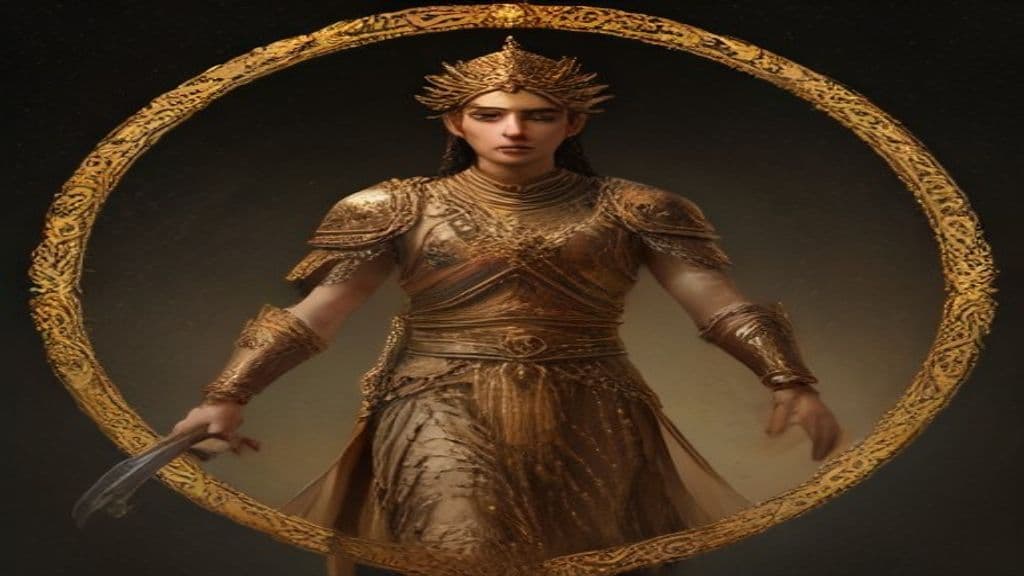
In Avestan literature Kərəsāspa is presented as son of Θrita and a member of the Sāma family; across successive traditions he is incorporated into epic genealogies as a ruling king and ancestor-hero. He appears in primordial mythic time (linked to Pishdadian-era chronologies and the era of Zahhāk) as a divinely favored monster-slayer and in later Zoroastrian texts is portrayed as a preserved corpse to be resurrected at the end of the world to battle Dahāg.
Sources provide no single, consistent physical portrait. Literary narratives depict him as a mighty warrior-king and youthful prodigy in epic poems (able in childhood to slay a dragon), commonly armed with lance or mace in iconographic captions and epic summaries. He is portrayed through actions—running along a dragon's back, wrestling a sea-monster for days, ruling and founding cities—rather than through standardized bodily description.
Across Avestan and later Zoroastrian and epic texts Garshāsp is credited with exceptional martial prowess and endurance: slaying dragons such as Aži Sruvara, fighting and flaying the sea-monster Gandarəβa after a prolonged struggle and binding it, surviving extreme combats (e.g., running along a dragon's back for hours, nine-day sea fights), campaigning abroad, restoring thrones and founding cities. In Zoroastrian eschatological accounts his corpse is preserved so he may be resurrected to slay the apocalyptic monster Dahāg and thereby save much of the world.
Ab-Zohr
Ab-Zohr is the culminating rite of the Zoroastrian Yasna service: a formal offering to the waters (Aban/Apas) that creates the consecrated liquid parahaoma and functions to purify, strengthen, and atone for damage done to waters. It is a ritual action rather than an independent supernatural being.
Aban (Āb/Ābān)
Aban (Avestan apas; Middle Persian āb/ābān) is the collective, sacred principle of the waters in Zoroastrian cosmology — both the element water and its personified hypostases (the Apas/Ahuranis). Aban functions as a primordial, life-giving creation, a calendrical and liturgical focus (day-name, month-name, Abanagan feast), and a ritual object of veneration (ape zaothra, Aban Yasht) rather than a malign force to be expelled.
Aban Yasht
The Aban Yasht is a hymn from the Persian tradition that praises Anahita, a goddess associated with water, fertility, and wisdom. It consists of 132 stanzas and is part of the 21 Yashts collection. (Note: - Power tier should be "Primordial" or possibly "Cosmic", given that it's a hymn of great spiritual significance and associated with a goddess. - The article incorrectly states that Anahita is associa)
Aeshma
Aeshma is the Zoroastrian hypostasis of wrath — a fiendish being who personifies rage and functions as an ontological opponent to Ahuric principles and ritual discipline. In scripture and later tradition he distracts worship, foments violence and drunkenness, can be driven off by prayer or by divine agents such as Sraosha and Mithra, and will be overthrown or flee at the final renovation.
Ahriman (Angra Mainyu)
Angra Mainyu (Middle Persian Ahriman) is the hypostasis or personification of destructive, deceitful, and disordering mentality in Zoroastrian tradition. In the earliest (Gathic) layer it is presented as a choiceful destructive mainyu opposed to the constructive Spenta Mainyu; in later Pahlavi exegesis it becomes a personified cosmic antagonist who nevertheless is described as ontologically deficient and non-divine.
Ahura
Ahura is an Avestan term that designates a class of divinities in the Indo‑Iranian and Zoroastrian tradition, marking the sacred ‘lords’ who are to be reverenced and opposed to the rejected class of daevas. In Zoroastrian scripture the label functions as both a technical category and an honorific applied to high divine figures such as Ahura Mazda, Mithra, and Apam Napat.
Ahura Mazda
Ahura Mazda is the principal deity of Zoroastrian tradition, invoked as the supreme source of goodness and wisdom who instructs Zoroaster and commands helper spirits (yazatas). Historically attested in Achaemenid royal inscriptions, Ahura Mazda occupies a central role in Zoroastrian liturgy (notably the Yasna) and in various Iranian religious formulations.
Ahurani
Ahurani (Avestan ahurani; pl. ahuranis) is a Zoroastrian divinity or class of divinities of the waters in the Avesta. In hymnic contexts (notably Yasna Haptanghaiti and Yasna 68) the ahurani(s) are invoked as companions of the ahura(s), bearers of health, fertility and other gifts, and the ritual recipients of libations (Ab‑Zohr).
Airyanem Vaejah
Sacred homeland and territory in Zoroastrianism, considered the cradle of Iranian civilization. (Note: * Power tier: Greater (Airyanem Vaejah is a sacred territory, not a cosmic entity) * Appearance and Abilities sections are missing * Weaknesses and Wards sections are missing * Summary should be rewri)
Aka Manah
Aka Manah (Akem manah; Middle Persian Akoman, New Persian Akvan) is the personification of 'evil mind' in Zoroastrian literature. Originating as a Gathic term for corrupt thought, the figure is later reified in the Younger Avesta and Pahlavi texts as a high-ranking demonic opponent of Vohu Manah and ally of Angra Mainyu, whose activity is to pervert human thought and moral discrimination.
Amesha Spenta
Amesha Spenta (Avestan Aməša Spəṇta) are a canonical heptad of divine, bounteous principles in Zoroastrian thought, described as the first emanations of Ahura Mazda and later functioning as moral ideals and protectors or guardians of portions of creation.
Anahita (Arədvī Sūrā Anāhita / Ardwisur Anāhīd)
Anahita is a worship-worthy divine figure (yazata) in Iranian religious tradition, attested in the Avesta and later Middle Persian texts, who personifies the waters and the mythical heavenly river and is associated with fertility, procreation, wisdom, and (in later syncretic forms) martial success and the planet Venus.
Community Record
- [1]Garshasp - Wikipedia. Wikipedia: Garshaspwiki
- [2]Wikidata: Garshasp: The Monster Slayer (Q3052022). Wikidata entry for Garshaspwiki
- [3]Archive descriptive summaries and captions (NYPL / archive images). Archival image captions referenced in source summaries (e.g., 'Garshasp, an ancestor of Rustam, kills a dragon with a lance')other
- [4]Garshāsp-nāma / Shāhnāma summaries (secondary summaries in provided notes). Summary references to Garshāsp-nāma and Shāhnāma episodes (Garshāsp as king of Zābolestān, youth prodigy, campaigns)literary
- [5]Summaries of Avestan and Zoroastrian texts (as cited in notes). Collected summaries in the supplied research notes describing Kərəsāspa's slayings of Gandarəβa and Aži Sruvara and the Sūdgar/Rivayat eschatological account of Kirsāsp's resurrection to slay Dahāg.literary