
In Vodou narrative motifs recorded in the sources, certain named Gede are presented with origin-language roles: Papa Gede is described ritually as 'the corpse of the first man who ever died' and Baron Criminel as 'the first person to kill another.' These formulations function as mythic or ritual origins within Vodou belief-worlds to explain their roles (psychopomp, enforcer) rather than as historical claims.
Descriptions vary by named lwa. Papa Gede is ritually characterized as a short, dark man wearing a high hat who smokes cigars and eats apples; he is frequently depicted at crossroads. Maman Brigitte is associated with graves, crosses, and gravestones and is syncretized with St. Brigid. Other members of the family (Gede Nibo, Brav Gede, Baron Criminel, etc.) are primarily identified through cemetery roles, ritual comportment, and narrative attributes rather than a single fixed visual form; many Gede are principally encountered through drumming, dance, and possession rather than static iconography.
Collectively the Gede serve as psychopomps who escort the deceased to the afterlife and as guardians of burial sites. Specific roles include Brav Gede as graveyard watchman who 'keeps the dead souls in and the living souls out,' and Gede Nibo as patron of those who died violently or prematurely and guardian of graves of the unrecovered dead; Gede Nibo's chevals (possessed devotees) may 'give voice to the dead spirits' whose bodies are lost. Baron Criminel is depicted as the enforcer of violent transgressions and is petitioned for vengeance; his horses (possessed devotees) display voracious appetite and aggressive behavior until fed. Papa Gede is prayed to for protection of children, is said to 'read minds' and to know events across the living/dead divide, and in ritual has a boisterous, ribald persona. In possession the Gede 'will drink or rub themselves with a mixture of clairin and twenty-one scotch bonnet or goat peppers,' and the family is associated with the banda drum rhythm and related dances.
Weaknesses
None recorded.
Wards
- ritualPrayer and offerings to named Gede (e.g., Papa Gede for protection of children; offerings to Baron Criminel)
- ritualFèt Gede (annual observance on 2 November) — repaying boons and making offerings before the feast to avoid retribution

Baron Samedi
A principal lwa of Haitian Vodou who serves as master of the dead and psychopomp, head of the Gede family; associated with cemeteries, crossroads, resurrection/healing, and licentious, comic behavior.
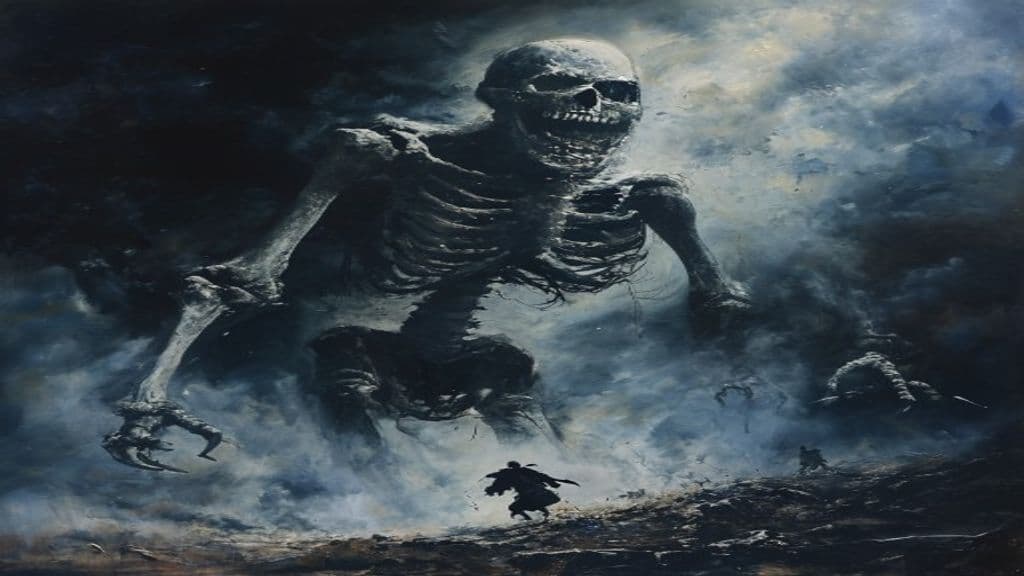
Gashadokuro
A fifteen-times-human-height skeletal yokai formed from the bones of those who starved to death or died on battlefields, their unburied remains fused together into a hungry colossus.
Adjassou-Linguetor
Adjassou-Linguetor is a loa in Haitian Vodou associated with spring water. The limited cited sources describe her as having protruding eyes and a bad temper; beyond these points, the available documentation (Wikipedia and Wikidata) is minimal.
Agwé
Agwé is a high-ranking lwa in Haitian Vodou associated with the sea, navigation, fishing, and certain funerary conveyances. He is portrayed as a naval officer who lives in a palace beneath the sea, commands attendant spirits, and is propitiated with maritime offerings and ceremonies.
Ayida Wedo
Ayida Wedo is a primordial rainbow-serpent loa of Haitian Vodou (with counterparts in Fon and Ewe vodun) associated with water, the rainbow, and the elemental forces; she often appears paired with Damballa as the dual cosmic serpent that assisted the creator in forming and upholding the world.
Ayizan
Ayizan is a racine (root loa) in Haitian Vodou and related West African-derived Vodoun traditions, functioning as the archetypal mambo (priestess) and a guardian of ritual order, initiation (kanzo), and the transmission of sacerdotal implements such as the asson. She is also associated with the marketplace and commerce and is syncretized with the Catholic Saint Clare.
Baron Samedi
A principal lwa of Haitian Vodou who serves as master of the dead and psychopomp, head of the Gede family; associated with cemeteries, crossroads, resurrection/healing, and licentious, comic behavior.
Damballa (Damballah)
Damballa is one of the most important loa (spirits) in West African Vodun and its New World continuations such as Haitian Vodou and related African-diasporic practices. Traditionally associated with serpentine imagery and sometimes depicted as a rainbow, Damballa represents a central, revered presence transmitted from the Whydah/Ouidah region of modern Benin into Caribbean Vodou practice.
Erzulie Dantor
Erzulie Dantor (Èzili Dantò) is a senior Petro lwa (spirit) in Haitian Vodou, a dark-mother manifestation within the Erzulie family associated with womanhood and maternal protection. She is prominent in Haitian folk art and is sometimes iconographically syncretized with images of the Black Madonna (Our Lady of Czestochowa) in popular devotional contexts.
Erzulie Freda
Erzulie Freda is a manifestation within the Ezili/Erzulie family of loa in Haitian Vodou associated with aspects of love and femininity. She is named among the prominent incarnations of Erzulie alongside Erzulie Dantor and Lasirenn in the cited sources.
Ezili Dantor
Ezili Dantor (Èzili Dantò, Erzulie Dantor) is a principal Petro lwa in Haitian Vodou, venerated as a dark-complexioned, maternal and fiercely protective spirit of children, single mothers, and marginalized gender identities. She is known for quick, destructive wrath as well as deep suffering, and figures in Haitian devotional life, syncretic Catholic imagery, and revolutionary memory in some traditions.
La Sirène
La Sirène is a mermaid-like water spirit (lwa) within Haitian Vodou, represented in ritual art and drapo (Vodou flags) and situated in Vodou pantheon lists alongside other named lwa. She is associated with marine imagery and participates in the visual and religious culture of Haitian Vodou rather than appearing only as a folkloric sea creature.
Lwa (Loa)
Lwa, also spelled loa, are spirit beings venerated within the African diasporic religion of Haitian Vodou and incorporated into some revivalist forms of Louisiana Voodoo. Many lwa identities derive in part from deities of West African traditions, especially Fon and Yoruba.
Marassa (Marassas, Marassa Jumeaux)
In Haitian Vodou the Marassa (Marassas, Marassa Jumeaux) are described as divine twins: childlike yet presented as older than other loa and as personifications of core moral and cosmological principles. Sources characterize them as paradoxical 'children mysteries' who synthesize aspects of the loa and are linked to love, truth, justice, reason, and astronomic‑astrological learning.
Community Record
- [1]Gede (Haitian Vodou). Wikipedia, 'Gede (Haitian Vodou)'wiki
- [2]Living Vodou. Patrick Bellegarde-Smith, Living Vodou (archive)other
- [3]Vodou Lwa Gede Nibo - Erzulies Voodoo. Erzulies Voodoo, 'Vodou Lwa Gede Nibo'other
- [4]Haitian Vodou History & Beliefs - Erzulies. Erzulies Voodoo, 'About Haitian Vodou - History & Beliefs'other
- [5]GHEDE - the Haitian God of Death (Vodou mythology). Godchecker, 'Ghede'other
- [6]Gede: Voodoo spirits in New Orleans traditions. Via Nola Vie, 'Gede - Voodoo spirits in New Orleans traditions'other