
According to the Eddic tradition (Völuspá) and the prose account in Gylfaginning, before the world existed there was Ginnungagap, the yawning void situated between elemental realms. The northern quarter bordering Niflheim became filled with ice, rime and dripping moisture, while the southern quarter was lit by sparks and glowing masses from Múspellheim; the meeting of these opposite conditions in Ginnungagap produced life and matter — notably the emergence of the primordial giant Ymir — and thus set the stage for the gods' subsequent fashioning of the world.
As a non-corporeal, pre-creation space it is portrayed cosmologically rather than visually: a central chasm or interval whose northern face is heavy with ice, rime and drizzling rain and whose southern face is lit by sparks and glowing masses from Múspellheim. Later medieval commentators and cartographers sometimes reinterpreted Ginnungagap as a physical sea-channel (e.g., proposals placing it between Greenland and Vinland or equating it with northern straits), but such geographic localizations are secondary, post-mythic readings.
Ginnungagap is not described as an agent with volition; in the primary sources it functions as the receptive, generative milieu in which oppositional elemental forces meet. Its role is transformational and ontological: by providing the indeterminate, liminal space where ice and fire interact, it enables the emergence of primordial beings (such as Ymir) and the raw materials later shaped by the gods into the world.
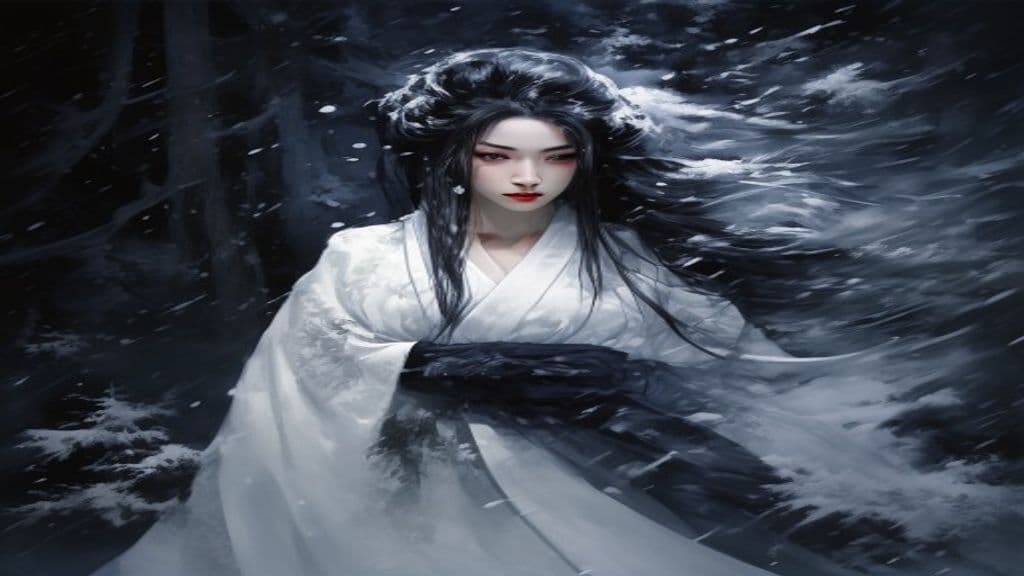
Yuki-onna
The Snow Woman of Japanese folklore — a spirit born of blizzards who appears to travelers lost in snowstorms. Beautiful and lethal, she can show mercy or bring death depending on her mood.
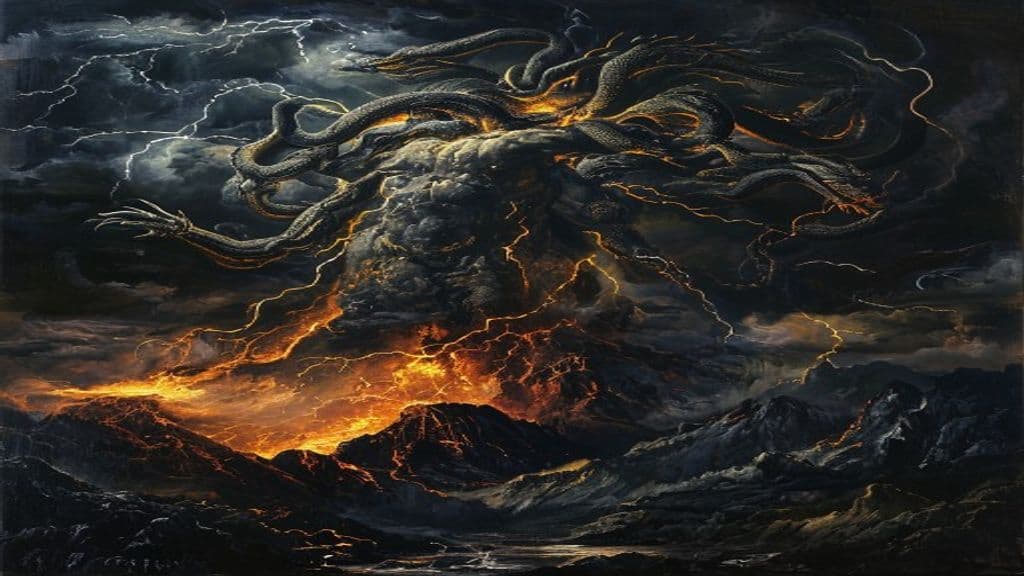
Typhon
The last great monster of Greek mythology — a vast, fire-breathing giant whose shoulders sprouted a hundred serpent heads, nearly toppling Zeus from Olympus.
Alvaldi
Alvaldi (Old Norse: Alvaldi / Ölvaldi) is a jötunn in Norse mythic genealogies, attested chiefly as the father of the notable jötunn Þjazi and described in one source as exceedingly rich in gold. He survives in the record mainly as a familial antecedent and an etiological figure rather than as an active participant in preserved narratives.
Andhrímnir
Andhrímnir is the named cook of the Æsir and the einherjar in Old Norse myth, responsible for slaughtering and preparing the beast Sæhrímnir daily in Valhalla and for producing the gods' mead from Heiðrún's milk. He is attested in the Poetic Edda and summarized in modern reference works.
Austri, Vestri, Norðri and Suðri
A quartet of named dwarfs in Old Norse cosmology positioned at the four cardinal points who are described in medieval sources as holding up the sky after the gods made heaven from Ymir’s skull. They function as structural/cosmogonic supports and are attested in the Prose Edda and the Dvergatal of Völuspá, with echoes in skaldic kennings and in later scholarly interpretation linking their role to roof-beam terminology.
Bestla
Bestla is a jötunn (giantess) in Old Norse mythic genealogies, attested as the mother of Odin, Vili, and Vé by the giant Borr. She functions primarily as a maternal progenitor in the medieval Icelandic corpus (Poetic Edda, Prose Edda, and skaldic verse), and surviving references to her are sparse and fragmentary.
Brimir
In Old Norse mythic tradition the name Brimir appears in two closely related roles: as a name applied to a primordial jötunn (often equated with Ymir/Aurgelmir) whose body supplies the material of the world, and as the name of a beer‑hall or hall of plenty that Snorri interprets as an afterlife dwelling for virtuous survivors after Ragnarök.
Búri
Búri is an Old Norse primordial divinity attested in the Prose Edda and a skaldic verse as an early ancestor of the Æsir. He is presented as a first-born godlike figure who is freed from salty rime by the primeval cow Auðumbla and is genealogically prior to later gods such as Borr and, by descent, the Æsir.
Býleistr
Býleistr is an Old Norse mythic name attested as a brother of Loki. He appears only as a kin-term in skaldic and Eddic contexts and in Snorri Sturluson's prose lists; no independent deeds or narratives are preserved for him in the cited sources.
Dagr
Dagr is the Old Norse personification of the day: a luminous being who rides across the sky on the horse Skinfaxi, bringing daylight in the mythic cosmology preserved in the Poetic Edda and Prose Edda. The lexical item Dagr functions both as the common noun for 'day' and as a proper name for this mythic actor.
Durinn
Durinn is an early named dwarf (Old Norse: dvergr) attested in the medieval Norse corpus; counted as the second-created dwarf after Mótsognir and associated in saga tradition with exceptional smithcraft, including a role in forging the magic sword Tyrfing.
Dvalinn
Dvalinn is an Old Norse mythic name attested in the Poetic Edda and several sagas applied to at least two distinct figures: a named dwarf among the dwarf-kind (craftsman, rune‑figure, leader in some lists) and one of the four harts/stags that feed among the branches of the world‑tree Yggdrasill. The corpus does not reconcile these uses of the same name into a single coherent biography.
Eitri
Eitri (also attested as Sindri) is an Old Norse dwarf smith celebrated in the Skáldskaparmál episode for forging three famous artifacts — Gullinbursti, Draupnir, and Mjöllnir — while working with his brother Brokkr. He is presented as a master craftsman whose work directly affects the gods, not as a deity.
Eldir
Eldir is a named servant of the sea-being Ægir in Old Norse myth, attested in the poem Lokasenna where he stands outside Ægir's hall and speaks with Loki. His name, Old Norse Eldir, is glossed as 'fire-stoker' and marks him as a household attendant and threshold interlocutor rather than a deity.
Community Record
- [1]Ginnungagap (Wikipedia). "In Norse mythology, Ginnungagap ... is the primordial, magical void mentioned in three poems from the Poetic Edda and the Gylfaginning..."; etymology discussion and Gylfaginning quotation cited in research notes.wiki
- [2]Völuspá and Gylfaginning (summary as cited). Summaries and quotations from Völuspá and Gylfaginning describing Ginnungagap as the yawning void between Niflheim and Múspellheim, whose meeting of ice and sparks produces Ymir and the materials of creation.literary
- [3]Comparative 'Chaos Primordial' motifs (Archive excerpt). Comparative listing that places Ginnungagap among Indo-European 'Chaos Primordial' examples (noting thematic parallels with Indic and Greek cosmogonies).other
- [4]Medieval/localizing traditions (Gripla, scholia, Guðbrandur Thorlaksson) — summary from notes. Notes report that 15th–17th century authors and commentators attempted to localize Ginnungagap as a geographic sea-channel (between Greenland and Vinland or equated with northern straits); treated in the scholarship cited in the Wikipedia article.other