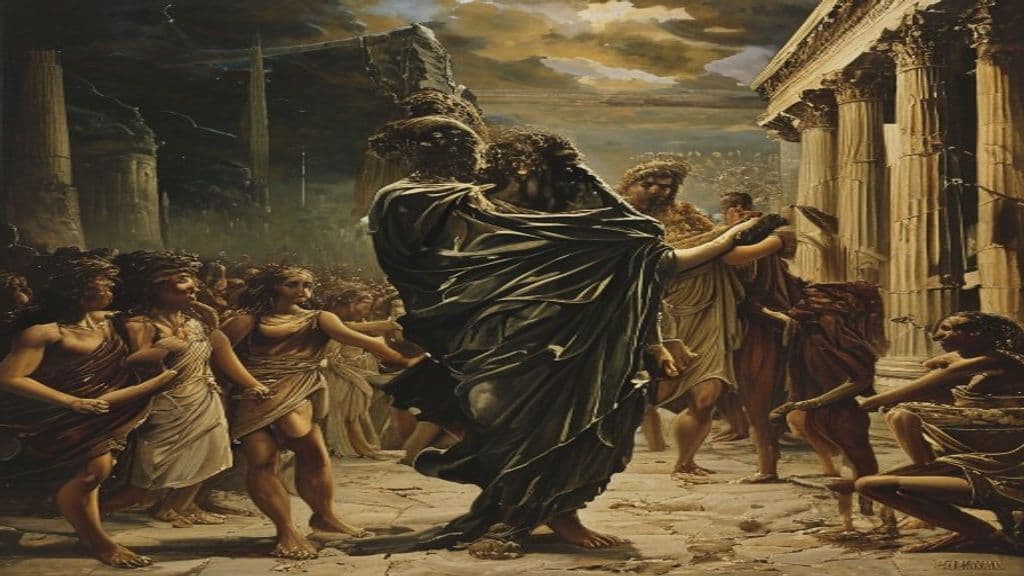
Greek mythology was created through the collective storytelling of ancient Greeks, with roots in oral tradition.
The gods, goddesses, and heroes possess supernatural powers and engage in human-like behavior, as described in various myths.

Zeus
Zeus (Ancient Greek: Ζεύς) is the supreme deity of the classical Greek pantheon, a sky-and-thunder god who rules as king of the gods on Mount Olympus and functions as a sky‑father who assigns roles among the immortals.

Athena
Athena is a major ancient Greek goddess associated with wisdom, handicraft (notably weaving), and warfare; she serves as a tutelary protector of cities—most prominently Athens—and is central to myth, cult, and civic identity in the Greek world.
Athena
Athena is a major ancient Greek goddess associated with wisdom, handicraft (notably weaving), and warfare; she serves as a tutelary protector of cities—most prominently Athens—and is central to myth, cult, and civic identity in the Greek world.
Cebren
Cebren (Ancient Greek: Κέβρην) is a Greek river-god (potamos) of the Troad, a divine personification of the river Kebren near ancient Troy. He is named as a son of Oceanus and Tethys and as the father of naiads such as Asterope/Hesperia and Oenone; the nearby city Cebrene took its name from him.
Greek water deities
A class of divine and semi‑divine beings in ancient Greek religion and mythology associated with seas, rivers, springs, and liminal watery places. The category ranges from primordial water powers through an Olympian sea‑god to localized nymphs, heroized mortals, trickster elder sea‑figures, and monstrous progeny, reflecting how the Greeks sacralized maritime and freshwater spaces.
Hades
In ancient Greek religion and mythology, Hades is the god who rules the subterranean realm of the dead and presides over all things beneath the earth, including subterranean riches. He is a son of Cronus and Rhea and one of the generation of Olympian gods, allotted the underworld after the Titanomachy.
Melete
Melete (Ancient Greek: Μελέτη) is one of the original triad of Boeotian Muses—Aoide (song), Melete (practice/contemplation), and Mneme (memory)—personified in ancient Greek cultic contexts as the principle of practice, meditation, or rehearsal necessary for poetic and musical performance.
Miasma (Ancient Greek)
In ancient Greek religion, a miasma is a malevolent force arising from human wrongdoing that can cause catastrophe and has an independent life. (Note: - The draft states that a miasma causes catastrophe, disease, famine, or war, which is not supported by the source material. - Power tier: Primordial (not Ancient), since it's described as having an ")
Phoebe
Phoebe (Ancient Greek: Φοίβη, 'bright') is a first‑generation Titan in Greek mythology, daughter of Uranus (Sky) and Gaia (Earth). The name Phoebe is also used as an epithet for lunar goddesses (Artemis/Diana, Selene/Luna) and has been recycled in modern taxonomy and nomenclature (a moon of Saturn, plant and animal genera), but these are distinct referents rather than a single supernatural persona.
Polyhymnia
Polyhymnia (Greek: Πολυύμνια), also Polymnia, is one of the nine Muses in ancient Greek myth and cult, traditionally associated with sacred hymn, contemplative eloquence, and solemn poetic praise. As a daughter of Zeus and Mnemosyne she functions as a divine inspirer whose presence belongs to the sanctuary world of the Muses (notably Mount Parnassus and the spring above Delphi) and to the institutionalized practice of sacred song and oracular ritual.
Rhea
Rhea is a principal mother goddess of the Titans in ancient Greek religion and mythology, daughter of Gaia and Uranus, sister and consort of Cronus, and mother of major Olympian deities. In Roman reception she is identified with the Magna Mater (the Great Mother), reflecting continuity of her maternal and cultic role across Greek and Roman traditions.
Selene
Selene is the ancient Greek goddess and personification of the Moon, who drives her moon-chariot across the heavens. Daughter of the Titans Hyperion and Theia and sister to Helios and Eos, she embodies both the luminous aspect of the Moon and its function as regulator of the month.
Strymon
Strymon is the personified river-god (potamos) of the ancient Strymon/Struma River in Thrace/Edonia. In classical Greek tradition he functions as a local natural deity, a genealogical ancestor in foundation myths, and a civic emblem known from literary summaries and local coinage references.
Tenerus
Tenerus is a Theban hero in ancient Greek tradition identified as the son and prophet of the god Apollo by the Oceanid nymph Melia. He functions in the sources as a local prophetic/heroic figure tied to Thebes' religious landscape rather than as a broader mythic category or cosmological spirit.
Community Record
- [1]