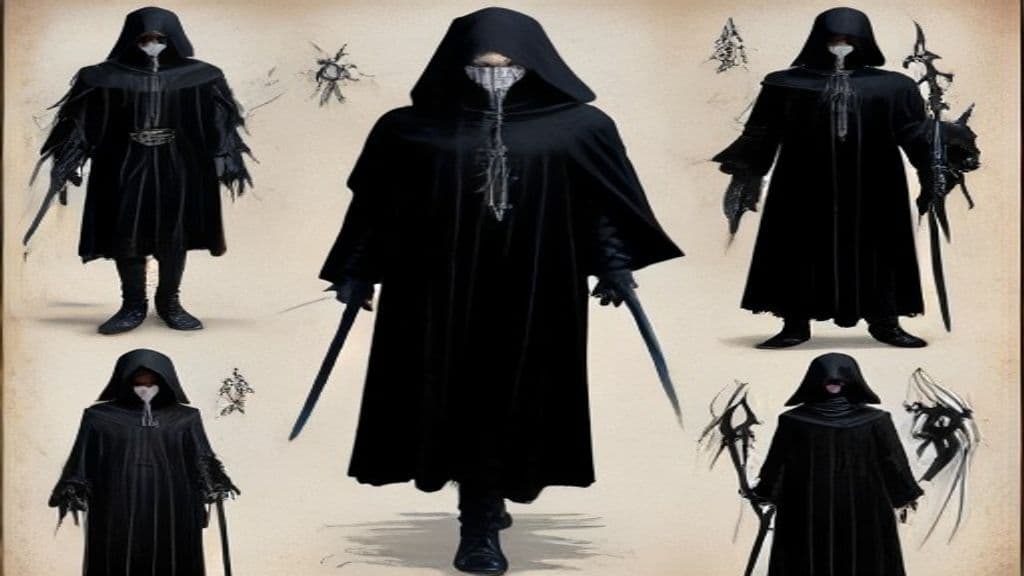
The modern consolidated image of the Grim Reaper emerges from a long history of European personifications of death in late medieval and Renaissance art, with particular intensification during and after the Black Death in the 14th century. Various skeletal and corpse-like figures, danse macabre motifs, and apocalyptic 'Triumph of Death' images across Europe contributed visual elements that were later recombined. The specific English label 'Grim Reaper' first appears in print in the 1840s; by the mid-19th century a standardized modern composite image (hooded skeleton in black robe with scythe) became common in Anglophone contexts.
In modern consolidated imagery the Grim Reaper is shown as a hooded, robed figure in black clothing, frequently skeletal or corpse-like in form, carrying a scythe; iconography sometimes includes an hourglass and sometimes depicts wings. Earlier and regional variations existed — death was sometimes shown as female in Romance-language cultures and more often male in Slavic and Germanic contexts, and earlier depictions included crowned skeletons, dancing skeletons, or riders rather than the later hooded scythe-bearer.
As characterized in the sources, the Grim Reaper's 'abilities' are symbolic and narrative: it serves as a personified emblem that appears to signal, herald, or 'collect' death in art and storytelling. The scythe functions as an agricultural metaphor for harvesting human lives. The sources do not document literal supernatural powers, ritual agency, or technical mechanisms of soul-harvesting beyond its representational role in cultural works.
Grendel's mother
A principal antagonist in the Old English epic Beowulf, presented as the mother of Grendel and a member of the poem's category of Cain-descended “monsters.” She attacks Heorot in vengeance for her son and is slain by Beowulf in her underwater lair.
Grey Gargoyle (Paul Pierre Duval)
A Marvel Comics supervillain whose right hand was permanently transformed into living stone by an industrial chemical accident; he can transmute touched matter to stone temporarily and can convert his whole body into living stone, acting as a recurring antagonist to superheroes such as Thor. He has at times been amplified by cosmic events (e.g., becoming Mokk during Fear Itself) and has been reverted or contained through a variety of tactical and magical interventions.
Grey Hulk
A distinct persona/alter of Bruce Banner within mainstream American comic-book continuity and adaptations, identified by grey skin in many iterations and a temperament that differs from other Hulk personae. The Grey Hulk is an internal, emergent identity that manifests during Banner's transformations rather than an external spirit or traditional folkloric being.
Grey wolf (mythology)
The Grey wolf is both the biological species Canis lupus and a mythic/symbolic animal in several Eurasian traditions. In Turkic, Mongolian, and broader Altaic contexts it is described as a sacred animal and national symbol; in other Eurasian mythic corpora wolves also appear as powerful mythic figures (e.g., Norse Fenrir) though those are distinct literary entities.
Griffin
The griffin (also griffon, gryphon) is a composite legendary creature combining the body, tail, and hind legs of a lion with the head, wings, and often taloned forelegs of an eagle. In classical and medieval Eurasian traditions it functions chiefly as a majestic guardian figure associated with rulership and the protection of treasure, and appears widely across artistic vocabularies rather than as a single codified religious being.
Griflet
Griflet is a human narrative figure of the Arthurian literary tradition, appearing across medieval romances and later retellings as a loyal young squire who rises to become a knight of the Round Table. He is a recurring martial attendant of King Arthur, notable in sources for battlefield service, frequent captures and rescues, and variant fates at the end of the cycle.
Gringolet
Gringolet is the named war-horse of Sir Gawain in Arthurian literature, depicted as an extraordinary mounted companion used in questing and battle. Across multiple medieval sources the steed functions as a marker of Gawain's chivalric identity, a partner in martial action, and occasionally bears hints of supernatural provenance.
Grivet
The grivet (Chlorocebus aethiops) is an Old World monkey species native to parts of northeastern Africa. The provided sources treat it as a biological taxon with ecological, behavioral, and historical-cultural associations (not as a supernatural being).
Groot
Groot is a fictional extraterrestrial tree-like sentient being (a Flora colossus) originating from Planet X in Marvel Comics. Introduced in 1960 as an invader, later reinterpretations recast Groot as a heroic figure and long-time companion of Rocket Raccoon within Marvel continuity and its adaptations.
Grootslang
A legendary enormous serpent from South Africa (literally 'big snake' in Afrikaans/Dutch) said to dwell in deep caves and river pools of the Richtersveld and Orange River region; traditionally represented as an ancient guardian of hoarded diamonds and other riches and as an explanation for dangerous places and disappearances.
Gryneus
Gryneus is a polysemous name attested in modern biological taxonomy (Callophrys gryneus, the juniper/olive hairstreak), as an epithet of the classical god Apollo in data records, as the name of a centaur slain in the Lapith–centaur fight in a mythic source, and as the Latinized surname of an early modern theologian (Ioannes/ Johann Iacobus Grynaeus). The supplied sources do not present Gryneus as a single supernatural entity within a living folk cosmology.
Guahaioque
Guahaioque is recorded in available sources as a minor deity of the Muisca people, described as the god of evil, stealing, lies, and death. The Muysccubun name is given as meaning "figure of the deceased." The documentary attestation is brief and does not include myths, iconography, or ritual detail.
Community Record
- [1]Grim Reaper (Wikipedia). Wikipedia contributors, 'Grim Reaper,' Wikipedia, The Free Encyclopedia.wiki
- [2]Death (Wikidata entry: personification of death). Wikidata, 'Death' (Q161936).other
- [3]Green Grim Reaper Favorites (Archive). Archive collection referencing modern uses of Grim Reaper imagery.other
- [4]Florida Church sold bleach Coronavirus miracle cure. Grim Reaper will troll Florida's opened beaches (Archive). Archive item documenting modern cultural/media uses of Grim Reaper imagery.other
- [5]The Grim Reaper of retail: Spirit Halloween (Archive). Archive item on commercial use of Grim Reaper imagery.other