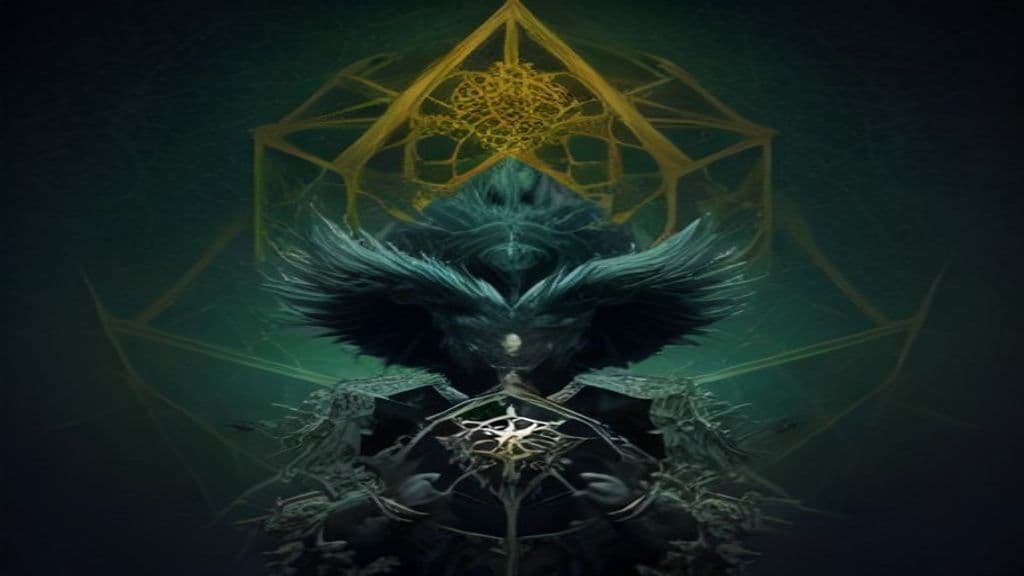
Gusion appears in the catalog-style cosmology of the Ars Goetia, part of the Lesser Key of Solomon, where many nonhuman intelligences are listed with ranks and duties. Within that ritual-magical framework Gusion is presented as one of the rostered spirits that a magician might summon, interrogate, or command; the supplied sources do not provide a narrative origin myth or pre-grimoire legend for the entity, and they treat the name as transmitted through Latin/English grimoire compilations rather than as derived from a separately attested folkloric origin.
The provided materials do not include a direct, detailed physical description of Gusion from primary Ars Goetia texts. Secondary summaries characterize him in general terms (for example, as having a 'dignified and authoritative presence' in a fandom summary), but no concrete iconographic or bodily details are documented in the supplied sources.
In the grimoire-derived listings summarized in the available sources, Gusion is described as a high-ranking spirit (styled a 'Great Duke of Hell' in modern summaries and catalog entries) who commands many subordinate spirits and is attributed the ability to answer truthfully about the past, present, and future. The number '40 legions' is given in a later secondary summary drawing on Ars Goetia material; primary ritual texts and fuller attributions or step-by-step conjurations are not present among the supplied excerpts, so these capabilities are recorded here as functions reported in grimoire catalog tradition and later compendia rather than as independently corroborated by additional primary-source ritual instructions in the provided materials.
Agares
Agares is a named, ranked spirit in the European grimoire tradition. Frequently presented as an elderly man associated with the eastern quarter, he is credited in multiple grimoires with teaching languages, stopping or retrieving runaway persons, causing earthquakes, and granting noble titles, and is invoked in evocations and object-binding experiments.
Forneus
Forneus is a named spirit in the grimoire tradition of The Lesser Key of Solomon (the Ars Goetia), described there as a Great Marquis of Hell who commands twenty-nine legions and is said to teach rhetoric and languages while making men beloved and giving them a good name. Sources depict him as able to take many forms — described as a great sea monster but said to mainly prefer human form — and note that he is "partly of the Order of Thrones, and partly of that of Angels."
Gunungsin (War Gods)
Korean deities associated with war and conflict, possibly connected to the Jakjaegeon myth. (Note: 1. Power tier should be Primordial only if it's supported by source material; based on the provided sources, the power level is unspecified. 2. Abilities are unknown or unspecified in source material,)
Gupna (Gufna)
In Mandaean cosmology, the gupna or gufna is described in secondary sources as an uthra — a personified, heavenly grapevine that resides in the World of Light. References are brief and present the figure as a sacralized vine elevated into the register of luminous beings rather than as a terrestrial plant.
Guruvayurappan
Guruvayurappan is the local form of the Hindu god Vishnu worshipped at the Guruvayur Temple in Kerala, identified specifically with Krishna in his child form (Guruvayur Unnikkannan). The murti is the temple's living presiding deity in local tradition and is portrayed in devotional narratives as responsive to devotees and capable of intervening in their lives.
Gurzil
Gurzil is an ancient Berber (Amazigh) sacred figure attested in late‑antique and medieval sources and in archaeological remains from Tripolitania. Best known from Corippus’s mid‑6th‑century poem Iohannis as a war‑associated cult image carried into battle by the Laguatan, and attested archaeologically at the site commonly identified as Ghirza.
Gusainji Maharaj
A revered figure in Hindu tradition, venerated by both Hindus and Muslims. (Note: 1. Power tier should be Lowered from Primordial to Ancient, as no cosmic or deity-level abilities are mentioned. 2. No specific weaknesses, wards, or sensory cues can be determined from the source mat)
Guy
Guy is primarily an English-language lexical item: a male given name and surname, a colloquial/slang term for a man, several place-names in North America, technical terms (e.g., guy-wire, sailing guy), and a modern cultural object in the form of "The Guy," the effigy burned on Guy Fawkes Night. The supplied sources do not describe Guy as a supernatural being or part of a traditional cosmology.
Gwenhwyfach
Gwenhwyfach is a figure in medieval Welsh Arthurian tradition, named as a sister and antagonist of Gwenhwyfar (Guinevere). Her surviving attestations are fragmentary: she appears in the tale Culhwch and Olwen and is cited in two Welsh Triads as whose quarrel with her sister precipitated the Strife of Camlann.
Gwion Gwion
A regional tradition/style of painted anthropomorphic rock art from the north‑west Kimberley region of Western Australia, characterized by finely rendered human figures with ornamentation. The tradition (also known by local names such as Kiro Kiro/Giro Giro) is archaeologically significant and the subject of debate over age and authorship.
Gwisin
In Korean folklore, gwisin are spirits or ghosts that are humans who have died. Sources describe the term as a class of departed-human spirit, noted as similar to yogoe or mamul and explicitly contrasted with non-human beings such as dokkaebi.
Gwragedd Annwn
In Welsh tradition the Gwragedd Annwn are female Otherworld fairies tied to freshwater—lakes and rivers—counted among the Tylwyth Teg. Depicted as beautiful women (often dressed in green) who live beneath lakes, they herd enchanted white cattle and occasionally cross into the human world.
Community Record
- [1]List of demons in the Ars Goetia (Wikipedia). "the demons' names are taken from the goetic grimoire Ars Goetia, which differs in terms of number and ranking from the Pseudomonarchia Daemonum of Johannes Wier. As a result of multiple translations, there are multiple spellings for some of the names..."wiki
- [2]Gusion (Wikidata). Wikidata entry describing Gusion as 'a strong Great Duke of Hell in demonology.'wiki
- [3]Gusion | Public Domain Super Heroes (fandom summary). Fandom summary: 'Gusion, in the Ars Goetia of the Lesser Key of Solomon, is a Great Duke of Hell who commands 40 legions of demons. Described as possessing a dignified and authoritative presence, Gusion is known for his ability to answer truthfully about the...'other
- [4]Archive listing (name usage example). Archival item showing later cultural usage of the name 'Gusion' (listed among supplied source URLs).other
- [5]Gundam Gusion Origin custom – GUNJAP (example of modern name reuse). Modern/pop-culture reuse of the name 'Gusion' (provided among source URLs).other