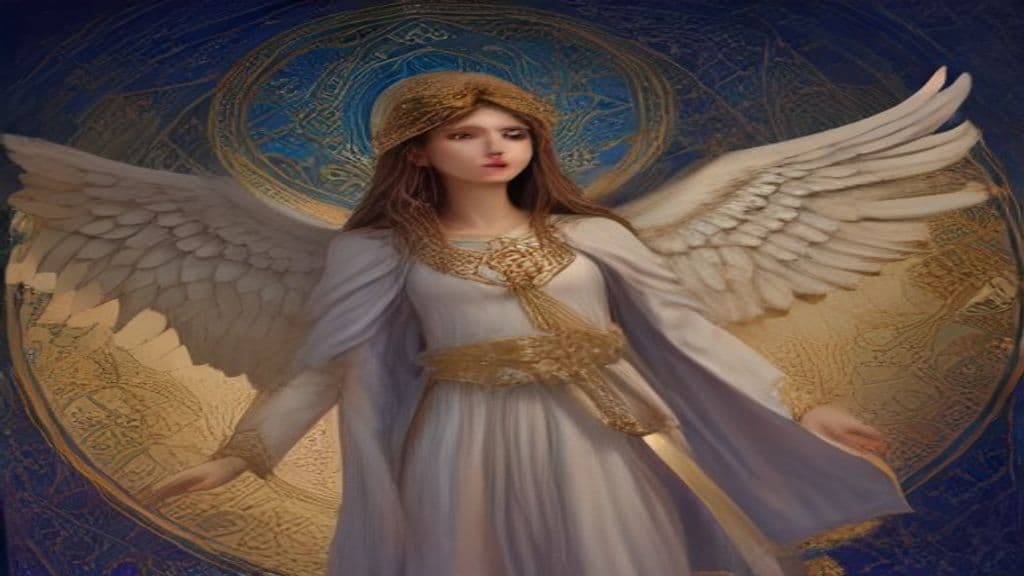
Within Jewish angelology and later lists of celestial intelligences, Haniel appears as one of the principal archangels and is often grouped among the canonical seven archangels. Sources present Haniel as the archangel associated with the sephirah Netzach on the Kabbalistic Tree of Life, linking the angel to a specific metaphysical role within the hierarchical system of spiritual beings that mediate divine attributes and cosmic forces. The etymology given for the name—derived from Hebrew Ḥēn (חֵן, 'grace, favour, charm') plus the theophoric element -ʾĒl ('God')—frames Haniel as a celestial intelligence whose office and character express divine grace; this semantic and cosmological positioning carries forward into Christian angelographies and into Renaissance occult systems, where Haniel's name and cipher are included among devices such as the Sigillum Dei Aemeth used by John Dee and Edward Kelley.
The supplied sources do not record a fixed pictorial or iconographic description unique to Haniel; instead, Haniel is identified generically as an angel/archangel within textual angelological lists. From that standing within Jewish and Western angelic typology, Haniel would be expected to be depicted by tradition as a celestial being in tune with other archangels (i.e., a non-corporeal intelligence often represented in religious art by angelic form), but the primary material consulted is silent on colors, garments, wings, number of faces, or distinct emblematic attributes. The absence of a detailed visual tradition in the provided sources is explicitly noted in the primary reference.
The sources connect Haniel's functions to the planetary sphere of Venus and to Netzach, the sephirah commonly associated with victory, endurance, beauty, attraction, and related affective states; accordingly Haniel is described as embodying qualities of grace, charm, and joy and as the archangel ruling Netzach. Beyond these correspondences the material does not catalogue concrete magical powers or narrative actions toward humans, but it records that Haniel's name (and by implication its authority) was incorporated into Renaissance ritual equipment: Haniel is among the archangels encrypted in the Sigillum Dei Aemeth compiled by John Dee and Edward Kelley, indicating an operative place for the angel within later ceremonial and talismanic practices.
Weaknesses
- otherNo weaknesses recorded in supplied sources
Wards
- otherNo wards or protective measures involving Haniel recorded in supplied sources
Binah (בינה)
Binah (Hebrew: בִּינָה Bīnā, "understanding") is the third sephirah on the Kabbalistic Tree of Life, a non-personal divine attribute that receives, contains and structures the undifferentiated creative impulse (Chokmah). It functions as an intellectual/metaphysical principle in Kabbalistic cosmology and psychology rather than as an independent, anthropomorphic spirit.
Camael
Camael is presented in mainstream Christian angelology as an archangel associated with love, peace, and harmony. Separately, an archival excerpt uses the same name for a spirit described as a 'demon' who appears in dreams and to those who summon him and who instructs humans in violent and sexualized acts; these are distinct, conflicting portrayals in the supplied sources.
Chochmah
Chochmah (Heb. חָכְמָה; also Chokmah/Chokhmah) is a metaphysical principle in Jewish Kabbalistic thought: the second of the ten sefirot, described as the primordial point of divine wisdom — the first flash of conscious intellect that issues from Keter and becomes intelligible through Binah.
Chokmah
Chokmah (חָכְמָה, 'wisdom') is the second sefirah on the Kabbalistic Tree of Life, described in classical kabbalistic texts as the primordial point of divine wisdom that emerges from Keter and precedes differentiation by Binah. It functions as an abstract metaphysical principle and cognitive archetype rather than a personified spirit in the provided sources.
Daʻat
Daʻat (Hebrew: דַּעַת, "knowledge") is a Kabbalistic locus or mystical state on the Tree of Life in which the sefirot are united; it functions as a mediating point between the transcendent Keter and the manifest sefirotic structure and as a correlate of certain human cognitive-emotional capacities.
Demon (tradition)
A broadly attested category of harmful or malevolent supernatural beings found across many cultures, used to explain illness, death, misfortune, temptation, and social disruption. The concept is historically flexible, ranging from neutral intermediary spirits in ancient contexts to negatively valenced agents in many later religious traditions, and is the object of ritual responses such as exorcism or magical conjuration in some traditions.
Dominion (angel)
In Christian angelology, Dominions (also Dominations or Lordships; Greek kyriotētes) are an order of created heavenly beings listed among categories such as thrones, principalities, and powers. Major theological sources (Colossians 1:16 as cited, Pseudo‑Dionysius the Areopagite, and the Second Book of Enoch) treat them as a ranked class within a hierarchical cosmos rather than as individual personalities encountered in folklore.
Ein Sof
Ein Sof (אֵין סוֹף, ʾēn sōf) is the Kabbalistic designation for the pre‑manifest, nameless divine principle—literally “no end” or “infinite”—from which the Ohr Ein Sof (Infinite Light) and the ten sefirot are said to emanate. It is described apophatically: beyond names, attributes, form, space and time.
Ein Sof Aur
A Kabbalistic metaphysical formulation linking Ein Sof (the Infinite) with ʾOr (divine 'light'), used to discuss divine emanation and the manifestation of revealed divine names (e.g., YHWH Elohim) rather than a personified folkloric being.
Gevurah
Gevurah (Hebrew: גְּבוּרָה, Găḇūrā) is the fifth sephirah on the Kabbalistic Tree of Life, an emanation representing the divine principles of judgment, limitation, and disciplined strength. It functions as a structural attribute within Jewish mystical cosmology rather than an individual personal spirit.
Keter
Keter (Hebrew: כֶּתֶר, "crown") is the highest of the ten sefirot in Jewish Kabbalistic cosmology, the first emanation from the Ein Sof that functions as the primal divine will or initial impulse toward creation. It is described as utterly concealed — "the most hidden of all hidden things" — and as the origin point from which subsequent sefirot emerge.
Malkuth (מַלְכוּת)
Malkuth is the tenth sefirah on the Kabbalistic Tree of Life, the lowest sphere representing the manifest world or 'Kingdom'. It functions as the receiving endpoint of the divine emanations, the realm of material existence (the World of Assiah), and a symbolic locus for humility, embodied action, and the Shekhinah in Zoharic material.
Community Record
- [1]Haniel - Wikipedia. Wikipedia, 'Haniel' article (as provided in research notes).wiki
- [2]Wikidata: Haniel. Wikidata entry for Haniel (referenced in research notes).other
- [3]Sigillum Dei Aemeth reference (Dee & Kelley). Noted in the same Wikipedia article that Haniel is encrypted in the Sigillum Dei Aemeth of John Dee and Edward Kelley.wiki