
In the Mahābhārata Hidimbī and her brother Hiḍimba dwell in the forest in a towering śāla (Sala) tree and prey on travellers; Hiḍimbī assumes a beautiful maiden form to approach Bhīma while he keeps watch during the Pāṇḍavas' exile. Her brother Hiḍimba intends to kill the Pāṇḍavas and is slain by Bhīma in combat. Hiḍimbī subsequently marries Bhīma and gives birth to Ghaṭotkaca, who becomes a mighty rākṣasa warrior. Scholarly work notes that the Himalayan cult of Haḍimbā (centered at the Hidimba Devi Temple, Manali) likely predates or developed independently of the epic identification: reasons cited include the historical absence of Bhīma in early ritual records, the late appearance of Ghaṭotkaca in local cult, and arguments that a local or tantric goddess was later Sanskritized by linking her to the Mahābhārata narrative.
In the Mahābhārata Hidimbī is a forest-dwelling rākṣasī who inhabits a lofty tree and originally has a terrifying, monstrous aspect; the epic explicitly reports she can transform into a beautiful maiden to approach Bhīma. The provided sources do not give detailed iconography from the Hidimba Devi Temple, only noting that she is worshipped there as a goddess (Haḍimbā); specific temple images or iconographic descriptions are not supplied in the cited materials.
Textual sources attribute shape-changing to Hidimbī (ability to assume a beautiful woman’s form), and present her and her brother as predators of human travellers (the siblings 'make their home in a towering Sala tree and prey on travelers'); the sources ascribe cannibalistic predation explicitly to the sibling pair in the narrative but emphasize the brother Hiḍimba's hostile intent and death at Bhīma's hands. Hidimbī demonstrates moral choice and loyalty in the epic—she warns Bhīma of her brother’s plan, pledges fidelity, and enters marriage with him. She also performs a reproductive role as mother of Ghaṭotkaca, whose martial prowess affects human political conflicts. In regional religion Haḍimbā functions as a local guardian goddess who is propitiated at a temple rather than portrayed chiefly as a predator.
Weaknesses
- othernone specified in sources
Wards
- othernone specified in sources
Naga
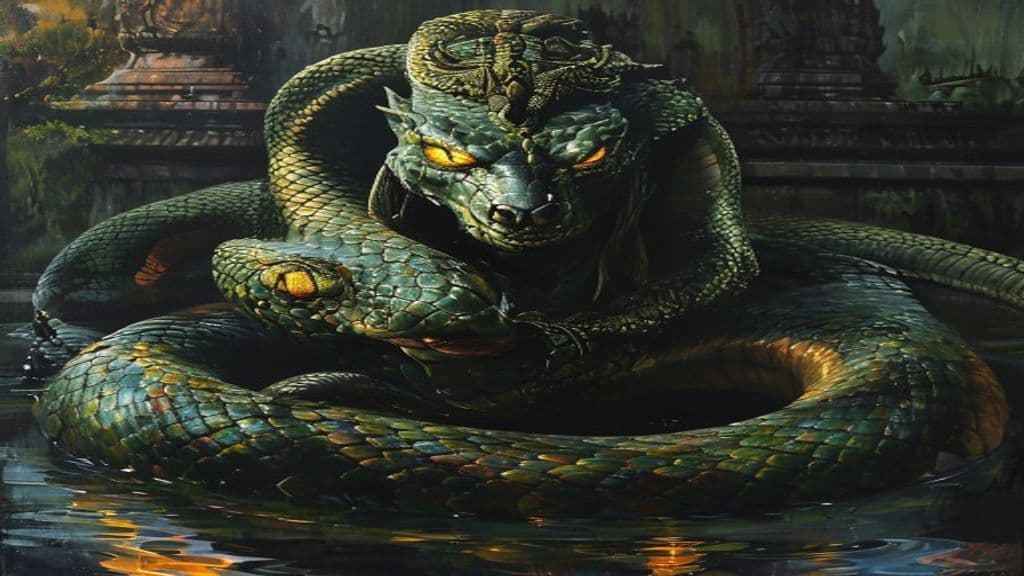
Divine serpent beings of Hindu, Buddhist, and Jain cosmology — powerful guardians of water, earth, and underground treasures. Revered as deities in South and Southeast Asia.

Rakshasa (Himalayan variants)
A Himalayan reception of the pan-Indian rakshasa motif: hostile or disruptive non‑human beings known from Sanskrit epic and Puranic literature, here noted where Himalayan sources and discussions intersect with the broader epic tradition. The supplied sources do not document distinct, well‑attested Himalayan folklore variants; the entry therefore presents primarily the epic/legendary profile as transmitted into Himalayan contexts in general references.

Ghoul
A ghoul is a demon-like or monstrous humanoid originating in pre-Islamic Arabian religion, traditionally associated with graveyards and the consumption of human flesh. The concept later entered broader folklore and has been widely reused and transformed in modern fiction and popular culture.
Hidimba
Hiḍimba is a powerful demon king in the Indic epic Mahābhārata who dwells in the forest, preys on humans (including cannibalistic behavior), and is slain in single combat by the Pandava Bhīma. In regional tradition the cultic attention shifts to his sister Hiḍimbī (Hiḍimbā Devī) and their son Ghaṭotkaccha, whose shrines and festival roles are prominent in Himachal Pradesh.
Hesperides
The Hesperides are a group of Greek mythic nymphs who tend the sacred garden of Hera at the western edge of the world. Associated with evening and the west, they guard trees bearing golden apples and are linked in myth to major episodes such as Heracles' eleventh labour and the origin of the Apple of Discord.
Hesperus
Hesperus is the Greek personification of the Evening Star—the planet Venus as seen after sunset. Treated in mythic genealogies as a child of Dawn and related to other celestial personifications, Hesperus figures in literary and philosophical discussion about the identity of the evening and morning appearances of Venus.
Heyókȟa (Heyoka)
A sacred contrarian figure and ceremonial role in Lakota and Dakota (Sioux) traditions, the heyókȟa functions as a sanctioned 'sacred clown' whose deliberate inversion of social norms, satire, and ritualized shame help heal emotional pain and test communal values. Cosmologically the role is tied to visions of the thunder beings (Wakíŋyaŋ) and is sometimes represented in myth as a thunder or lightning spirit.
Hibagon
The Hibagon is a regional cryptid reported around Mount Hiba in Hiroshima Prefecture, Japan, described as a large, bipedal, hairy humanoid. Reported since the 1970s, it is presented in sources as a local analogue to North American Bigfoot and the Himalayan Yeti and treated primarily as a cryptozoological/folkloric curiosity rather than a being embedded in traditional religious cosmology.
Hibil (Hibil Ziwa)
Hibil Ziwa is a luminous uthra (lightworld being) in Mandaean religion who serves as a salvific agent. Created by Manda d‑Hayyi, he is sent into the World of Darkness to confront and bind hostile powers, retrieve dangerous elements, and secure the return of souls to the World of Light; he is also reflected as a human archetype cognate with Abel.
Hiderigami (Hanba)
Hiderigami (Japanese) / Hanba (Chinese, 旱魃) is a drought‑associated supernatural being in East Asian tradition. Treated variously as a goddess, spirit/ghost, monster, and later vampire‑like or shape‑changing entity, it is chiefly known for causing severe drought and drying up waters in affected places.
Hiiden Hirvi
Mythical moose from Finnish tradition that must be hunted by skiing. (Note: - Power tier: Greater (given its classification as a mythical entity that requires special skills to hunt, it's likely more powerful than a Minor Spirit) - Weaknesses: specify what the source material)
Hiisi
A term in Finnic mythologies referring to both sacred localities and associated mythological entities. (Note: - Power tier: Downgrade to Lesser (local spirit) as there's no indication of Primordial-level power. - Summary: Update to clarify that Hiisi refers both to sacred locations and associated entities, bu)
Hikairo
Hikairo is attested in the provided sources as a personal and group name within Māori contexts (used for individuals and iwi/hapū identifiers such as Ngāti Hikairo), rather than as a documented supernatural being. References show historical and contemporary usages tied to leadership, ceremonial roles, and local guardianship projects.
Hildeburh
Hildeburh is a human literary character in the Old English heroic-material cycle (the Finnsburg episode as preserved in Beowulf and related fragmentary material). In the narrative she functions as a freothuwebbe or 'peace-weaver'—a marriage-link between royal houses—whose story exemplifies marriage-as-peace-weaving, kin-feud, and funerary response after battle.
Hilkiah
Hilkiah (Hebrew: Ḥilqiyyā(hu), "my portion is Yahweh") is attested in biblical and epigraphic sources as a kohen (priest) and, in the biblical narrative, the High Priest of the Jerusalem Temple during King Josiah's reign. He is chiefly remembered for finding the 'Book of the Law' in the Temple and delivering it to royal officials, an act that precipitated Josiah's religious reforms.
Community Record
- [1]Hidimbi — Wikipedia. Wikipedia: Hidimbiwiki
- [2]Hiḍimbī — Wikidata. Wikidata: Hiḍimbī (Q2472701)other
- [3]17 Edited Full Class 29 10 07 SB 1.14.42 Eve. Archival SB commentary (class recording)other
- [4]17 Full Class 29 10 07 SB 1.14.42 Eve. Archival SB commentary (full recording)other
- [5]Epic under Erasure: Demythologizing Bhima in Randamoozham. Article on modern literary reinterpretation (Randamoozham)academic