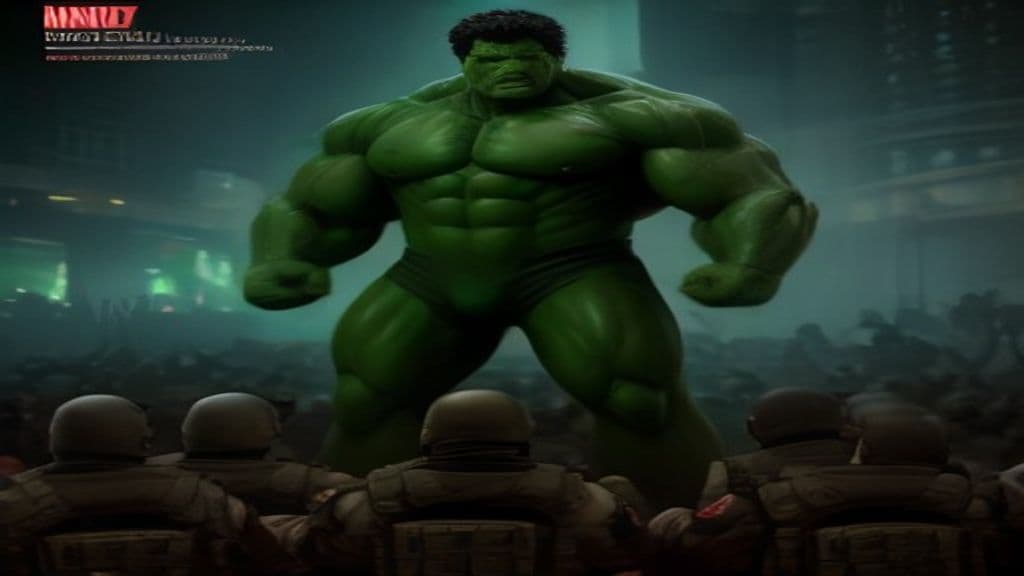
The name 'Hulkbusters' refers not to a single mythical origin but to three organizational origins within Marvel's shared fictional setting. The earliest usage denotes a U.S. Army/Air Force task force created and headquartered in New Mexico and led in-story by figures such as Thunderbolt Ross, John Ryker, and Major Glenn Talbot to capture or destroy the Hulk. A later origin is Bruce Banner's own Hulkbusters team, assembled at a government-reconstructed Gamma Base after Doc Samson managed to separate Banner and the Hulk; Banner leads this iteration in tracking down versions of the Hulk. A third origin is a S.H.I.E.L.D. formation, created within that agency to capture villains and, in at least one storyline, to deploy technological means (for example, implants described as nanotechnology in the cited sources) to nullify powers.
As organizations, the Hulkbusters have no single physical appearance; descriptions depend on the iteration and medium. The original military Hulkbusters are described as a task force composed of U.S. Army and Air Force personnel based in New Mexico, implying standard military uniforms and equipment used in field operations. Banner's Hulkbusters are specialists operating from Gamma Base and include named members who later became powered figures; in those stories members acquire or employ technological or biological alterations (for example, Redeemer later using an exoskeletal suit and Rock developing an external mineral hide). The S.H.I.E.L.D. Hulkbusters are an agency team led in one cited roster by Clay Quartermain and including Agent Cheesecake, Agent Crimson, and She‑Hulk; in some media tie-ins (video games, toys, LEGO commentary) armed or armored versions inspired by the Hulkbusters concept are depicted.
The Hulkbusters' capabilities are organizational and technological rather than supernatural. The military Hulkbusters mount coordinated operations to 'capture or destroy the Hulk' under military leadership and doctrine. Banner's Hulkbusters operate from Gamma Base to track, contain, study, and—when narrative circumstances permit—attempt to cure or separate Banner from the Hulk; individual members in those stories may be equipped with or transformed by technology or gamma-related effects (e.g., Redeemer's weaponized exosuit, Rock's mineral hide). The S.H.I.E.L.D. Hulkbusters have been described in sources as capturing villains and, in at least one storyline, implanting them with technology described as nanotechnology to nullify their powers. Across iterations their behavior is enforcement-oriented: confronting, neutralizing, detaining, or attempting to medically/technologically resolve superhuman threats.
Weaknesses
- conditionlegal/political reconciliation (narrative) — disbandment after Banner's pardon
- otherorganizational limits — human/technological forces susceptible to escalation and transformation (members becoming powered figures, as attested in sources)
Wards
- othernone (fictional organizations; sources do not document ritual wards)
Huitztlampaehecatl
Huitztlampaehecatl is the Nahuatl name for the Aztec personification and deity of the South wind, one member of a quartet of cardinal wind gods in Aztec cosmology.
Huiñao
The Huiñao is a geographical location with cultural significance in Inca tradition, possibly having some supernatural connotations. (Note: 1. Power tier should be Primordial (since it's a geographical location with cultural significance, implying a more significant impact). 2. Add Appearance, Abilities, Sensory cues, Weaknesses, and Ward)
Hulder (Huldra)
The hulder (Norwegian huldra) is a class of Scandinavian 'hidden folk' — a forest-associated local spirit traditionally conceived as a race or kind rather than a single individual. They are counted among the rå (wardens/keepers) of particular natural places and are widely attested in Scandinavian toponyms and folk belief.
Huldra
A seductive forest spirit of Scandinavian folklore — beautiful from the front but with a cow's tail or hollow back — who lures men into the wilderness, sometimes to their ruin.
Huldufólk (Hidden People)
Huldufólk is a broad, loosely defined category of place‑bound hidden people in Nordic and Insular Scots traditions—beings who live in a parallel, concealed layer of the landscape and who look and behave much like humans. They are tied to mounds, rocks, mountains, forests, and waters, and traditions emphasize respect, avoidance, and occasional interaction or retaliation when their habitat is disturbed.
Huli jing (Fox spirit)
Huli jing (狐狸精), commonly rendered in English as "fox spirit," are shapeshifting supernatural beings from Chinese folklore and mythology. Classified among the broader class of yāoguài, they are morally ambivalent figures that may be benevolent, malevolent, or trickster-like depending on the tale and context.
Huma Bird
In Persian tradition, the Huma bird is a mythical creature that inhabits the air, never touching down on the ground. (Note: - Power tier: Primordial (or not specified at all), as it has cosmic abilities - Appearance: Invisible entity (already correct) - Abilities: Add "existing solely as a concept rather than a tangible be)
Humbaba
The divine guardian of the Cedar Forest appointed by Enlil, a terrifying giant whose roar was the flood, whose breath was fire, and whose gaze was death — slain by Gilgamesh and Enkidu.
Humban
Ancient Elamite god associated with divine protection and revered as a protector deity. (Note: 1. Power tier: Humban's association with "divine protection" and his importance as a deity suggest he should be placed at Ancient power tier is correct. 2. Weaknesses: absence of specific weaknesses m)
Huminodun
Huminodun is a sacred ancestral maiden in the Nunuk Ragang cycle of Kadazan‑Dusun tradition whose voluntary sacrifice ends a famine and, according to the legend, gives rise to cultivated staple crops (especially rice) and the ritual institutions of Momolianism including the bobohizan priesthood. Her story is commemorated in the Kaamatan harvest festival and the Unduk Ngadau pageant.
Hun Hunahpu
Hun Hunahpu is a mythic ancestral figure in the Kʼicheʼ Maya Popol Vuh narrative: one of two brothers (with Vucub‑Hunahpu) who were lured into Xibalba, sacrificed, and whose severed head was suspended in a trophy tree and changed to a calabash. The calabash-head's juice impregnates Xquic, producing the Hero Twins (Hunahpu and Xbalanque); later the Twins recover their fathers' remains but cannot fully resuscitate them. Some scholars compare Hun Hunahpu with the Classic-period Tonsured Maize God, though this identification is debated in the sources provided.
Hun and Po
Hun (魂) and po (魄) are complementary soul-aspects in classical Chinese thought: hun is the more ethereal, yang-associated component that departs the body after death, while po is the more corporeal, yin-associated component tied to physiological and lunar-linked functions and which remains with the corpse.
Community Record
- [1]Hulkbusters (Wikipedia). Hulkbusters — Wikipediawiki
- [2]Hulkbusters (Wikidata). Wikidata Q5574746 — Hulkbusterswiki
- [3]Hulkbusters (Bruce Banner's team) — Marvunapp Appendix. Marvunapp Appendix: Hulkbusters (Bruce Banner's team)other
- [4]Redeemer (Craig Saunders Jr.) — Marvunapp. Marvunapp: Redeemer (Craig Saunders Jr.)other
- [5]Clay Quartermain — Wikipedia. Clay Quartermain — Wikipediawiki
- [6]Marvel Cinematic Universe Wiki — Hulkbusters. MCU Wiki: Hulkbustersother
- [7]Evolution of the LEGO Marvel Hulkbuster – Blocks magazine. Blocks magazine: Evolution of the LEGO Marvel Hulkbusterother