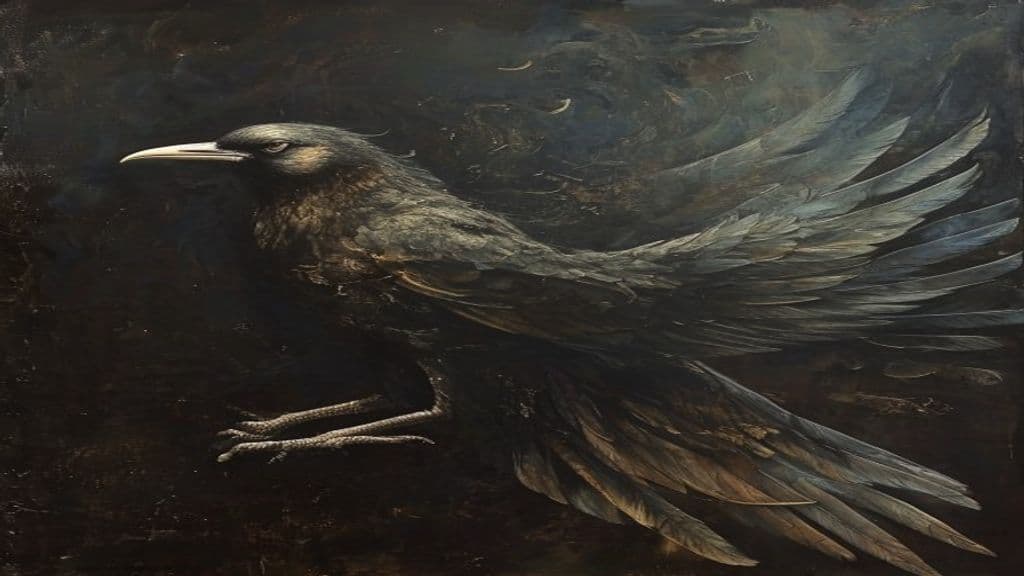
The Huma bird's origin is not specified in the source material.
Physical description of the Huma bird is not provided in the source material. It remains an invisible entity, existing solely as a concept rather than a tangible being.
The primary characteristic of the Huma bird is its ability to exist and thrive in the air without ever touching down on the ground.
Azadeh
Azadeh (Persian: آزاده) is a Persian female given name meaning broadly 'free' or 'free-minded'; some sources also gloss it as 'someone noble'. The name appears in modern Iranian usage (borne by several contemporary public figures) and as the name of a character in Ferdowsi's Shahnameh. It is a personal name rather than a supernatural being in the provided sources.
Darab-nama (Persian tradition)
Historical romance novel from 12th-century Persia, with possible references to supernatural entities in Persian folklore. (Note: - Power tier: Primordial (due to its historical significance and cultural impact) - Summary: Needs more specific information on supernatural entity references - Appearance: No information provided in )
Farhad (Persian literature)
In Persian literature and mythology, Farhad is a character associated with the love story of Khosrow and Shirin. (Note: 1. Power tier should be revised to "Minor Spirit" since Farhad's abilities are more related to his devotion and determination, rather than cosmic or deity-level powers. 2. Remove description of "Appea)
Rohham
Loyal paladin and hero in the Persian epic Shahnameh, embodying values of loyalty and military prowess. (Note: * Power tier should be Primordial or Ancient, as Rohham is described as a hero in an epic that deals with "ancient Iranian history and mythology", implying a high level of power. Greater seems too low)
Tahmina
In Persian epic tradition, Tahmina is a human character in the Shahnameh, a 10th-century epic poem. She is Rostam's wife and Samanganshah's daughter, appearing in the story 'Rostam and Sohrab'. Tahmina serves as a figure illustrating themes relevant to 10th-century Persian society. (Note: 1. Power tier should be "Lesser" since Tahmina is a human character with no supernatural powers. 2. Origin story section is missing. 3. Appearance section needs to state that there is no physical desc)
Vis and Rāmin
Vis and Rāmin are the protagonists of a classical Persian romantic tale composed by Fakhruddin As'ad Gurgani in the 11th century. The narrative reflects the traditions and customs of ancient Persia. (Note: 1. Power tier should be "Minor Spirit" given that no supernatural abilities or behaviors are described. 2. Origin story is incorrect; source material states Parthian origin and not likely to have Part)
Zafarnamah (Mustawfi)
Persian epic poem written by Hamdallah Mustawfi, exploring Iranian history and culture. (Note: 1. Power tier should be Ancient (deity-level) does not fit; Primordial is typically reserved for entities related to the creation of the world or fundamental forces. 2. Appearance section is missing 3)
Huldufólk (Hidden People)
Huldufólk is a broad, loosely defined category of place‑bound hidden people in Nordic and Insular Scots traditions—beings who live in a parallel, concealed layer of the landscape and who look and behave much like humans. They are tied to mounds, rocks, mountains, forests, and waters, and traditions emphasize respect, avoidance, and occasional interaction or retaliation when their habitat is disturbed.
Huli jing (Fox spirit)
Huli jing (狐狸精), commonly rendered in English as "fox spirit," are shapeshifting supernatural beings from Chinese folklore and mythology. Classified among the broader class of yāoguài, they are morally ambivalent figures that may be benevolent, malevolent, or trickster-like depending on the tale and context.
Hulkbusters
Hulkbusters is the name applied to three distinct organized human groups in Marvel Comics whose purpose is to confront, capture, or neutralize the Hulk. The label is used for a U.S. military task force, a Bruce Banner–led scientific/operational team based at Gamma Base, and a S.H.I.E.L.D. unit; each iteration functions as an instrument of state or agency policy within the fictional Marvel Universe.
Humbaba
The divine guardian of the Cedar Forest appointed by Enlil, a terrifying giant whose roar was the flood, whose breath was fire, and whose gaze was death — slain by Gilgamesh and Enkidu.
Humban
Ancient Elamite god associated with divine protection and revered as a protector deity. (Note: 1. Power tier: Humban's association with "divine protection" and his importance as a deity suggest he should be placed at Ancient power tier is correct. 2. Weaknesses: absence of specific weaknesses m)
Community Record
- [1]Wikipediawiki