
In Nunuk Ragang origin narratives within Kadazan‑Dusun cosmology, famine follows social disorder. To relieve the hunger of the people Kinoingan (creator) or, in some variants, Suminundu sacrifices their daughter. The maiden (called Ponompuan in genealogical accounts and known widely as Huminodun) offers herself; according to the legend her body becomes the source of cultivated plants. After her sacrifice she re‑manifests in the paddy/jars (described in sources as a resurrection or emergence, including a named form Bambazon/Bambarayon), and her spirit founds ritual offices and practices that sustain the community. The episode provides the mythic origin of rice cultivation, the bobohizan priesthood, and the Kaamatan harvest festival and Unduk Ngadau commemoration.
Sources do not provide a detailed pre‑sacrifice physical portrait beyond identifying her as a maiden. In the post‑sacrifice account her spirit is described as reappearing among jars and paddy: seven maidens (including the central daughter) emerge from jars, with the principal figure associated with the largest jar. Contemporary commemorative practices (the Unduk Ngadau pageant) celebrate her attributes—bravery, grace, strength and beauty—but those evaluative traits are presented in the sources as commemorative honors rather than detailed supernatural physiognomy.
Legend attributes generative potency to Huminodun: her sacrificed body produces staple crops—explicitly given in the Nunuk Ragang account as statements that her flesh yields rice, her head the coconut, her bones tapioca, her toes ginger, her teeth maize and her knees yams. Her voice is reported in the narrative as issuing from the plants to Kinoingan in the episode that follows the sacrifice, and her spirit is said to re‑manifest from the paddy and jars. She is also credited with transmitting ritual knowledge: the spirit of Huminodun is said to have founded the bobohizan and taught incantation, rituals and customary laws (including the law of sogit), as well as ritual arts such as bamboo‑beating and the sumazau dance.
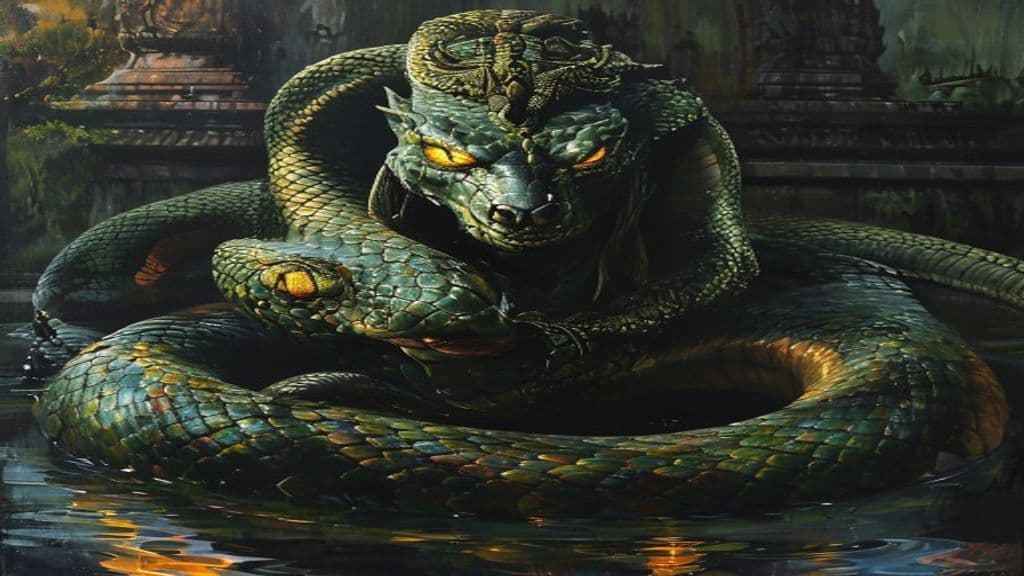
Naga
Divine serpent beings of Hindu, Buddhist, and Jain cosmology — powerful guardians of water, earth, and underground treasures. Revered as deities in South and Southeast Asia.
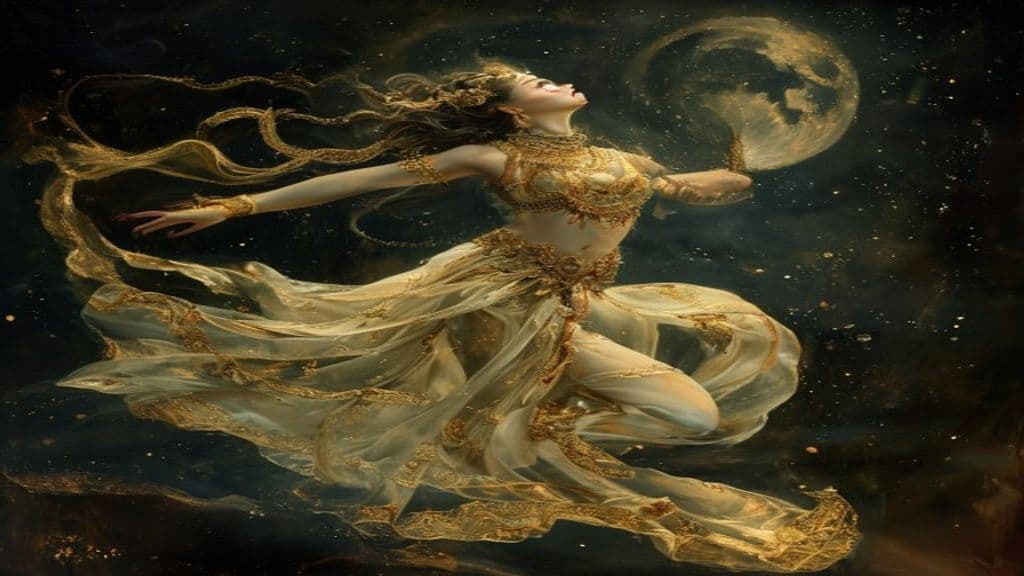
Apsara
Celestial dancers and water nymphs of Hindu cosmology — beautiful semi-divine beings who dance at the court of Indra and, by his command, descend to earth to distract sages from excessive asceticism.

Dewi Sri
Dewi Sri (also Shridevi, Nyai Pohaci Sanghyang Asri in Sundanese contexts) is the indigenous rice-and-fertility goddess of parts of the Indonesian archipelago (Java, Bali, Lombok and surrounding islands). She is a living cultic presence in village ritual life believed to preside over rice, household and communal prosperity, and the prevention of famine; in Hindu-influenced contexts she is often equated or syncretized with the Sanskritic goddess Sri/Lakshmi.
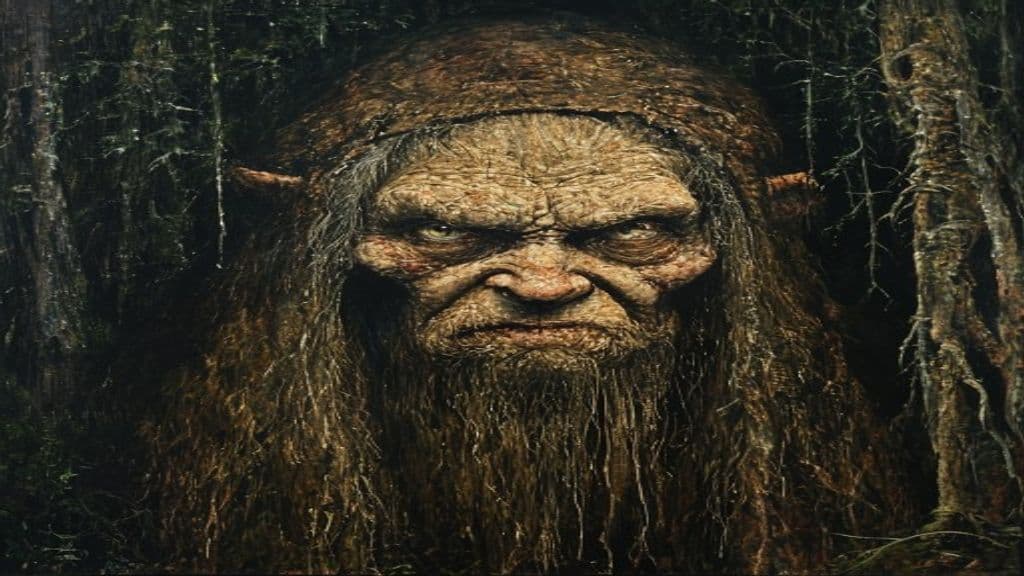
Baba Yaga
Baba Yaga is an ambivalent female figure of East Slavic folktale tradition, depicted variously as a fearsome, child-eating crone or as a helpful, maternal donor. She is associated with the deep forest, a hut described as standing on chicken legs, and the motific accoutrements of a mortar and pestle.
Huldufólk (Hidden People)
Huldufólk is a broad, loosely defined category of place‑bound hidden people in Nordic and Insular Scots traditions—beings who live in a parallel, concealed layer of the landscape and who look and behave much like humans. They are tied to mounds, rocks, mountains, forests, and waters, and traditions emphasize respect, avoidance, and occasional interaction or retaliation when their habitat is disturbed.
Huli jing (Fox spirit)
Huli jing (狐狸精), commonly rendered in English as "fox spirit," are shapeshifting supernatural beings from Chinese folklore and mythology. Classified among the broader class of yāoguài, they are morally ambivalent figures that may be benevolent, malevolent, or trickster-like depending on the tale and context.
Hulkbusters
Hulkbusters is the name applied to three distinct organized human groups in Marvel Comics whose purpose is to confront, capture, or neutralize the Hulk. The label is used for a U.S. military task force, a Bruce Banner–led scientific/operational team based at Gamma Base, and a S.H.I.E.L.D. unit; each iteration functions as an instrument of state or agency policy within the fictional Marvel Universe.
Huma Bird
In Persian tradition, the Huma bird is a mythical creature that inhabits the air, never touching down on the ground. (Note: - Power tier: Primordial (or not specified at all), as it has cosmic abilities - Appearance: Invisible entity (already correct) - Abilities: Add "existing solely as a concept rather than a tangible be)
Humbaba
The divine guardian of the Cedar Forest appointed by Enlil, a terrifying giant whose roar was the flood, whose breath was fire, and whose gaze was death — slain by Gilgamesh and Enkidu.
Humban
Ancient Elamite god associated with divine protection and revered as a protector deity. (Note: 1. Power tier: Humban's association with "divine protection" and his importance as a deity suggest he should be placed at Ancient power tier is correct. 2. Weaknesses: absence of specific weaknesses m)
Hun Hunahpu
Hun Hunahpu is a mythic ancestral figure in the Kʼicheʼ Maya Popol Vuh narrative: one of two brothers (with Vucub‑Hunahpu) who were lured into Xibalba, sacrificed, and whose severed head was suspended in a trophy tree and changed to a calabash. The calabash-head's juice impregnates Xquic, producing the Hero Twins (Hunahpu and Xbalanque); later the Twins recover their fathers' remains but cannot fully resuscitate them. Some scholars compare Hun Hunahpu with the Classic-period Tonsured Maize God, though this identification is debated in the sources provided.
Hun and Po
Hun (魂) and po (魄) are complementary soul-aspects in classical Chinese thought: hun is the more ethereal, yang-associated component that departs the body after death, while po is the more corporeal, yin-associated component tied to physiological and lunar-linked functions and which remains with the corpse.
Hundings
A legendary tribe or clan in Germanic tradition, known for their conflict with the Wulfings. (Note: * Power tier should be Ancient (deity-level) is too high; given the lack of supernatural powers and behaviors associated with the Hundings. * The article incorrectly states that no physical descriptio)
Hundred‑Eyed Demon Lord
A powerful non‑human spirit figure from the 16th‑century Chinese novel Journey to the West (Chapter 73). Presented in the story as a centipede spirit who disguises himself as a Daoist abbot, reveals a hundred glowing eyes beneath his ribs that emit a blinding golden light, and serves poisoned tea to the pilgrims before being subdued by the bodhisattva Pilanpo.
Hungry Spirit of Mahāmāyā
A proposed label for a 'hungry spirit' (preta) associated with the name Mahāmāyā mentioned in some modern queries; the supplied sources do not document any such named entity. The materials provided only place the general notion of postmortem experiential states within Tibetan bardo literature and do not describe a Mahāmāyā preta.
Hungry Tiger
The Hungry Tiger is a fictional anthropomorphic tiger character created by L. Frank Baum for his Oz books, first appearing in Ozma of Oz. Presented within the enchanted Land of Oz as a speaking, feeling animal-person, he served as comic relief in Baum's work and was later expanded into a protagonist by subsequent Oz authors and continuators.
Community Record
- [1]Huminodun. Wikipedia, entry 'Huminodun'.wiki
- [2]Huminodun – A Borneo Legend. Litopia: 'Huminodun – A Borneo Legend' (popular retelling and summary of the Nunuk Ragang account).folk
- [3]Kaamatan. Wikipedia, entry 'Kaamatan' (festival linked to Huminodun and Unduk Ngadau).wiki
- [4]Kaamatan, A Celebration of Culture. Sabah Tourism Board: description of Kaamatan and cultural commemorations tied to Huminodun.other
- [5]Tandak Mengalai The Exquisite Dances Sabah and Sarawak – Kakiseni. Kakiseni event page referencing ritual dances such as the sumazau associated with Kadazan‑Dusun culture and the ritual arts traced to Huminodun in sources.other