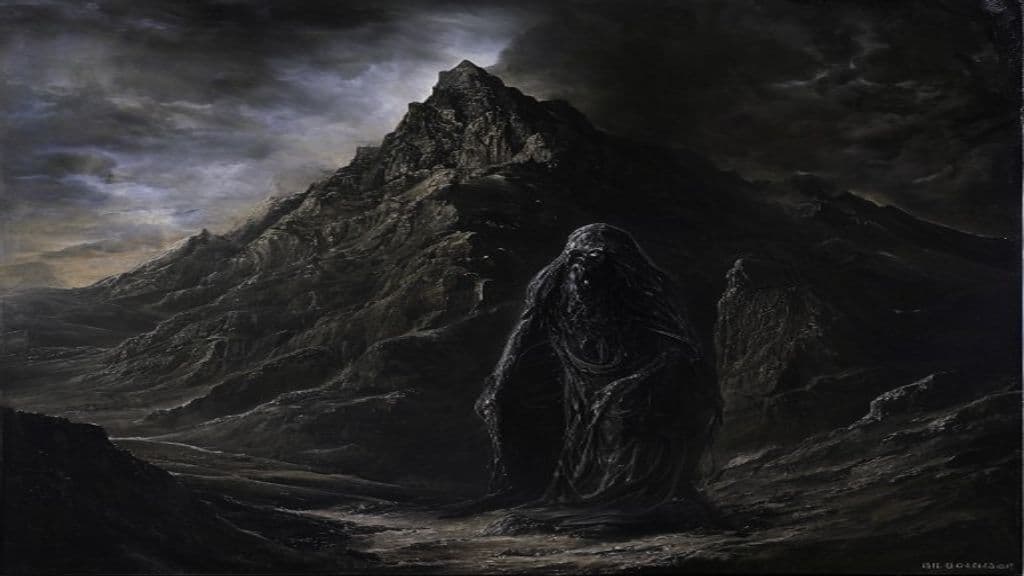
Not applicable, as Hursag is a natural landform.
Hursag does not have a describable appearance, as it refers to a mountain or hill.
There are no reported abilities associated with Hursag. However, its primordial status implies immense power or influence over the surrounding landscape.
Weaknesses
None recorded.
Wards
- conditionapproach with caution
Me (Mesopotamian Tradition)
A Mesopotamian ritual or practice that embodies the divine, representing a sacred and transcendent aspect of the deity itself. (Note: - Power tier: Primordial is plausible given the described abilities (incarnation of deity). - Appearance: needs to be filled in with source material. - Origin story: needs to be filled in with source )
Hungry Spirit of Mahāmāyā
A proposed label for a 'hungry spirit' (preta) associated with the name Mahāmāyā mentioned in some modern queries; the supplied sources do not document any such named entity. The materials provided only place the general notion of postmortem experiential states within Tibetan bardo literature and do not describe a Mahāmāyā preta.
Hungry Tiger
The Hungry Tiger is a fictional anthropomorphic tiger character created by L. Frank Baum for his Oz books, first appearing in Ozma of Oz. Presented within the enchanted Land of Oz as a speaking, feeling animal-person, he served as comic relief in Baum's work and was later expanded into a protagonist by subsequent Oz authors and continuators.
Hungry ghost (E gui)
Listed in a compiled catalogue of supernatural beings from Chinese folk culture and contemporary literature, 'hungry ghost (E gui)' appears as an itemized class of supernatural being in the provided sources. The supplied materials contain the name but do not give further descriptive or ritual detail.
Huodou
A legendary fire-associated beast from texts describing southern China, depicted as a large black dog that 'eats fire' and emits flames; in classical passages it is treated as an omen or sign of conflagration and is grouped with calamities.
Huoshu (火鼠)
The huoshu or huo shu (火鼠), literally "fire rat" or "fire mouse," is attested in modern reference works as a fantastical beast in Chinese tradition. Available cited references (Wikipedia and Wikidata) provide only this lexical identification and classification; no further descriptive, narrative, or ritual material is supplied in those sources.
Huracán (Hunraqan / U Kʼux Kaj)
Huracán (Mayan: Hunraqan), often rendered in Kʼicheʼ as U Kʼux Kaj ('Heart of Sky'), is a Kʼicheʼ Maya creator deity associated with wind, storm, fire, and lightning. He takes part in the cosmogonic attempts to create humanity and is the agent of the Great Flood who calls land up from the waters.
Hutena and Hutellura
Hurrian divine female figures associated with fate and with birth/midwifery. Frequently attested as part of the court of the goddess Ḫepat (Hebat), they appear in ritual offering lists and in mythic narratives as attendants who determine destiny and assist at births.
Huītzilōpōchtli
Huītzilōpōchtli is the principal Aztec (Nahua) solar and war deity, patron of the Mexica and Tenochtitlan. In Aztec cosmology he is a cosmic warrior whose continued vigor is sustained by ritual nourishment—notably human blood and hearts—administered in formal festivals and sacrifices.
Hušbišag
Hušbišag (Hushbishag) is a Mesopotamian netherworld goddess attested as a member of the underworld household; she is named as the wife of Namtar and mother of Hemdikug and is described in one literary passage as a 'handmaid of the dark gods' who may welcome the dead.
Hwanung
Divine being in Korean tradition, son of Hwanin, Lord of Heaven. Associated with human development and progress. (Note: - Power tier: Primordial may be too high given the description of abilities (institution of laws, teaching arts and medicine) which more closely align with a Greater (deity-level, but not cosmic) or A)
Hwin
Hwin is a fictional talking mare from C. S. Lewis's The Chronicles of Narnia, prominently featured in The Horse and His Boy (1954). She is a Narnian free-talking beast characterized by humility, clear thinking, and gentle temperament, who was captured in Calormen as a foal and later escapes back to Narnia.
Community Record
- [1]Wikipediawiki