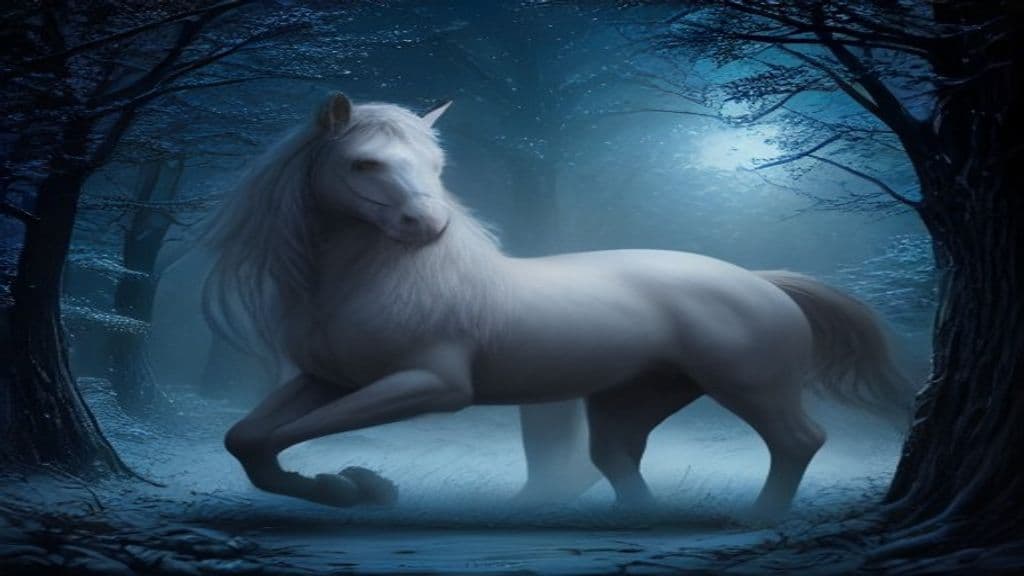
Within C. S. Lewis's fictional cosmology of Narnia, Hwin was born as a free talking beast in Narnia. As a foal she was captured by Calormenes and taken to Calormen, where she lived as a domesticated mare while concealing her ability to speak until the events of The Horse and His Boy, during which she escapes and returns to Narnia.
Described in the sources simply as a mare (female horse). The provided materials do not give further detailed physical description beyond her being a Narnian talking mare who had been kept in Calormen.
Hwin is a member of Narnia's 'free talking beasts' and thus possesses human-comparable speech and reasoning. She is noted for clear thinking, logical planning, humility, gentleness, and occasional nervousness or shyness. She participates in travel, devises plans (for example, for moving through Tashbaan), and asserts personal agency within social hierarchies.
Jill Pole
Jill Pole is a fictional English schoolgirl created by C. S. Lewis who appears as a protagonist in The Silver Chair and The Last Battle of The Chronicles of Narnia. In the narrative she is called by Aslan into Aslan's Country and sent to Narnia to undertake a quest and later to take part in the final events of Narnia.
Maugrim
Maugrim is a fictional Talking Animal — a large, sentient Narnian wolf — who serves as the Captain of the White Witch's Secret Police in C. S. Lewis's The Lion, the Witch and the Wardrobe. He functions as an armed enforcer of the Witch's tyranny, is described as very large and fearsome, and is ultimately killed in single combat by Peter Pevensie.
Mr. Beaver
Mr. Beaver is a fictional anthropomorphic beaver character who appears in the secondary world of C. S. Lewis's The Chronicles of Narnia. The provided sources identify him only as a character entry in lists/databases of Narnia characters.
Polly Plummer
Polly Plummer is a fictional human character created by C. S. Lewis who appears as a child in The Magician's Nephew (set 1900) and later as an adult in The Last Battle. She is a practical, emotionally steady companion to Digory Kirke, participates in inter-world travel via Uncle Andrew's rings and the Wood between the Worlds, and after her death in The Last Battle is transported to Aslan's country.
Hutena and Hutellura
Hurrian divine female figures associated with fate and with birth/midwifery. Frequently attested as part of the court of the goddess Ḫepat (Hebat), they appear in ritual offering lists and in mythic narratives as attendants who determine destiny and assist at births.
Huītzilōpōchtli
Huītzilōpōchtli is the principal Aztec (Nahua) solar and war deity, patron of the Mexica and Tenochtitlan. In Aztec cosmology he is a cosmic warrior whose continued vigor is sustained by ritual nourishment—notably human blood and hearts—administered in formal festivals and sacrifices.
Hušbišag
Hušbišag (Hushbishag) is a Mesopotamian netherworld goddess attested as a member of the underworld household; she is named as the wife of Namtar and mother of Hemdikug and is described in one literary passage as a 'handmaid of the dark gods' who may welcome the dead.
Hwanung
Divine being in Korean tradition, son of Hwanin, Lord of Heaven. Associated with human development and progress. (Note: - Power tier: Primordial may be too high given the description of abilities (institution of laws, teaching arts and medicine) which more closely align with a Greater (deity-level, but not cosmic) or A)
Hyades
A sisterhood of mythic figures in ancient Greek tradition identified with an open star cluster in the constellation Taurus; popularly called 'the rainy ones' because their seasonal risings and settings were associated with rain and the rainy season. They appear in myth as nurses/escorts (notably caring for the infant Dionysus) and in astronomy as the Hyades star cluster.
Hyakki Yagyō
An idiom and folkloric motif in Japanese tradition describing a mass nocturnal procession of supernatural creatures (yōkai and related beings) that march through human streets at night. Depictions and stories vary: sometimes an orderly parade, sometimes a chaotic riot, and encounters are commonly described as dangerous to humans.
Hyang
Hyang is an indigenous spiritual concept from Java and Bali denoting a venerated unseen presence that ranges from deified ancestors and place-spirits to formulations of a supreme divine principle. Hyang inhabit a realm called Kahyangan and are engaged through ritual practices such as sembahyang and Sanghyang trance dances.
Hydaspes
Hydaspes is the Hellenic personification of the river now known as the Jhelum (Vitasta) in north‑western India; in Greek epic and late antique poetry he appears as a river-god (Potamos) and local naiads who participate in the narrative of Dionysus’ Indian campaign.
Community Record
- [1]Hwin - Wikipedia. Wikipedia contributors, 'Hwin,' Wikipedia, The Free Encyclopedia.wiki
- [2]Hwin - Wikidata. Wikidata item Q2843299, 'Hwin'.other