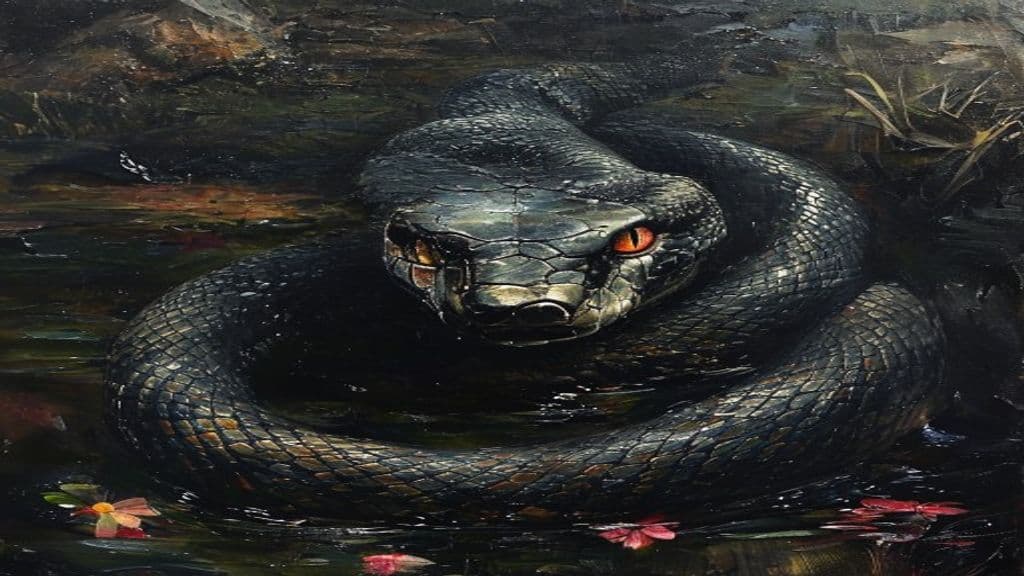
According to Lozi mythology, an Ilomba is created by a witch doctor using their finger nails and blood from various parts of their body as part of dark magic.
When viewed by others, the Ilomba appears as a normal snake. However, its appearance changes when seen by its owner.
The Ilomba can be fed and controlled by its owner, who commands it to kill. If not fed, it turns on its master and attempts to consume them. Its destruction requires the intervention of its creator (the witch doctor).
Weaknesses
- conditionlack of food supply
Wards
- ritualintervention by witch doctor
- otherhaunting by consumed souls (deterrent/consequence)
Ileana Cosânzeana
Ileana Cosânzeana is a central feminine figure in Romanian folklore, presented variously as an idealized beautiful princess and as a powerful fairy. She commonly appears as the heroic object of quests (kidnapped by a Zmeu and rescued by Făt‑Frumos) and is associated with healing, floral/vegetal motifs, and astral/seasonal imagery in variant traditions.
Ili-mīšar
Ili-mīšar (Mīšaru, Misharu) is a Mesopotamian deity who functions as the personification of justice and is sometimes portrayed as a divine judge. He is attested from the Ur III period onward and was worshiped in multiple Mesopotamian cities with at least one attested local tutelary role.
Ilib
Ilib (Ugaritic ‘l’b) is an ambivalent ancient Ugaritic term attested as both a primordial ancestral theogonic figure placed before El in ritual lists and as a generic designation for household ancestor-spirits honored by families. Evidence for Ilib is primarily ritual and onomastic: the name occurs early in offering lists, in temple sacrificial contexts, and in literary instruction about filial memorials.
Ilmarinen
Ilmarinen is a Finnic divine artificer and sky-associated being from Finnish and broader Finno-Ugric tradition, known as the archetypal smith who forges cosmological works such as the dome of the sky and the Sampo. He appears throughout oral rune-song material and in the Kalevala corpus and is invoked in several incantation runes.
Ilmatar (Luonnotar)
Ilmatar, also called Luonnotar, is a female spirit of the air and a nature-spirit figure in the Finno-Karelian epic tradition as compiled in the Kalevala. In Elias Lönnrot's Kalevala she is presented as the virgin mother who is impregnated by sea and wind and becomes the mother of the culture-hero Väinämöinen, though regional runic variants sometimes name other maternal figures for Väinämöinen.
Ilmr
Ilmr is attested as a goddess (ásynja) name in the Old Norse poetic corpus: she appears in the Nafnaþulur list of ásynjur appended to Snorri Sturluson's Prose Edda and as an element in several skaldic kennings from the 10th–11th centuries. Her original nature and functions are not preserved; scholars have proposed competing etymologies (scent, noise/battle, or elm/tree) to account for her poetic usage.
Ilus
Ilus (Ancient Greek: Ἶλος) is a personal name borne by several legendary mortal figures in Greek and Roman epic tradition, most notably founders and genealogical ancestors associated with Dardania and Troy, plus other mortals appearing in Homeric and Virgilian narratives. The figures function as eponymous founders or named human actors within mythic genealogies rather than as supernatural beings.
Imbrasus
Imbrasus is a Greek theonym applied to at least two distinct mythic personages: a river-god associated with a river on the island of Samos and a Thracian pater/genealogical figure named as father of Asius and the Trojan leader Peirous.
Imbreus
No folkloric or supernatural entity named Imbreus is attested in the supplied sources. The string 'imbreus' appears only as a Latinized species epithet in entomological/taxonomic records (notably Pediobius imbreus).
Imbrus
Imbrus (Ancient Greek: Ἴμβρος) is an Egyptian prince in Greek mythology, one of the sons of King Aegyptus. He married the Danaid Euippe and was slain on his wedding night along with most of his brothers on the orders of Danaus; Lynceus is named as the sole surviving brother in the cited accounts.
Imbulu (Mbulu)
Imbulu (also spelled Mbulu) appears in Bantu-language material as a 'fabulous creature' that, in the surviving excerpt, overtakes a girl traveling between settlements. The available sources are fragmentary and provide only a brief narrative mention without detailed attributes, rituals, or cosmological placement.
Imhotep
Imhotep was a historical Old Kingdom Egyptian official (chancellor to Pharaoh Djoser) whose memory was gradually glorified and by the Late Period and Ptolemaic era had been assimilated into Egyptian cult as a deified patron of medicine, wisdom, architecture, and scribal arts. He functioned as a non-royal cult deity centered at Memphis and was syncretized with gods such as Thoth and equated by Greeks with Asclepius.
Community Record
- [1]Lozi mythology. Research notesfolk