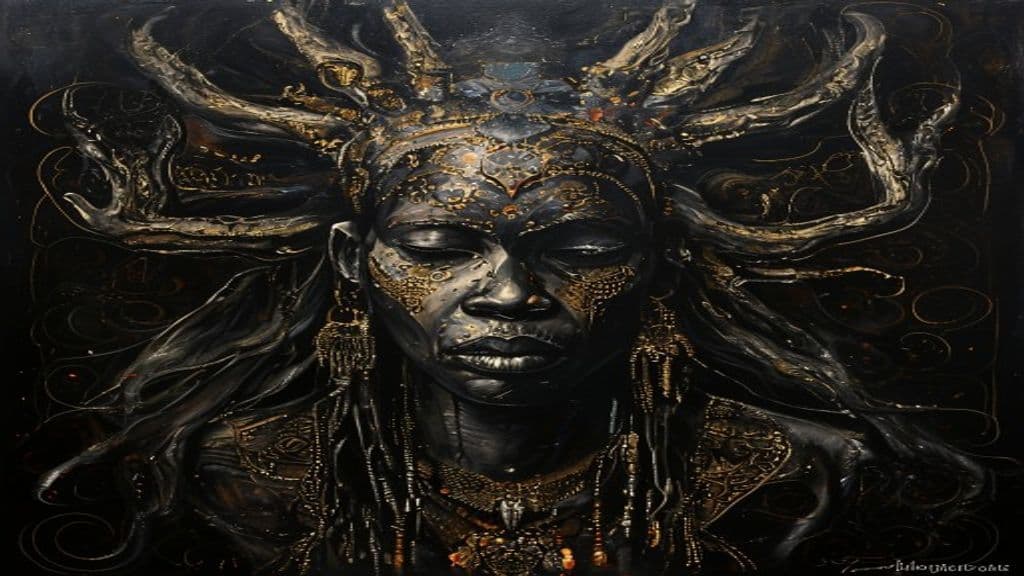
As the primordial spirit of all creation, Iya Nla has significant influence over existence and human relationships.
Abiku
In Yoruba tradition, the Abiku is a Primordial entity representing the spirits of children who die young. (Note: - Power tier: Primordial seems plausible but should be supported by additional source material confirming its cosmic or deity-level abilities. - Appearance: While the draft mentions spirits often appe)
Ifa-Orisha
In the Yoruba tradition, Orishas are supernatural beings with divine powers and attributes, worshiped as intermediaries between humans and Olodumare. (Note: - Power tier: Should be Ancient (deity-level) instead of Primordial - Abilities: The statement "each Orisha has distinct attributes" is unclear and could be rephrased to better reflect the source mate)
Iroko
In Yoruba tradition, Iroko is associated with the sacred hardwood tree of the same name. (Note: 1. Remove Power tier: Minor Spirit as it's not supported by source material. 2. Add origin story: The Iroko is associated with the sacred hardwood tree of the same name in Yoruba tradition. 3. Under A)
Obi Divination
A system of divination used in the Yoruba tradition and its derivatives, involving palm nuts or coconut pieces to communicate with ancestors and deities. (Note: 1. Remove "Greater" power tier as Obi divination is a system of divination, not an entity with supernatural abilities. 2. Add sensory cues related to the use of palm or kola nuts/coconut pieces (e.g.,)
Ofinran
16th-century king of the Oyo Empire, known for his leadership and interactions with other communities in pre-colonial West Africa. (Note: 1. Power tier is likely Greater (regional power) based on the description, but it's worth noting that the sources don't explicitly mention any supernatural or magical abilities. 2. Add specific sensor)
Iwin (Yoruba forest spirits/ogres)
No evidence for a Yoruba supernatural entity named 'Iwin' was found in the supplied sources. The available materials that contain the string 'Iwin' refer to unrelated modern place names and commercial game sites, not to Yoruba cosmology or spirits.
Ixchel
Ixchel is a major Maya goddess attested in Post‑Classic and colonial accounts and identified by scholars with the Classic codical figure ‘Goddess O’ (often rendered Chak Chel). She functions primarily as an aged female divine patron of childbirth, midwifery, and medicine, and is also associated in codices with rain/water imagery and occasionally fearsome jaguar/warrior aspects.
Ixtab
Ixtab (Ix Tab) is an indigenous Yucatec Maya female supernatural figure reported in colonial sources as the being who receives or escorts those who died by hanging to a special heaven. The figure's identification as a pre‑Spanish 'goddess of suicide' is contested in modern scholarship and popular accounts.
Iya
A malevolent storm-monster from Lakota mythology, consuming villages and living beings. (Note: 1. Power tier: Downgrade to Ancient (deity-level) - Iya's abilities are not primordial or cosmic in scale. 2. Origin story: Remove "born from the same cosmic energies as his brother Iktomi" - there is)
Izhma (forest spirit)
Izhma is a putative name sometimes discussed in secondary sources in relation to the Izhma River and the Izhma Komi people, but the provided materials contain no primary folkloric attestations describing an entity named Izhma as a forest spirit. References to spirits and landscape beings exist in the regional cultural context, but an Izhma spirit is not documented in the supplied sources.
Iðunn
Iðunn is an Old Norse goddess of the Aesir who keeps ash-wood box(es) of apples that restore the gods' youth. She is attested as wife of the skald-god Bragi and central to a myth in which her abduction by the jötunn Þjazi causes the gods to age until she is returned.
Ištaran
Ištaran is the tutelary deity and divine judge of the Mesopotamian city of Der. He is attested from the Early Dynastic period through the Middle Babylonian period, associated with serpents (especially the snake god Nirah), and was politically important in legitimizing local rulers; his cult statue was at times seized by Assyrians to secure the city's loyalty.
Community Record
- [1]Wikipedia: Iya Nla. Lawal (1996), Washington (2005)wiki