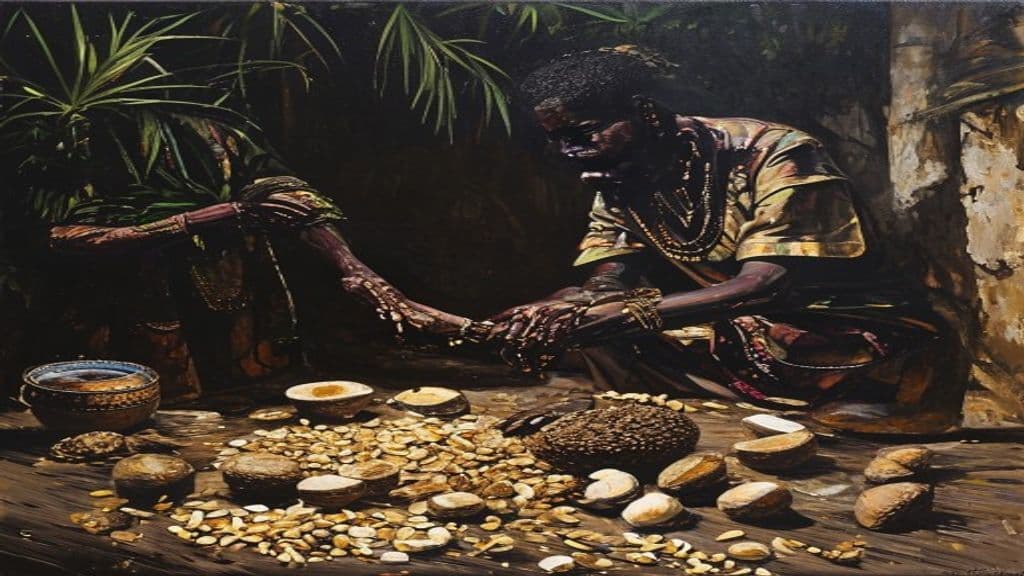
Obi divination has its roots in the Yoruba culture, where it was used to communicate with ancestors and deities. The original name 'Obi' refers to palm nuts or kola nuts, while 'Iroko' and 'Ekewe' refer to specific types of palm trees.
In Yorubaland, Obi divination is associated with palm nuts, while in Latin America/Caribbean, it involves coconut pieces. There is no physical description of Obi divination as a supernatural entity.
Obi divination serves as a tool for humans to communicate with the spiritual realm and receive guidance from ancestors and deities. It provides insight into the future, helping practitioners navigate life's challenges with wisdom and clarity.
Abiku
In Yoruba tradition, the Abiku is a Primordial entity representing the spirits of children who die young. (Note: - Power tier: Primordial seems plausible but should be supported by additional source material confirming its cosmic or deity-level abilities. - Appearance: While the draft mentions spirits often appe)
Ifa-Orisha
In the Yoruba tradition, Orishas are supernatural beings with divine powers and attributes, worshiped as intermediaries between humans and Olodumare. (Note: - Power tier: Should be Ancient (deity-level) instead of Primordial - Abilities: The statement "each Orisha has distinct attributes" is unclear and could be rephrased to better reflect the source mate)
Iroko
In Yoruba tradition, Iroko is associated with the sacred hardwood tree of the same name. (Note: 1. Remove Power tier: Minor Spirit as it's not supported by source material. 2. Add origin story: The Iroko is associated with the sacred hardwood tree of the same name in Yoruba tradition. 3. Under A)
Iya Nla
The primordial spirit of all creation in Yoruba cosmology, considered the source of all existence. (Note: - Power tier: Primordial -> This seems accurate given that Iya Nla is considered the source of all existence. - Appearance: Not mentioned in the source material, so remove or clarify. - Origin story: )
Ofinran
16th-century king of the Oyo Empire, known for his leadership and interactions with other communities in pre-colonial West Africa. (Note: 1. Power tier is likely Greater (regional power) based on the description, but it's worth noting that the sources don't explicitly mention any supernatural or magical abilities. 2. Add specific sensor)
Obambo
A supernatural being in Central African tradition with dual capacities for evil and good, capable of causing harm or sickness but also bringing positive change. (Note: 1. Power tier should be Primordial since it has dual capacities for evil and good, implying a much more powerful entity. 2. Sensory cues are missing from the draft. 3. The source material does not exp)
Obariyon
Obariyon is attested in modern reference works as a yōkai associated with local folklore of Niigata Prefecture, Japan. The supplied sources provide no traditional descriptions, origin myths, abilities, rituals, iconography, or warding practices for Obariyon. The name has also been used as a contemporary professional wrestling persona in event listings, which do not supply folkloric information.
Obatala
Obatala is a high-ranking primordial orisha in the Yoruba religious framework, widely described as the sculptor of humankind who molds human bodies and is regarded as father of humanity and owner of all heads. He is associated with wisdom, coolness of thought, and senior or royal status among the orisha; some traditions connect him to the founding of Ife.
Obayifo
A supernatural entity from Ashanti folklore that inhabits the bodies of humans, emitting a phosphorescent light and exhibiting vampiric/witch-like qualities. (Note: - Power tier: Lesser (inhabiting human bodies, not cosmic/Primordial) - Abilities: Remove "exhibiting supernatural powers" as it's not mentioned in the source material - Weaknesses: Add information ab)
Obia (West African Folklore)
A monstrous entity sent by witches to commit heinous crimes against humanity, described as a massive animal. (Note: - Power tier: Primordial (given its cosmic-level impact on human society) - Origin story: Needs to be added from source material - Sensory cues: Unknown is not sufficient; needs to be revised or more )
Oboroguruma
Oboroguruma (朧車, "hazy cart") is a yōkai in Japanese folklore described as a ghostly ox cart with a face. Legend reports that on misty, moonlit nights in Kyoto one can hear squeaking like an ox cart and, if they step outside, find the Oboroguruma parked outside their home.
Oceanids
In Greek myth the Oceanids (Ancient Greek: Ὠκεανίδες, Ōkeanídes) are a vast class of nymphs, described as daughters of the Titans Oceanus and Tethys. They are dispersed spirits associated with watery places and related functions—often linked with springs, companionship of goddesses, and care of youths—and include a few individually significant figures within their large poetic roster.
Community Record
- [1]