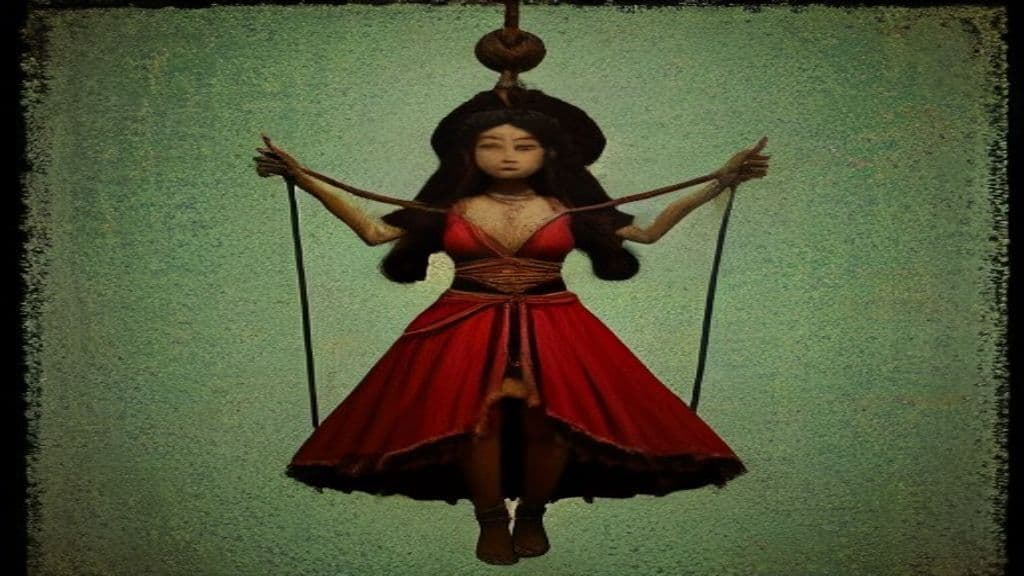
The principal origin for the figure of Ixtab in the provided materials is Diego de Landa’s 16th‑century Relación, which reports that Maya people in Yucatán believed those who hanged themselves went to a particular heaven escorted by 'la diosa de la horca... Ix Tab.' That colonial report is the central documentary basis; other documentary traces (comparative references to ah Tab/Tabay and an image in the Dresden Codex that some authors have linked to a suspended woman) are fragmentary and contested. Modern scholarship warns that the picture of a pre‑Spanish 'suicide goddess' rests on sparse evidence and may be an overinterpretation or later reading of Landa’s account and related imagery.
No detailed, uncontested traditional iconography of Ixtab is recorded in the provided sources. Landa’s text names her but gives no physical description. A suspended female figure with a rope around the neck appears in the Dresden Codex (DC53b) and has been proposed by some writers to represent Ixtab; the same sources emphasize that this identification is speculative and that the image occurs in an eclipse section where it may instead symbolize lunar/eclipse motifs or consequences for the Moon Goddess. Modern artistic portrayals are creative reinterpretations rather than documented traditional depictions.
In Diego de Landa’s report Ixtab’s primary function is psychopompic: she 'would bring' those who hanged themselves to their heaven, implying an intermediary role for a specific mode of death. Comparative discussion in the sources connects the name to ah Tab or ensnaring/hunting deities, proposing—hypothetically rather than as established fact—that the rope/noose functions symbolically as a snare consecrating a person to such a being. Later popular folklore figures with similar names (e.g., the Xtabay) are described as predatory seductresses who ensnare men, but that behavior is distinct from the benevolent escort role attributed to Ixtab in the colonial report. Scholarship cautions that any attribution of agency encouraging suicide or a 'cult of suicide' is likely sensationalized and not securely supported by the available evidence.

Chaac
Chaac is the Maya god of rain, thunder, and lightning, a central agricultural deity who produces storms by striking clouds with a lightning axe. He appears as both a singular figure and as multiple directional Chaacs, is associated with subterranean waters (cenotes and caves), and is the focus of communal rain-request rituals and specialist rainmaker practices.
Itzamná
Itzamná is a principal upper-world creator deity in Maya religious thought, associated with the sky, priestly arts (including writing), calendrical authority, agriculture (maize), and rulership. He appears across Classic iconography and Postclassic codices in multiple transformative aspects (aged tonsured maize form, a Principal Bird Deity, and within a two‑headed caiman earth image) and is invoked in specific ritual months in early‑colonial reports.
Itūr‑Mēr
Itūr‑Mēr is an Old Babylonian-era tutelary deity of the city of Mari (Tell Hariri), closely associated with the royal house of Zimri‑Lim. He functions in civic religion as a guardian of oaths, a protector of the city and dynasty, an agent in forensic revelation, and—in limited attestations—a healer.
Iunit
Iunit is a minor ancient Egyptian goddess whose name is translated as "She of Armant" and who is attested as the consort (wife) of the war-god Montu (also spelled Mentu). Surviving references are brief and localizing; no substantial myths, iconography, or cultic rites for Iunit are recorded in the supplied sources.
Iusaaset
Iusaaset is a primordial female deity from the Heliopolitan creation tradition of Ancient Egypt, presented as a feminine counterpart or aspect of the creator Atum and associated with the emergent, growth-related side of creation and abundance.
Iwin (Yoruba forest spirits/ogres)
No evidence for a Yoruba supernatural entity named 'Iwin' was found in the supplied sources. The available materials that contain the string 'Iwin' refer to unrelated modern place names and commercial game sites, not to Yoruba cosmology or spirits.
Ixchel
Ixchel is a major Maya goddess attested in Post‑Classic and colonial accounts and identified by scholars with the Classic codical figure ‘Goddess O’ (often rendered Chak Chel). She functions primarily as an aged female divine patron of childbirth, midwifery, and medicine, and is also associated in codices with rain/water imagery and occasionally fearsome jaguar/warrior aspects.
Iya
A malevolent storm-monster from Lakota mythology, consuming villages and living beings. (Note: 1. Power tier: Downgrade to Ancient (deity-level) - Iya's abilities are not primordial or cosmic in scale. 2. Origin story: Remove "born from the same cosmic energies as his brother Iktomi" - there is)
Iya Nla
The primordial spirit of all creation in Yoruba cosmology, considered the source of all existence. (Note: - Power tier: Primordial -> This seems accurate given that Iya Nla is considered the source of all existence. - Appearance: Not mentioned in the source material, so remove or clarify. - Origin story: )
Izhma (forest spirit)
Izhma is a putative name sometimes discussed in secondary sources in relation to the Izhma River and the Izhma Komi people, but the provided materials contain no primary folkloric attestations describing an entity named Izhma as a forest spirit. References to spirits and landscape beings exist in the regional cultural context, but an Izhma spirit is not documented in the supplied sources.
Iðunn
Iðunn is an Old Norse goddess of the Aesir who keeps ash-wood box(es) of apples that restore the gods' youth. She is attested as wife of the skald-god Bragi and central to a myth in which her abduction by the jötunn Þjazi causes the gods to age until she is returned.
Ištaran
Ištaran is the tutelary deity and divine judge of the Mesopotamian city of Der. He is attested from the Early Dynastic period through the Middle Babylonian period, associated with serpents (especially the snake god Nirah), and was politically important in legitimizing local rulers; his cult statue was at times seized by Assyrians to secure the city's loyalty.
Community Record
- [1]Relación de las cosas de Yucatán (Diego de Landa) — quoted. Diego de Landa, Relación de las cosas de Yucatán (as quoted on Wikipedia entry for Ixtab)academic
- [2]Ixtab (Wikipedia). Wikipedia: Ixtab (summary and bibliography)wiki
- [3]Dresden Codex image discussion (DC53b) — as discussed in secondary summaries. Discussion of DC53b image and its contested identification with Ixtab (per sources cited in the Wikipedia article)academic
- [4]Revisiting the 'Suicide Goddess' in Maya Archaeology (secondary literature cited in notes). Modern scholarly literature summarized in the provided notes (e.g., Reyes‑Foster & Kangas 2016 referenced in the research materials)academic
- [5]Contemporary folklore comparison: Xtabay (summary in provided notes). Summary of the distinction between Ixtab (as reported by Landa) and the later folkloric Xtabay (Wikipedia entry and provided notes)folk