
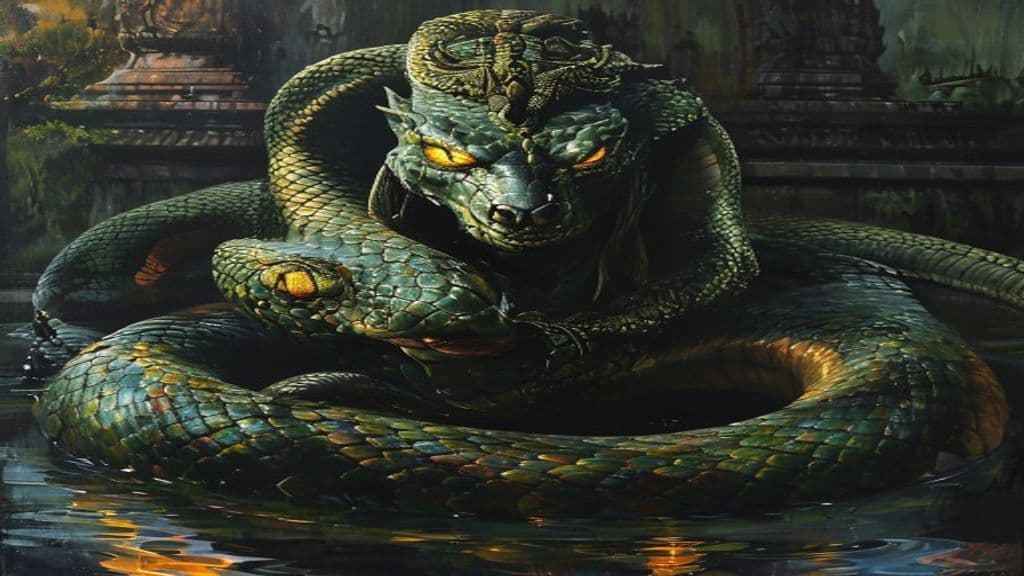
Japanese dragon concepts are syncretic formations combining indigenous Shinto serpent- and water-spirit beliefs with continental imports (Chinese long/dragon, Korean variants, and Indian/Buddhist nāga). Early classical texts such as the Nihongi record interactions with river-spirits (mizuchi) and imperial responses (e.g., offerings during Emperor Nintoku's reign), while later Buddhist transmission incorporated nāga and nāgarāja figures as protectors of Buddhism and as dragon kings (ryūō). Specific named figures—Ryūjin/Watatsumi (sea-ruler with an undersea palace), the Dragon Kings (four sea-kings), and the monstrous Yamata no Orochi—illustrate strands of indigenous and imported material woven into a broad category of serpentine, often aquatic supernatural beings (sources: Wikipedia summary and Nihongi reference as noted in the research material).
Most Japanese dragons conform to the East Asian long/dragon form: large, elongated, serpentine bodies commonly depicted without wings and possessing clawed feet, though artistic conventions and local variants differ (the wingless long-dragon is typical but not universally fixed). Variants include the eight-headed, eight-tailed Yamata no Orochi; composite figures such as the Nure-onna (woman's head with a serpentine body); Wani rendered as a large shark- or crocodile-like sea monster; and human-transforming figures like Ryūjin or Zennyo Ryūō who may appear in human guise or with a human-snake hybrid form. Depictions of claw number and other details vary between Japanese artistic practices and broader East Asian conventions.
Abilities vary by named example and tradition rather than applying uniformly to every dragon. Many function as water deities controlling rainfall, tides and bodies of water (Ryūjin/Ryūō; possession of magical tide-jewels is attributed to Ryūjin). Buddhist-influenced forms appear as nāga or nāgarāja serving as protectors of Buddhism. Individual narratives show shapechanging (Ryūjin and Zennyo Ryūō), transformative origin from humans (Kiyohime becoming a dragon through rage), dangerous and vengeful capacities (Yamata no Orochi's destructive threat; mizuchi provoking demands for sacrifice in Nihongi), and roles as messengers or animal companions in related myths (Raijū sometimes appears in dragon form).
Weaknesses
- otherdefeat by powerful deity or hero (mythic slaying)
- otherplacation through offerings or sacrifices (appeasement)
Wards
- ritualofferings/placation (imperial/locally attested)
- ritualBuddhist protective invocation (temple ritual framing of nāga as protectors)
Abumi-guchi
A Japanese yōkai classed as a tsukumogami: an animated stirrup (abumi) depicted in Sekien Toriyama's Gazu Hyakki Tsurezure Bukuro. Traditional accounts say it is formed from a stirrup that belonged to a soldier who fell in battle and that it waits where the stirrup lies for its dead owner to return.
Abura-sumashi
A yōkai spirit from the Amakusa region of Kumamoto Prefecture, Japan, said to inhabit mountain passes. Traditionally explained as the ghost of a person who stole oil, it appears to surprise travelers and is represented in modern media with a straw-coat body and a potato- or stone-like head.
Ajisukitakahikone
Ajisukitakahikone is a kami in Japanese mythic literature (Kojiki/Nihon Shoki). He appears in the transfer-of-rule cycle between heaven and earth, is described as a son of Ōkuninushi, associated with the Kamo cult (called Kamo no ōmikami in some modern museum/catalog entries), and features in narratives that explain landscape formation and meteorological genealogy.
Akaname
Akaname is a Japanese yōkai associated with baths, bathtubs, toilets, and other places where scum and filth accumulate. Traditionally depicted as a child-like creature that licks grime, it functions in folklore as a cautionary figure tied to cleanliness; a few narrative variants cast it as dangerously predatory.
Akateko
Akateko (赤手児, lit. 'red child's hand') is a yōkai from Japanese folklore commonly told as a small, red, disembodied child's hand that appears from trees—especially the Japanese honey locust—and startles travelers; in some regional variants it is accompanied by a specter of a young woman or manifests as paired foot- or leg-like apparitions. Accounts vary between mostly harmless trickster apparition and a violent variant that attacks humans.
Akubōzu
Akubōzu (灰坊主, Akubōzu) is a household yōkai from parts of Akita and Iwate Prefectures in northern Japan said to live in the ashes of the hearth. Sources say they appear when people (notably children) play with or dig in hearth/furnace ash; the figure is cited as part of a broader Tōhoku motif warning against disturbing ash.
Akuma
Akuma (悪魔/あくま) in Japanese sources is an evil spirit, devil, or demon associated with misfortune and mental disturbance. The term appears in Buddhist texts and Heian-period literature and was later used to translate the Christian figure of Satan, as well as the Buddhist Mara.
Akurojin-no-hi
Akurojin-no-hi (悪路神の火, "fire of the god of the bad road") is a flamelike ghost from the folklore of Mie Prefecture, Japan. It is reported to appear on rainy nights; those who encounter it and do not run away are said to become gravely ill. The phenomenon is sparsely documented and is usually compared to will-o'-the-wisp type ghost-lights.
Amabie
Amabie is a mid-19th-century Japanese yogenjū-type wondrous creature attested in kawaraban and related pamphlet culture that emerges from the sea (in canonical accounts) to prophesy about harvests and epidemics and prescribes that its image be drawn and shown to the sick as a protective measure.
Amanojaku
Amanojaku (天邪鬼 / あまのじゃく) is a Japanese yōkai-type being portrayed as a contrarian, heart-reading trickster. Treated in different contexts as a small ogre (ko-oni), a wicked demon (jaki) in Buddhist iconography, and a folkloric spirit that provokes human vice, it appears across regional tales with variable roles from malicious kidnapper to household oddity.
Amaterasu Ōmikami
Amaterasu Ōmikami is the sun deity and a principal kami in Shinto tradition, presented in classical Japanese sources as ruler of Takamagahara (the High Celestial Plain) and the mythic ancestress of the Imperial House through her grandson Ninigi. She is central to shrine cult at Ise and to ritual nomenclature and practice within institutional Shinto.
Amatsumara
Amatsumara (天津麻羅), also called Amenomahitotsu, is a Shinto kami presented in sources as the divine smith of Takamagahara who is said to have aided in making the mirror used in the Amaterasu cave episode and who serves as a patron of earthly blacksmiths.
Community Record
- [1]Japanese dragon. Wikipedia, 'Japanese dragon' article (as summarized in research notes)wiki
- [2]Wikidata: Japanese dragon. Wikidata entry for Japanese dragon (referenced in research notes)other