
Sources present the jengu as an indigenous institutionalized category of water spirit among Sawabantu-speaking coastal peoples rather than giving a single mythic origin tale. Scholars note affinities between miengu and other Gulf of Guinea water-spirit complexes (for example bisimbi/simbi in Kongo religion) and suggest possible regional connections, but the supplied materials do not record a single emic creation or genealogical origin narrative for the jengu.
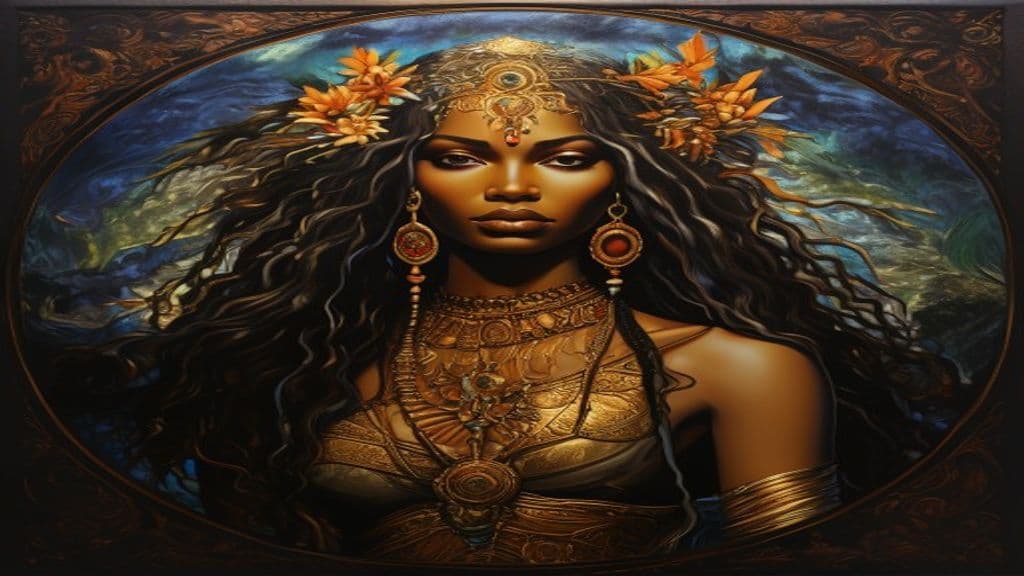
Descriptions in the surveyed sources commonly depict miengu as beautiful, mermaid-like beings with long hair; a distinctive detail reported in summaries is that they have 'beautiful gap-teeth.' Representations vary by ethnic group, and sources caution that the English label 'mermaid' is an imprecise analogue for the institutionally embedded spirit category.
Traditional accounts describe miengu as intermediaries between humans and the ancestor/spirit realm: they receive offerings and can return prophetic messages (for example at Ngondo). They are believed to bring good fortune to worshippers and influence human and communal fortunes tied to waterways (fisheries, success in pirogue races, seasonal markers) and to provide healing when biomedical measures fail. Jengu specialists perform sacrifices, administer ritual medicines (including emetics), prescribe taboos, and stage controlled underwater presentations of tribute; collectively these practices secure miengu favor, health remedies, and communal guidance.
Jehoiarib
Jehoiarib (Hebrew: יְהוֹיָרִיב, Yehōyārîḇ, 'Yahweh contends') is the eponymous head of one of the twenty-four priestly divisions instituted under King David. In later Jewish tradition the name denotes that priestly course and its descendants, remembered especially as the course on duty at the destruction of the Second Temple.
Jehoshaphat
Jehoshaphat (Hebrew: יְהוֹשָׁפָט, Yəhōšāpāṭ, "Yahweh has judged") is presented in the biblical tradition as a historical king of Judah—son of Asa—known for judicial and religious reforms, organizing priests and Levites, and appearing in genealogical lists. Some textual traditions also preserve the name in priestly genealogies, producing scholarly disputes about whether a High Priest by this name appears in some lists.
Jehovah
Jehovah is the Latinized/Anglicized form of the Tetragrammaton (יהוה, YHWH), the personal name of the God of Israel in the Hebrew Bible / Old Testament. The form 'Jehovah' arose when the consonants YHWH were combined with the vowel points of the substitute word Adonai in medieval/early modern transliteration; scholarly consensus favors 'Yahweh' as the likely historical vocalization.
Jellia Jamb
Jellia Jamb is a fictional human character in L. Frank Baum's Land of Oz stories and later sequels, serving as the head maid and a personal attendant in the royal household of the Emerald City. Presented as a young, kindly servant associated with the court of Princess Ozma, she occupies a social and administrative role rather than a supernatural one.
Jen
Jen is attested in the provided sources only as a personal given name and as the name of various fictional characters; there is no evidence in the supplied materials that 'Jen' functions as a distinct supernatural deity, spirit, or folkloric entity.
Jenglot
A supernatural entity from Indonesian tradition, created as a deformed humanoid doll imbued with magical properties through black magic. (Note: 1. Power tier: Lower the power tier from Primordial to Ancient, as the jenglot's abilities are described as "provide protection", "take revenge", and "serve as a good luck charm", which suggests deity)
Jenny Greenteeth
A figure of northern‑English folklore personifying dangerous still and slow freshwater. Presented as a green‑skinned river‑hag who lures or seizes children and the elderly into ponds, rivers, and lakes; stories function primarily as cautionary warnings about aquatic hazards.
Jentil
In Basque mythology, the Jentil are a race of giants associated with pre-Christian civilizations and megalithic monument builders. (Note: - Power tier should be Primordial because the text suggests they are associated with pre-Christian civilizations and megalithic monument builders, but doesn't imply cosmic powers. - Summary should cla)
Jentilak (the Jentil / Gentiles)
Jentilak are a Basque folkloric race of enormous, hill‑dwelling humanoids traditionally credited with shaping the landscape and building megalithic monuments. Conceptually they are framed as pre‑Christian or 'gentile' ancestors whose disappearance is associated in folklore with the spread of Christianity.
Jeonggamnok
The Jeonggamnok is a compilation of prophetic works describing a messianic figure known as the 'True Man' with the surname Jeong, expected to bring about a new utopian dynasty. (Note: - Power tier: Primordial (due to the "messianic figure" and the scope of its prophetic works) - Origin story: missing - Appearance: missing - Abilities: should describe how it is believed the 'True Ma)
Jerahmeel (archangel)
Jerahmeel (Hebrew Yəraḥməʾēl) is a theophoric Hebrew personal name meaning roughly 'May God have mercy' that, in later apocryphal/deuterocanonical and devotional materials, appears also as the name of a heavenly being rendered Jeremiel/Eremiel/Remiel and sometimes listed among named archangels in varying traditions.
Jerry Cornelius
Jerry Cornelius is a fictional, protean literary persona created by Michael Moorcock, presented across multiple novels and stories as a mutable archetype — an urban adventurer, trickster/Pierrot figure, and one incarnation of Moorcock's Eternal Champion concept. The character's identity, appearance, and role shift across narratives rather than forming a single fixed biography.
Community Record
- [1]Water spirit (overview). Wikipedia, "Water spirit"wiki
- [2]Bantu religion. Wikipedia, "Bantu religion"wiki
- [3]Entry on: Mami‑Wata (by Babila Mutia; peer-reviewed entry). Daniel A. Nkemleke, "Entry on: Mami-Wata by Babila Mutia" (peer-reviewed entry), Our Mythical ...other
- [4]A History of the Traditional Beliefs and Practices of Africa's Bantu People. Brewminate, "A History of the Traditional Beliefs and Practices of Africa's Bantu People"other
- [5]What Mermaids Look Like In Different Cultures. Grunge, "What Mermaids Look Like In Different Cultures"other
- [6]Merfolk Magic | Superpower Wiki. Fandom, "Merfolk Magic"wiki
- [7]Merfolk Physiology | Superpower Wiki. Fandom, "Merfolk Physiology"wiki
- [8]Goddesses and Gods (blog, 2007). Goddesses and Gods blog (2007)other
- [9]Jengu (Wikipedia). Wikipedia contributors, 'Jengu,' Wikipedia, The Free Encyclopedia.wiki
- [10]Ngondo (Wikipedia). Wikipedia contributors, 'Ngondo,' Wikipedia, The Free Encyclopedia.wiki
- [11]Our Mythical Childhood Survey — Jengu entry. Our Mythical Childhood survey entry for Jengu.folk
- [12]Our Mythical Childhood export — Jengu. Exported item data for the Jengu entry in the Our Mythical Childhood survey.folk
- [13]Ronel the Mythmaker — 'Jengu: The Mermaid from Africa'. Ronel the Mythmaker, 'Jengu: the Mermaid from Africa,' blog post.other