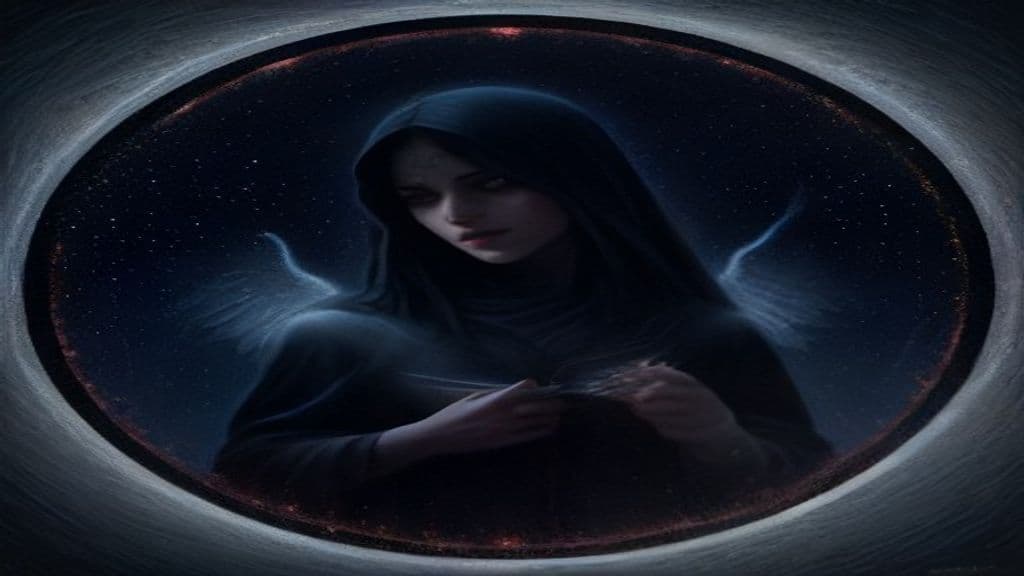
The provided sources do not give a narration of Kalqa'il's origin. Within the layered-heavens cosmology reflected in the citations, Kalqa'il is presented as an angelic being assigned a functional role—guarding the entrance of the fifth heaven and governing the houris—without a detailed mythic birth or origin tale in the available material.
No physical description or iconography of Kalqa'il is provided in the cited sources. The available material does not specify form, size, or distinguishing features.
Sources attribute to Kalqa'il the role of guarding the entrance to the fifth heaven and governance over the houris; he is also said to be invoked in exorcist rites. The material does not elaborate on the mechanisms by which he exercises authority, whether he manifests to humans outside ritual invocation, or specific effects produced when invoked.
Kalku
Kalku (also Calcu) is a Mapuche human practitioner who works with negative powers and harmful spirit-agents (wekufe). Presented in contrast to the benevolent machi, kalku command spirit-servants such as Anchimayen and can manifest powerful spirit-forms like the Chonchon; the role is often described as inherited and transgressive of admapu.
Kalladi
Kalladi is primarily attested in the provided documentary record as a social and geographic name (a sub‑caste in Kerala and place‑names in Sri Lanka), not as a clearly documented supernatural entity in Tamil folk belief. A single blog source mentions a related place‑linked spirit name 'Kalladikode Neeli', but the supplied official and archival sources do not describe a distinct folkloric being called 'Kalladi'.
Kallana
In Kaani (Kani) tribal accounts from the Western Ghats of southern India, kallana is reported as a distinct, small or 'dwarf' variety of elephant associated with rocky, higher‑altitude terrain. The lexical form 'Kallana' also appears in unrelated contexts (a planet name in fiction, a plant common name, and as a personal name in scholarly literature), but those uses are separate from the Kaani folk‑biological referent.
Kallikantzaros
A malevolent goblin-like creature in Greek and related Balkan and Anatolian traditions that dwells underground sawing at the world‑supporting tree for most of the year and emerges during the Twelve Days of Christmas (25 December–6 January) to harass households and people.
Kalma
Kalma is a female death‑figure in Finnish myth associated with Tuonela (the underworld) and with decay; she is attested in secondary summaries as one of the named offspring of the death‑mother Tuonetar and is described in some sources with language linking her to putrefaction.
Kalmāṣapāda
Kalmāṣapāda (also called Saudāsa, Mitrasaha, Amitrasaha) is a kṣatriya king of the Ikshvāku (Solar) line who, in various epic and Purāṇic accounts, is either directly cursed by a sage or possessed by a rakshasa and for a period becomes a flesh‑eating, forest‑wandering rakshasa; he is also treated in genealogies as an ancestor of Rāma. His story functions as a narrative about the power of sage‑curses, breaches of ritual hospitality, and the vulnerability of kingship to supernatural transformation.
Kalu Kumara
Kalu Kumara (literally given in the prompt as “Black Young Man” spirit) is an entity named by the user as part of Sri Lankan tradition. The supplied source excerpts in the research packet do not contain descriptions, origin stories, rituals, or other substantive information about this named spirit.
Kamadeva
Kamadeva is the anthropomorphic divine personification of the principle called kāma in Vedic and Purāṇic Hindu literature, representing desire, attraction, and the creative force of longing. He appears both as an impersonal cosmological principle in early Vedic hymns and as a named, youthful deity in later Purāṇic narratives and iconography.
Kamaitachi
A class of Japanese yōkai associated with sudden cutting winds and whirlwinds that cause sharp, initially painless wounds. Narratives vary by region: kamaitachi may be imagined as weasel-like creatures riding dust devils, trios of mischievous gods, animated sickles (tsukumogami), or other local spirit causes.
Kamapuaʻa
Kamapuaʻa is a Hawaiian kupua — a powerful shape‑changing fertility superhuman associated with Lono and especially linked to the island of Maui. Portrayed as a bold, untamed trickster and lover, he shifts between human, hog, tree and fish forms and figures in contests and negotiations with the fire goddess Pele.
Kambagiri Swamy
A powerful Hindu god associated with the Kambagiri Swamy temple in Andhra Pradesh, without known origin or appearance stories. (Note: 1. Remove power tier: Ancient - The source does not provide enough information to accurately determine the power tier. 2. Add a note on origin story: No origin story or known history is mentioned in t)
Kameosa
Kameosa is a modern and media-attested label associated with the idea of a jar or vessel animated in the conceptual family of tsukumogami (objects that acquire spirits). The provided sources do not establish a clear classical folkloric entity named Kameosa; the term appears primarily in contemporary art discussion and popular-media adaptations that draw on the tsukumogami motif.
Community Record
- [1]Kalqa'il. Wikipedia: Kalqa'ilwiki
- [2]Kalqa'il. Wikipedia: Kalqa'il (alternate page)wiki
- [3]Kalqa'il (Wikidata). Wikidata entry Q60789095 for Kalqa'ilwiki