
No discrete classical origin story for a named Kameosa is documented in the supplied sources. The term is presented in the provided material chiefly by analogy to tsukumogami — everyday implements or vessels that are said in Japanese folklore to acquire a spirit after long use — and appears in contemporary artworks and media which adapt that broader idea rather than preserving a single traditional origin narrative for Kameosa itself.
The supplied materials do not furnish a consistent traditional appearance for a distinct Kameosa. Modern entertainment references depict Kameosa-themed monsters with jar- or vessel-related motifs (and in one adaptation, associated imagery such as eggs), but these are media-specific visualizations rather than documented classical descriptions.
Classical, specific abilities for a named Kameosa are not recorded in the provided sources. By association, the tsukumogami tradition describes tools and implements that have acquired a spirit and thus can act with agency; this general behavioral pattern is the only folkloric behavior attested in the material. Separately, a contemporary fictional character described as a 'Kameosa-themed Ayakashi' in fan wikis is given media-specific abilities (e.g., placing eggs on humans to induce violence and using eggs offensively), but such traits are adaptations found in modern entertainment rather than classical folklore evidence.
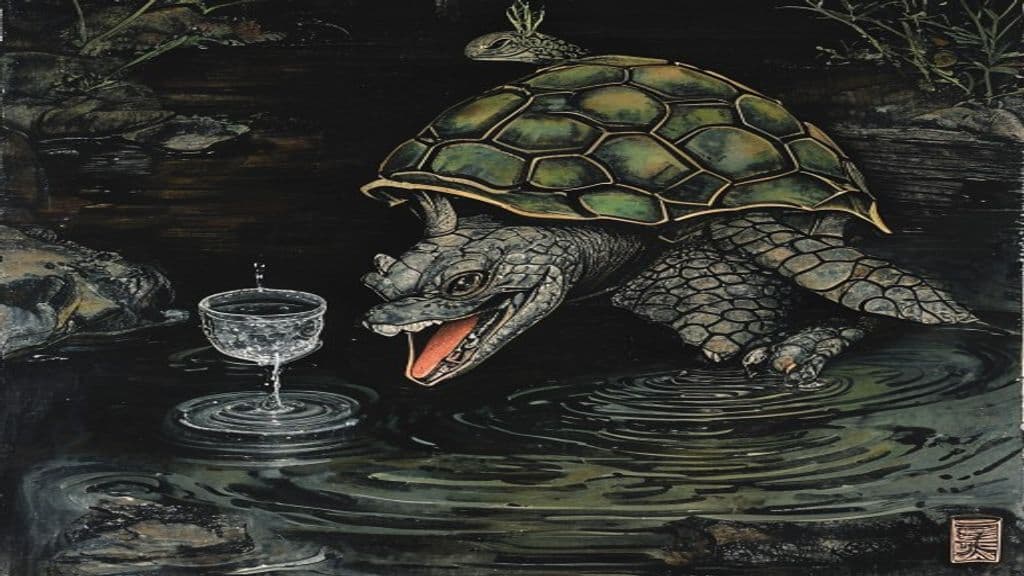
Kappa
A water-dwelling imp of Japanese folklore with a bowl of water on its head. Mischievous but bound by strict codes of politeness; dangerous near rivers.

Tokoloshe (Tokolosh)
A diminutive non-human spirit in Nguni and broader Bantu-speaking Southern African traditions, frequently portrayed as a dwarf-like, sometimes hairy water spirit used by malicious people to harass, frighten, or harm others. It functions both as a bogeyman for social discipline and as an explanatory agent for unexplained illness and death, and communities invoke traditional healers or pastors with an apostolic calling to counter it.
Prince Charming
A European-derived fairy-tale stock character archetype: an idealized princely rescuer who appears at the narrative moment of resolution to liberate a heroine (by kiss, recognition, marriage, or quest-completion) and thereby complete the tale's social or romantic reward.
Toxeus (Τοξεύς)
Toxeus (Ancient Greek Τοξεύς, lit. 'bowman') is a personal name borne by multiple human figures in Greek myth — chiefly princely/hunter figures tied to the Calydonian hunt and to Oechalian royal genealogies — and later reused as a modern taxonomic and toponymic label. In the classical material assembled in the provided sources, Toxeus denotes mortal mythic humans (princes, hunters, an inventor attestation) rather than a recurring supernatural creature.
Kalu Kumara
Kalu Kumara (literally given in the prompt as “Black Young Man” spirit) is an entity named by the user as part of Sri Lankan tradition. The supplied source excerpts in the research packet do not contain descriptions, origin stories, rituals, or other substantive information about this named spirit.
Kamadeva
Kamadeva is the anthropomorphic divine personification of the principle called kāma in Vedic and Purāṇic Hindu literature, representing desire, attraction, and the creative force of longing. He appears both as an impersonal cosmological principle in early Vedic hymns and as a named, youthful deity in later Purāṇic narratives and iconography.
Kamaitachi
A class of Japanese yōkai associated with sudden cutting winds and whirlwinds that cause sharp, initially painless wounds. Narratives vary by region: kamaitachi may be imagined as weasel-like creatures riding dust devils, trios of mischievous gods, animated sickles (tsukumogami), or other local spirit causes.
Kamapuaʻa
Kamapuaʻa is a Hawaiian kupua — a powerful shape‑changing fertility superhuman associated with Lono and especially linked to the island of Maui. Portrayed as a bold, untamed trickster and lover, he shifts between human, hog, tree and fish forms and figures in contests and negotiations with the fire goddess Pele.
Kambagiri Swamy
A powerful Hindu god associated with the Kambagiri Swamy temple in Andhra Pradesh, without known origin or appearance stories. (Note: 1. Remove power tier: Ancient - The source does not provide enough information to accurately determine the power tier. 2. Add a note on origin story: No origin story or known history is mentioned in t)
Kami
Kami (神; kami) are the central sacred beings and forces venerated in Shinto, encompassing deities, spirits, natural phenomena, qualities, and the spirits of the venerable dead. They are understood as immanent in nature, morally ambivalent, and inhabit a hidden or complementary existence sometimes referred to as the world of the kami (神界).
Kamoebas
Kamoebas is a giant, turtle-like kaiju introduced in Toho's 1970 film Space Amoeba; depicted as a spiked, reptilian menace that is one of several island animals transformed or controlled by an alien organism known as the Space Amoeba. It functions in media as a physical, cinematic threat rather than a folkloric spirit.
Kamutef
Kamutef is attested in Egyptian temple inscriptions and iconography as an epithet/aspect attached to the major god Amun/Amun‑Ra, invoked in contexts of divine maternity, royal status, and creative power rather than as an independently described deity in the supplied sources.
Kan-Laon
Kan-Laon (variously Laon, Lahon, Lalaon, Lauon, Malaon, Raom, Laonsina) is a supreme female creator anito in Visayan pre-colonial belief whose domain is identified with Mount Kanlaon on Negros Island; she is associated with creation, agriculture, the sky, and divine justice and is attested across multiple Visayan ethnolinguistic groups.
Kanaloa
Hawaiian god associated with marine life and possibly tied to fertility or creation. (Note: * Power tier should be Greater (powerful regional), not Primordial (cosmic). * No information on appearance or abilities/behaviors is available, so these sections should be removed. * The association )
Community Record
- [1]Tsukumogami. "In Japanese folklore, tsukumogami are tools that have acquired a kami or spirit."wiki
- [2]Synthetic Spirits: Kameosa - Neil Mendoza. "In Japanese folklore, tsukumogami are everyday objects that acquire spirits after long periods of existence, a belief that offers a striking counterpoint to today’s throwaway culture."other
- [3]Sasamatage | RangerWiki. "Sasamatage (ササマタゲ, Sasamatage) is a Kameosa‑themed Ayakashi."wiki
- [4]Sasamatage | Villains Wiki. Fandom/entertainment entry associating a media monster with the label 'Kameosa'.wiki
- [5]Gazu Hyakki Tsurezure Bukuro. Reference to the illustrated yokai tradition (Toriyama Sekien) as part of the broader context of yokai imagery; the supplied excerpts do not identify a classical Sekien depiction of a distinct Kameosa.wiki
- [6]Yokai.com: Kameosa (page). Online yokai reference page listed among supplied URLs (excerpted material was fragmentary and did not supply a full classical account in the provided notes).wiki