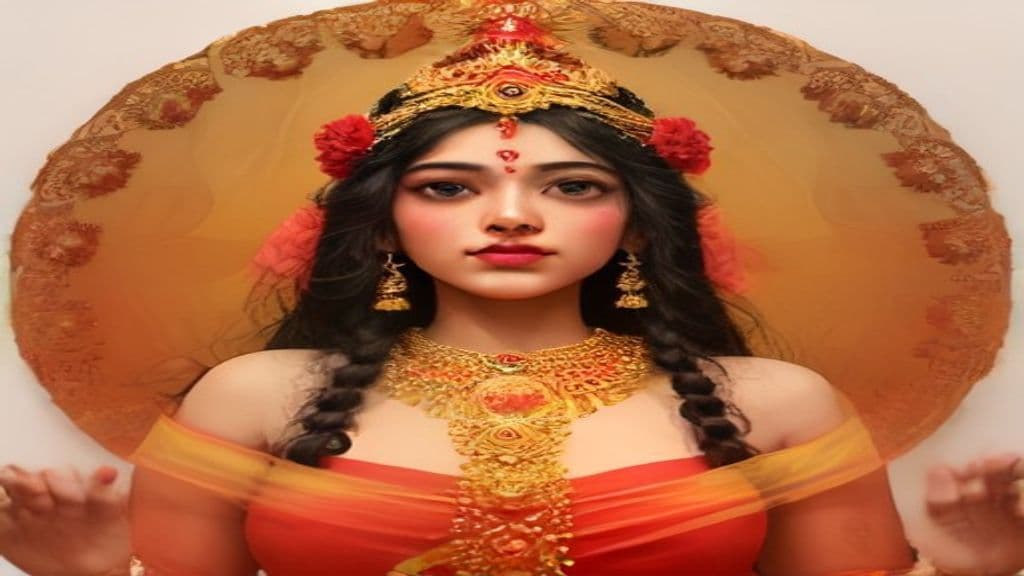
Local temple tradition at Thiruverkadu situates Karumariamman as a self-manifest (swayambu) goddess whose cult is integrated into regional Shakta/Amman devotional frameworks. A well-attested local legend recounts that Karumariamman, disguised as a soothsayer, foretold misfortune to the sun-god Surya; Surya lost his lustre until placating her, after which he vowed to let sunlight fall on her feet twice yearly at Thiruverkadu (Panguni and Puratasi). Sources report the goddess is regarded as an aspect of Parvati, Kali and Mariamman, and is worshipped as a family/caste deity by groups such as the Thevar and Agamudayar.
Karumariamman is commonly depicted as a beautiful young woman with an oval face, wearing a red dress, long jewellery and a large flower garland. Iconography often shows her with four arms; different local traditions record variant attributes. General descriptions include a knife in a right hand and a bowl of kumkuma in the left, with a trident (trishula) and a damaru (udeekai) in the other hands and a serpent entwined around the damaru; flames behind her head and a five-headed serpent above her crown are also described. Temple tradition at Thiruverkadu presents two forms: a swayambu in which only the head is visible and a seated Parasakthi image with four arms holding items variously listed (skull, sword, trishul, udukkai/damru) — accounts differ on exact held objects, and both variants are recorded in sources.
Temple tradition and local belief attribute to Karumariamman control over rain and aspects of solar favor (the Surya legend) and power over health, particularly skin diseases and smallpox; devotees believe that worship and temple rites can reduce risk of illness and bring cures. The temple tank (Vedatheertham/Thiruchamber Poigai) is held to have healing power for skin-related disorders; ritual bathing is recommended by tradition. Local legends also credit the goddess with empowering regional divine action — a tradition links her to providing the Vel (spear) to Muruga in a local legend — indicating a role as a protective mother who can grant martial or defensive aid in specific narratives. These are reported beliefs and temple claims from the cited sources.
Weaknesses
- otherno hostile vulnerability recorded
Wards
- ritualRegular worship and festival observance (Panguni festival, Ādi Thiruviḻa, Navaratri, Brahmotsavam)
- ritualBathing in the temple tank (Vedatheertham / Thiruchamber Poigai)
- ritualDaily poojas and archana with kumkum (e.g., Ko Pooja; Kalasandhi Pooja; evening archana times noted in temple practice)
Karkadann
A mythical creature with the body of a deer and a beautiful voice, said to inhabit the grassy plains of India and Iran. (Note: * Power tier: Primordial (no indication of its power level in relation to other regional or local entities) * Abilities: Add that it's able to heal and cure all wounds, but lack any mention of how it )
Karla Sofen
Karla Sofen is a fictional human character from Marvel Comics, introduced in Captain America #192 (December 1975). A former psychologist from Van Nuys who acquires an alien 'moonstone' (a fragment of a Kree Lifestone), she alternates between roles as a manipulative supervillain and an anti-heroic team member in groups such as the Masters of Evil, the Thunderbolts, and the Dark Avengers.
Karna
Karna (Sanskrit: Karṇa) is a principal human hero of the Indian epic Mahābhārata: a warrior of extraordinary skill, born to the solar deity Surya and the princess Kunti, raised by a sūta (charioteer) family, famed for his generosity, loyalty to Duryodhana, and tragic fate in the Kurukṣetra War.
Karsikko (Finnish)
In the Finnic tradition, a karsikko is a ritualistic marking made on a tree to prevent a deceased person's spirit from returning to its former location. (Note: - Power tier should be Minor Spirit instead of Lesser - Appearance description should be added (set of markings on a tree) - Origin story is missing entirely; add source material for it if applicable )
Kartikeya
Kartikeya (IAST: Kārttikeya), also known as Skanda, Subrahmanya, Shanmukha and Muruga among other names, is a major Hindu war‑deity—the son of Shiva and Parvati—who functions as commander of the devas' armies, a tutelary protector in regional cults (notably Kaumaram/Muruga traditions), and a teacher in some Shaiva contexts. Sources document his cult from early historic eras through medieval traditions and strong regional devotional developments, especially in Tamil Nadu and Sri Lanka.
Kartlos
In Georgian mythology, Kartlos is the 'father of all Georgians' and a patriarchal figure, part of a war against giant Titan king Nebrot. (Note: - Power tier: Greater (controlled a large territory, but not described as a deity-level figure) - Appearance: Add that there is no physical description provided in the source material - Abilities: Spe)
Karuppannaswamy
Karuppannaswamy is a Tamil folk guardian deity (kāval deivam) revered as a fierce protector, local enforcer of justice and communal guardian in rural and diasporic Tamil communities. He is typically venerated at village-boundary shrines and through oral, festival and shrine practices rather than Sanskritic temple liturgy.
Karuppu Sami
Karuppu Sami (also Karuppannaswamy, Karuppasamy, Karupparayan) is a principal Tamil village guardian deity (grama devata) venerated chiefly in rural Tamil Nadu and Kerala and among Tamil diasporas. He functions as a fierce protector, Kaaval Deivam (guardian deity), and upholder of justice and dharma, and is the focus of temple and shrine cults represented in statues and images.
Karura
A Japanese Buddhist divine creature with a human torso and avian head, derived from the Sanskrit garuḍa. Portrayed as an enormous, fire-breathing predator of serpents and incorporated into Buddhist guardian retinues and ritual-iconographic contexts in Japan.
Kasa-obake
A Japanese yōkai usually depicted as an animate umbrella (kasa) that acts as a playful trickster. Best known from visual and literary culture from the Edo period onward, it is commonly shown with one eye, one leg, and a long tongue and is not generally presented as malicious.
Kasanaan
Kasanaan (Tagalog: kasanaan) is a term in Tagalog/Philippine cosmology denoting a lower-world place of grief, affliction, and punishment where sinful or wicked souls suffer. It is presented in sources primarily as a locale or realm—sometimes described as a 'village in the lower world'—rather than an individual supernatural agent.
Kashvad
Legendary hero from the Persian tradition, known for his valor and military prowess. (Note: 1. Power tier: Downgrade from Ancient to Greater, as Kashvad is described as a heroic warrior with exceptional bravery and military skills, but not necessarily a deity-level being. 2. Weaknesses: Add )
Community Record
- [1]Karumariamman — Wikipedia. Wikipedia, 'Karumariamman' entrywiki
- [2]Karumariamman — Wikidata. Wikidata entry Q118902899other
- [3]THIRUVERKADU KARUMAARIYAMMAN (Archive). Archive.org collection 'THIRUVERKADU KARUMAARIYAMMAN' (Thiruverkadu temple tradition and ritual descriptions)folk