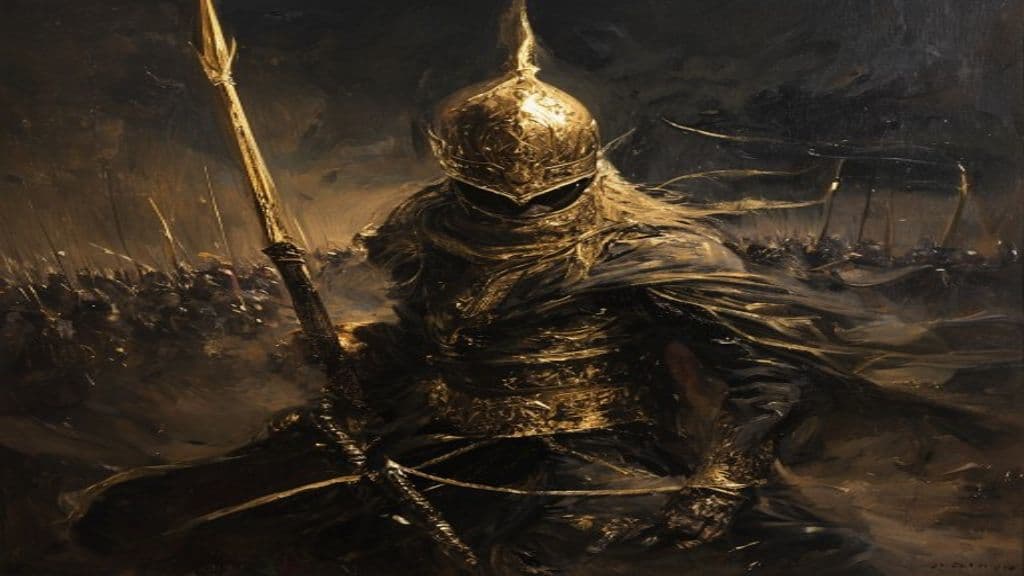
Kashvad is a member of the Goudarzian clan and serves under Iranian kings, fighting alongside legendary heroes like Rostam and Fariburz.
No physical description of Kashvad is given in the source material, although he is mentioned to wear a golden helmet.
Kashvad is described as having exceptional bravery and military skills, serving under Iranian kings and fighting against the Turanians.
Weaknesses
- otherlack of information
Wards
- conditionloyalty and bravery
Borzu Nama
A legendary hero from the Shahnameh epic cycle, embodying strength and courage. (Note: * Power tier should be Primordial (as it's a legendary hero from an epic cycle with no clear supernatural abilities). * Summary is accurate. * Appearance: No information available in source material, )
Cypress of Kashmar
A sacred cypress tree in Persian tradition, symbolizing the spread of Zoroastrianism. (Note: 1. Power tier is too low; based on its significance in Zoroastrian tradition, it should be Primordial. 2. Add sensory cues such as the scent of cedar or pine associated with cypress trees, and possibl)
Humban
Ancient Elamite god associated with divine protection and revered as a protector deity. (Note: 1. Power tier: Humban's association with "divine protection" and his importance as a deity suggest he should be placed at Ancient power tier is correct. 2. Weaknesses: absence of specific weaknesses m)
Jahangirnama (Qasim Madih Harawi)
Epic poem written in Persian, detailing the story of Jahangir son of Rostam, composed in Herat and published in Mumbai. (Note: - Power tier: Primordial (given its cosmic scope and ancient origin) - Origin story: The source material provides the information on its origin, stating it was composed in Herat. - Appearance: Not app)
Khosrow and Shirin
Human protagonists of a romantic epic poem in the Persian tradition, reflecting cultural values of ancient Persia. (Note: 1. Power tier: Should be adjusted to Primordial (as they are historical figures in a cultural context that predates modern power tiers). 2. Summary: Should include more information about their cultura)
Parī (Persian Tradition)
Supernatural entities existing in a realm separate from humans with complex social structures and described as winged creatures of immense beauty. (Note: - Power tier should be Primordial, but the source material does not specifically support this claim; it should be revised to a more accurate assessment based on available information. - Abilities sect)
Sindukht
A female character in the Persian epic poem Shahnameh, described as beautiful and intelligent. (Note: - Power tier should be Primordial (since she's a character from an ancient epic poem, implied to have significant cultural or narrative impact). - Abilities should include her emotional influence and )
Zabulistan
A historical region in southern Afghanistan and southeastern Iran, with no known supernatural entity associated with it. (Note: 1. Power tier should be Ancient (deity-level) instead of Primordial (cosmic), since there's no indication of supernatural or deity-level associations with Zabulistan. 2. Remove "Supernatural entity as)
Kasa-obake
A Japanese yōkai usually depicted as an animate umbrella (kasa) that acts as a playful trickster. Best known from visual and literary culture from the Edo period onward, it is commonly shown with one eye, one leg, and a long tongue and is not generally presented as malicious.
Kasanaan
Kasanaan (Tagalog: kasanaan) is a term in Tagalog/Philippine cosmology denoting a lower-world place of grief, affliction, and punishment where sinful or wicked souls suffer. It is presented in sources primarily as a locale or realm—sometimes described as a 'village in the lower world'—rather than an individual supernatural agent.
Kashyapa
Kashyapa (Sanskrit: Kaśyapa; Pali: Kassapa) is a revered ancient rishi in Vedic–Hindu literature and is also recognized in Buddhist canonical lists. Portrayed as a composer of some Rigvedic hymns, head of a Soma hymn school, and a progenitor in Puranic genealogies, he functions as an archetypal ancestral seer and culture‑founder associated especially with Kashmir.
Kassapa (name-group: Buddha, ascetics, and rulers)
Kassapa appears in South and Southeast Asian sources as a personal name borne by distinct figures: a canonical Buddha (Kassapa / Kassapa Dasabala), a set of ascetic brothers (Uruvelā‑Kassapa, Nadi Kassapa, Gaya Kassapa) who led monastic followings, and historical rulers (e.g., Kassapa II of Anuradhapura, Kumara Kassapa of Pagan). The supplied material treats Kassapa as reused personal/name‑title across religious and secular contexts rather than a single supernatural spirit.
Community Record
- [1]Wikipedia: Kashvad. unknown author, Wikipedia