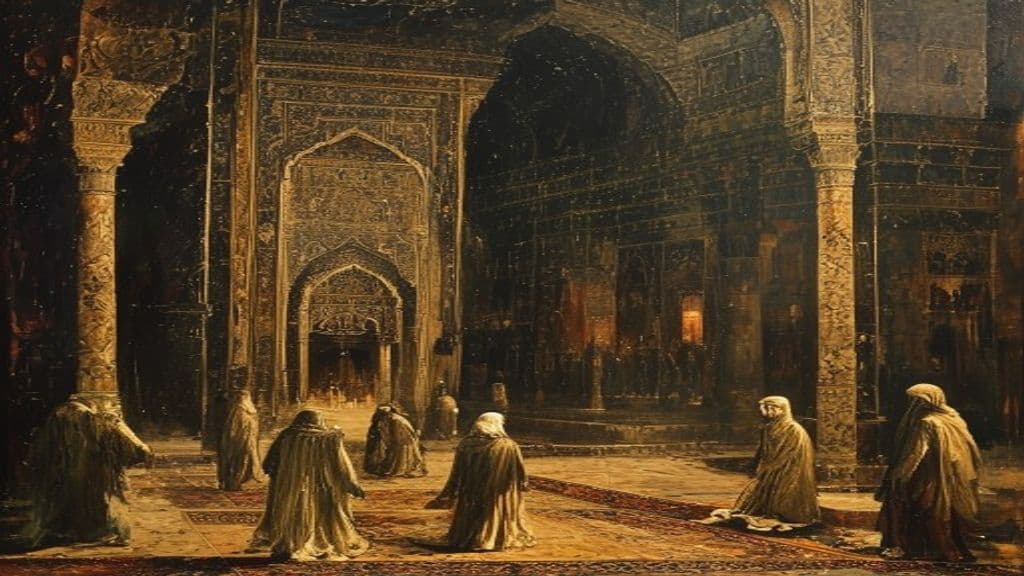
The Kayanians are said to originate from the ancient Avestan term for 'warrior poet', representing a blend of wisdom and power. They embody Iranian identity at its most militant and self-conscious.
No physical description is provided, only an allusion to their abstract qualities.
The Kayanians are associated with martial values and national pride, but no specific abilities or supernatural powers are mentioned in the source material.
Kaushiki
Kaushiki is a theophanic śakti in Hindu literature who issues from the sheath (kosha) of Parvati/Uma/Gauri and manifests as an independent warrior-mother deity to slay the asura kings Shumbha and Nishumbha. The same name appears in Jain literature as Kauśikīvidyā, a named vidyā (supernatural power) associated with certain Vidyadharas whose abilities are ethically conditioned.
Kaustubha
Divine gemstone associated with Vishnu's power, granted to him during the churning of the ocean, acting as a symbol of his divine authority. (Note: * The power tier should be Primordial (not Ancient) since it's a divine gemstone with cosmic significance. * The origin story could be more specific, mentioning that Kaustubha was granted to Vishnu du)
Kaval Deivam
Kaval Deivam (Tamil: guardian deity/spirit) is a category of village guardian spirits in Tamil folk religion charged with protecting village boundaries, people, cattle, fields and communal order. They are indigenous, non‑Agamic figures whose cults include fierce iconography, community festivals and offerings to secure protection and avert misfortune.
Kave
Kave (also attested as Kavet, Kaave, Kaveh; class-name Luonnotar/luonnottaret) is a polyvalent female spirit figure in Finnish and Karelian traditional belief, functioning both as an individual primordial woman and as a class of nature-women invoked in childbirth, healing, and cosmogonic accounts. Regional traditions vary: in some songs kapeet are lunar eaters, in others Kave frees or restores the sun and moon; she is commonly engaged through runic song and spells rather than fixed material cult.
Kaveh the Blacksmith
Mortal hero from Iranian mythology, leading an uprising against Zahāk, a tyrannical ruler. (Note: - Power tier: Primordial (since Kaveh is considered a mortal hero and does not demonstrate deity-level abilities) - Abilities: Add a specific description of how his leadership skills are presented in )
Kay Kāvus
A shah (king) in Persian mythology who rules over Iran for one hundred and fifty years, aided by Rostam. His temporal power allows him to manipulate time or aging. (Note: - Power tier should be Ancient (deity-level) as manipulating time or aging goes beyond regional power. - Summary should mention the character's aid from Rostam to be accurate. - Appearance and sensory)
Kayeri
Kayeri is a giant, plant- or mushroom-like humanoid from Cuiba folklore (Colombia and Venezuela). It is tied to forest fungi and tree bases and is held responsible in local narratives for the disappearance and death of cattle.
Kayra
Kayra (also Kaira; Old Turkic: 𐰴𐰖𐰺𐰀) is the supreme creator-being in Turkic mythic cosmology. Presented as the originative power who orders the world, plants the tree of life (Ulukayın), and directs fate from the seventeenth heaven, Kayra appears in some accounts as a non-human, liminal creator and a parent of other divine figures.
Ke'let
Ke'let (singular ke'le) are a category of hostile spirit-beings in Chukchi tradition that can denote cannibalistic giants/ogres, personifications of disease and death, or (in some uses) spirits summoned by shamans. A regional variant near the Pacific is called Re'kkenit (singular Re'kken), with distinctive local features.
Ke-alelo-O-Pilikua
A black lava outcropping in northern Kaua'i, Hawaii, with cultural significance within Hawaiian tradition due to its unique geological formation and association with ancestral figures. (Note: * Power tier should be Ancient (not Primordial) since there is no indication that it has cosmic powers. * Abilities statement should be corrected to reflect that no abilities are mentioned, but also c)
Kebehet
Kebehet is a minor divine figure attested in modern secondary literature on Ancient Egyptian funerary religion. She appears in discussions of the ensemble of attendant deities and personae invoked in royal mortuary ritual and the king's passage into the celestial afterlife, but primary-source details about her name, iconography, or distinct functions are sparse in the supplied sources.
Kechibi
Kechibi (けち火) are atmospheric ghost lights from the folk legends of Kōchi Prefecture (historical Tosa Province), Japan. They are local variants of onibi/funayūrei-type lights reported as human-linked luminous balls that emerge either at death or from sleeping persons and that figure in cautionary folktales about interaction with spirit phenomena.
Community Record
- [1]Wikipediawiki