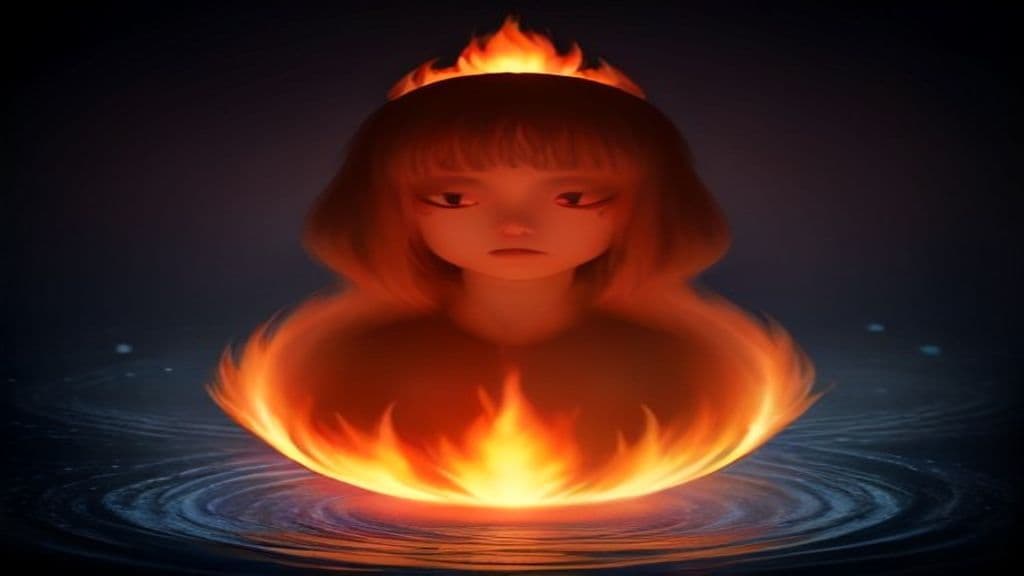
Local sources record two principal origin types for kechibi. One type is described as emanating from the flesh at the instant a human dies—a postmortem emergence of a luminous onryō-like light. The other type is said to issue from living humans while they sleep, projecting outward as a light that may correspond to dreams or nightmares. These dual accounts are attested in regional collections (Rinichihara Ichihara as cited) and are reflected in folktales from Kōchi in which a kechibi chased by a passerby corresponds to a sleeping man's fearful dream.
Kechibi are reported as balls of fire—luminous, mobile orbs often described with human features visible within the flame. One common remark in sources is that "the face of a human floats in the fire." In some accounts kechibi appear above water, aligning them with water- or boat-related ghost-lights in certain tellings; elsewhere they appear along roads or beside rivers in nighttime narratives.
Kechibi are portrayed as mobile and evasive lights that move away when approached; in one tale a roadside kechibi "started rolling around" as a man drew near and was chased into a house. Lore from Kōchi records vernacular techniques to summon or beckon a kechibi—beating a zōri three times or putting saliva on a zōri and calling for it—attested in local legend sources as actions ordinary people might perform. Some tales record harmful consequences from capturing or handling a kechibi: for example, a man named Kumaani Saitō who captured one was reported to develop a fever and die the next day. Sources present such cases as attested stories rather than universal causal laws.

Kayanian Dynasty
Ancient Persian dynasty embodying martial values and national pride. (Note: - Power tier: Primordial (The Kayanians are described as a blend of wisdom and power, suggesting a more fundamental or cosmic nature.) - Abilities: Mention "no specific abilities" but add that their a)
Kayeri
Kayeri is a giant, plant- or mushroom-like humanoid from Cuiba folklore (Colombia and Venezuela). It is tied to forest fungi and tree bases and is held responsible in local narratives for the disappearance and death of cattle.
Kayra
Kayra (also Kaira; Old Turkic: 𐰴𐰖𐰺𐰀) is the supreme creator-being in Turkic mythic cosmology. Presented as the originative power who orders the world, plants the tree of life (Ulukayın), and directs fate from the seventeenth heaven, Kayra appears in some accounts as a non-human, liminal creator and a parent of other divine figures.
Ke'let
Ke'let (singular ke'le) are a category of hostile spirit-beings in Chukchi tradition that can denote cannibalistic giants/ogres, personifications of disease and death, or (in some uses) spirits summoned by shamans. A regional variant near the Pacific is called Re'kkenit (singular Re'kken), with distinctive local features.
Ke-alelo-O-Pilikua
A black lava outcropping in northern Kaua'i, Hawaii, with cultural significance within Hawaiian tradition due to its unique geological formation and association with ancestral figures. (Note: * Power tier should be Ancient (not Primordial) since there is no indication that it has cosmic powers. * Abilities statement should be corrected to reflect that no abilities are mentioned, but also c)
Kebehet
Kebehet is a minor divine figure attested in modern secondary literature on Ancient Egyptian funerary religion. She appears in discussions of the ensemble of attendant deities and personae invoked in royal mortuary ritual and the king's passage into the celestial afterlife, but primary-source details about her name, iconography, or distinct functions are sparse in the supplied sources.
Kehua (Māori Ghosts and Spirits)
In Māori culture, kehua are ghosts or spirits that appear as apparitions of long deceased family members to warn of upcoming danger. They hold a sacred status, implying tapu. (Note: 1. The draft states "Kehua are considered to be apparitions of long deceased family members," but Source 1 mentions it as "long deceased family members may appear." This implies Kehua could also refer)
Kejōrō
Kejōrō is recorded only as a named entry (or image) associated with Toriyama Sekien’s Konjaku Gazu Zoku Hyakki (c. 1779) within the context of Sekien’s illustrated bestiary of supernatural beings. The available supplied source (a Wikipedia summary of Sekien’s work) confirms Sekien’s role as compiler-illustrator but does not supply further descriptive or folkloric detail specific to Kejōrō.
Kelenken
Kelenken is both a Tehuelche mythic referent described in the scientific literature as “a spirit… represented as a giant bird of prey” and the name-bearing fossil taxon Kelenken guillermoi, a very large middle Miocene flightless predatory bird (a phorusrhacid) from Patagonia. The cited sources supply extensive paleontological description and taxonomy but provide only the single, brief ethnographic note that the genus name was taken from a Tehuelche spirit-image; no Tehuelche narratives or rituals are recorded in the supplied material.
Kelpie
A Scottish shape-shifting water horse that appears as a beautiful tame horse near lochs and rivers, then drowns and devours any rider foolish enough to mount it.
Keneō
Keneō (懸衣翁), literally "clothes hanging old man," is an underworld attendant in Japanese popular Buddhist tradition who sits at the edge of the Sanzu River. Described in sources as an Oni-like figure, he receives the garments of arriving souls, hangs them on a riverside branch whose bend registers the weight of sin, and participates with Datsue-ba in postmortem punishments.
Kenmet
Kenmet (Egyptian Knm.t) is a named figure attested in ancient Egyptian temple, dramatic, and decanal/astronomical texts. The attestations place Kenmet within mythic and stellar ordering contexts — as a named component associated with the divine stars and decanal schemata rather than as a fully attested cultic deity with independent biography.
Community Record
- [1]Kechibi. Wikipedia, 'Kechibi' article (accessed via supplied research notes)wiki
- [2]Kechibi (Wikidata). Wikidata entry for Kechibi (as linked in supplied materials)other
- [3]Janjanbi. Wikipedia, 'Janjanbi' article (used for contextual relation to other ghost-light traditions)wiki
- [4]Yokai.com: Kechibi. Yokai.com entry on Kechibi (provided among supplied links; corroborates folkloric motifs)folk