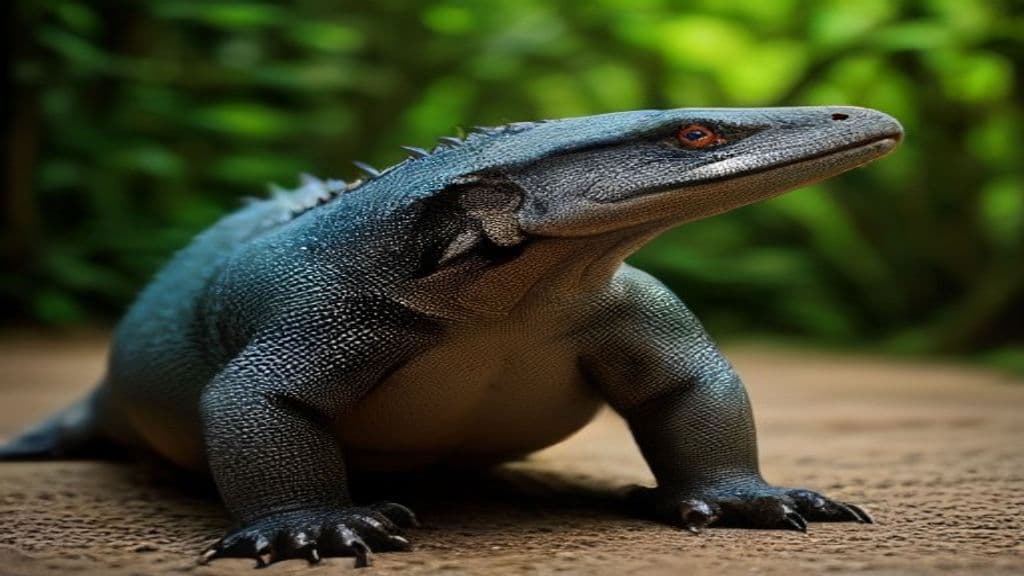
The provided sources do not document a mythic or cosmogonic origin story for the Komodo dragon. Ethnolinguistic material records that in the Komodo language the animals are called sebae ('twins') and that this name arises from a traditional belief that Komodo island people and the dragons share the same spiritual mother; however, no narrative origin myth or fuller cosmological account was supplied in the cited materials.
The Komodo dragon is the largest extant lizard species: males may reach a maximum length of around 3 m (10 ft) and weight estimates for large males reach up to 150 kg (330 lb), while typical wild adults often weigh about 70 kg (150 lb) and captive specimens can be heavier. Photographic and museum records (including preserved specimens and display skins) emphasize its large robust body, powerful limbs and tail, and appearance consistent with large monitor lizards but the supplied sources focus on size and specimen availability rather than fine-scale morphological description.
Biologically, Komodo dragons function as apex predators in their ecosystems. They hunt and ambush prey, feeding on a range that shifts from small animals (invertebrates and birds) in juveniles to larger mammals (notably Javan rusa deer and feral pigs) in adults, and they consume carrion. Cannibalism of juveniles by adults is recorded; young animals avoid predation by hiding in trees and by behaviors such as rolling in feces to repel adults. Life-history details in the sources note maturation at roughly 8–11 years, possible longevity estimates up to around 30 years (with some higher estimates reported), and a reproductive cycle in which mating occurs May–August, eggs are laid in September (up to about 20 eggs), incubate for 7–8 months, and hatch in April.
Kokko
Kokko is an item name that appears in discussions of Finnish mythology but is not described in the single provided source. The available material situates Kokko within the broader corpus of Finnish pagan folklore without providing specific details about its nature, appearance, or associated practices.
Kokum (Grandmother spirit)
No information about Kokum (a grandmother spirit in Algonquin tradition) is present in the single provided source. The supplied source (a Wikipedia entry for Joshua Whitehead's novel Jonny Appleseed) does not mention Kokum, Algonquin beliefs, or any grandmother spirit, so no factual claims about Kokum can be drawn from it.
Kola Sanni Yaka (Sanni yakuma / Daha ata sanniyas)
A set of ritual spirits invoked in the Sinhalese Sanni yakuma (Daha ata sanniyas) exorcism; understood as spirit-beings responsible for specific illnesses and addressed through a sequence of 18 masked dances that identify, confront, and banish the afflicting spirits.
Kola kanda
Kola kanda is a traditional Sri Lankan herbal congee (porridge) used as a breakfast food and in folk medicinal practice. Sources provided do not support treating 'Kalu Kandha' as a supernatural being; instead the documented term in the sources is the culinary/medicinal preparation 'Kola kanda'.
Kolanthes (Kolanthes the Child)
Kolanthes is a late‑period Egyptian local child deity documented in the Akhmim/Athribis circle (ninth Upper Egyptian nome). Attested in Greek, Demotic and hieroglyphic inscriptions and a hymn, he appears as a member of a local patron triad and is identified with the divine child motif (Horus) and called 'the child of Osiris and Isis'.
Komainu
Komainu (狛犬) are paired lion- or dog-like guardian statues placed at thresholds of Shinto shrines (and sometimes temples, noble residences, or private homes) in Japan. As apotropaic architectural figures they ward off evil and mark liminal boundaries; their paired 'a-un' mouths symbolize beginning and end.
Kompira (Konpira / Konpira Gongen)
Kompira (Konpira, Konpira Gongen) is a locally venerated Japanese protective deity associated primarily with the sea, sailors, and seafaring safety. Centered on the mountain Kotohira in Kagawa Prefecture, the cult is syncretic—embedded in Shinto shrine practice, Shugendō asceticism, and historically described in some texts with Buddhist identifications or foreign-origin narratives.
Komur Han
Komur Han is a named underworld functionary in Turkic myth, listed among the nine sons or subordinate 'hans' of Erlik. He is associated symbolically with coal/charcoal and darkness and is described in popular summaries as commanding evil entities and mediating between Erlik and 'dark shamans.'
Konaki-jiji
Konaki-jiji (子泣き爺) is a yōkai from Japanese folklore, originating in the mountain regions of Tokushima Prefecture on Shikoku and later recorded in national yōkai collections. It is known for luring compassionate travelers by imitating the cry of an infant and then suddenly becoming a crushing heavy weight that kills the carrier.
Kongamato
A pterosaur-like creature said to be a fearsome entity capable of causing large wounds, reportedly seen in the Jiwundu Swamps in western Zambia, Angola, and Democratic Republic of the Congo. (Note: 1. Power tier: Primordial seems too high given the limited abilities described (causing large wounds, aggressive behavior). Lesser would be more plausible. 2. Sensory cues: Add that witnesses report s)
Kopala
In Georgian tradition, Kopala is a hero or demigod with exceptional strength and strategic thinking, revered in the highlands of Pshavi. (Note: - Power tier: Lesser (Kopala is a demigod/hero, not Primordial) - Abilities: While Kopala's strength and strategic thinking are evident, there's no mention of Kviria's aid surpassing the ogres' throw;)
Korean Creation Narratives
A category of shamanic stories that recount the mythological beginnings of the universe, including tales from mainland Korea and Jeju Island. (Note: - Power tier should be Ancient (deity-level), as the creation narratives describe mythological beginnings of the universe. - Origin story is not entirely unclear; specific stories from various regions)
Community Record
- [1]Komodo dragon (Varanus komodoensis) — Wikipedia. Wikipedia: 'Komodo dragon (Varanus komodoensis)... is a large reptile of the monitor lizard family Varanidae that is endemic to the Indonesian islands of Komodo, Rinca, Flores, Gili Dasami, and Gili Motang.'wiki
- [2]Wikidata: Komodo dragon (Q4504). Wikidata entry for Komodo dragon (Q4504) — taxonomic and classification data.wiki
- [3]Komodo Dragon (archive photographic item). Archive photographic and publication material referencing Komodo dragon imagery and popular-press portrayal.other
- [4]FRANK SOMETE A UN DRAGÓN DE KOMODO (archive item). Archive item referenced in source list documenting popular/public interest and imagery.other
- [5]Animals Alive (book listing including Komodo dragon). Popular-press book entry that profiles Komodo dragon among living reptiles.other