
The sources provided do not record a detailed mythological origin narrative for the Kola Sanni Yaka spirits. Within the tradition, the term designates a roster of ritual personae associated with particular illnesses and the formalized exorcistic dances (Sanni yakuma / Daha ata sanniyas) through which those spirit-causes are called, named, negotiated with, and expelled.
In practice the spirits are represented by masked performers: the ritual consists of 18 masked dances, each depicting a particular illness or ailment. The available sources do not supply further descriptive detail of individual masks or visual features beyond this functional, performative representation.
These spirits are believed to cause and affect human sickness and ailments. In ritual interaction they can be summoned, identified, addressed in speech or performance, commanded not to trouble humans, and banished. They are treated as part of a broader class of supernatural agents (evil eye, demons, sorcery) implicated in illness within Sri Lankan popular belief.
Weaknesses
- ritualSanni yakuma / Daha ata sanniyas (ritual banishment)
Wards
- ritualSanni yakuma (call the demons, tell them not to trouble humans, and banish them)
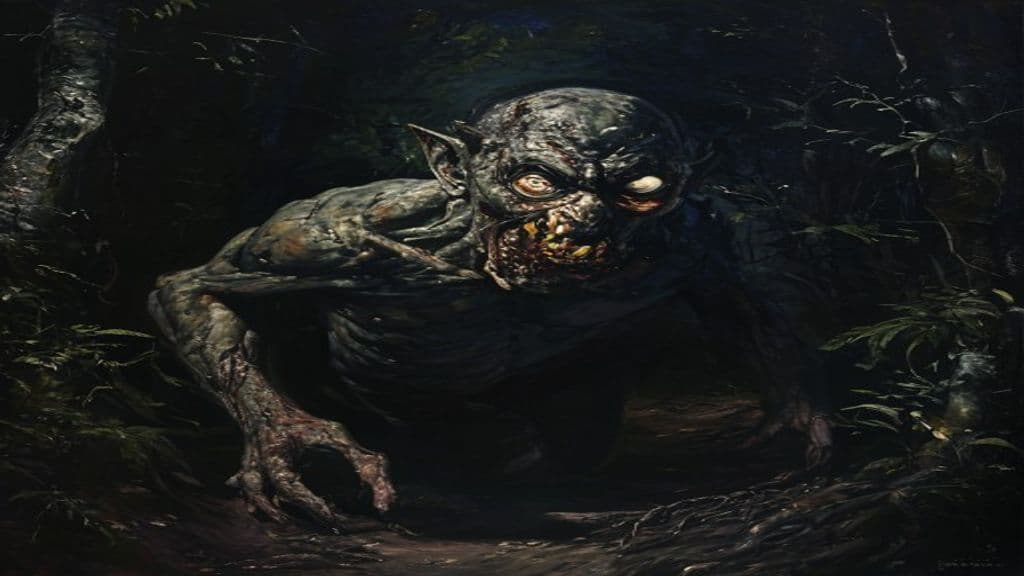
Pishacha
Flesh-eating spirits of Hindu mythology that haunt cremation grounds and are associated with disease, madness, and possession. The lowest class of demon in the Vedic hierarchy.
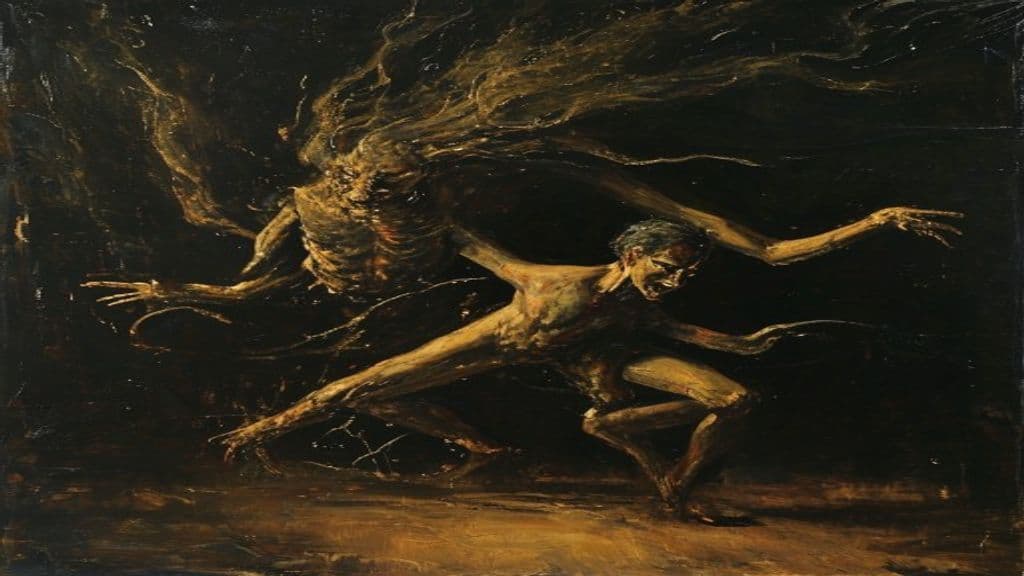
Pishacha-graha
The possessing variety of pishacha described in classical Ayurvedic and tantric texts — a grasping spirit (graha) that seizes the body of a victim, producing symptoms of madness and compulsion.
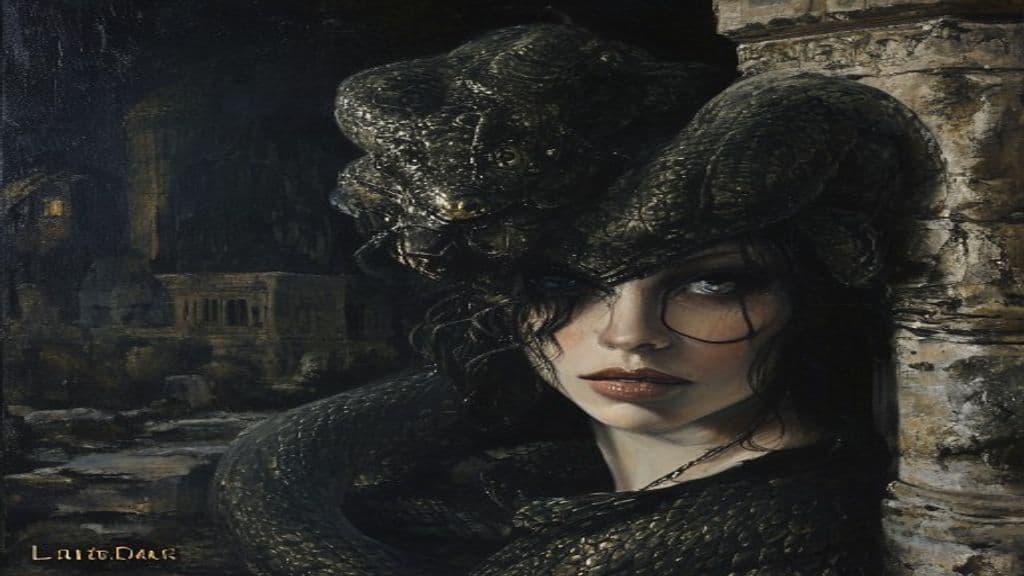
Lamia
A child-devouring demon of Greek mythology — once a queen of Libya and lover of Zeus, driven mad by Hera's destruction of her children and transformed into a monstrous hunter of other women's children.

Rakshasa (Himalayan variants)
A Himalayan reception of the pan-Indian rakshasa motif: hostile or disruptive non‑human beings known from Sanskrit epic and Puranic literature, here noted where Himalayan sources and discussions intersect with the broader epic tradition. The supplied sources do not document distinct, well‑attested Himalayan folklore variants; the entry therefore presents primarily the epic/legendary profile as transmitted into Himalayan contexts in general references.

Preta (Hungry Ghost)
A post-mortem supernatural being associated with extreme, unremitting hunger and thirst. In Hindu usage the Sanskrit term can mean a deceased person, while Buddhist traditions develop the category into a distinct realm of hungry spirits whose condition illustrates karmic consequences for demeritorious action.
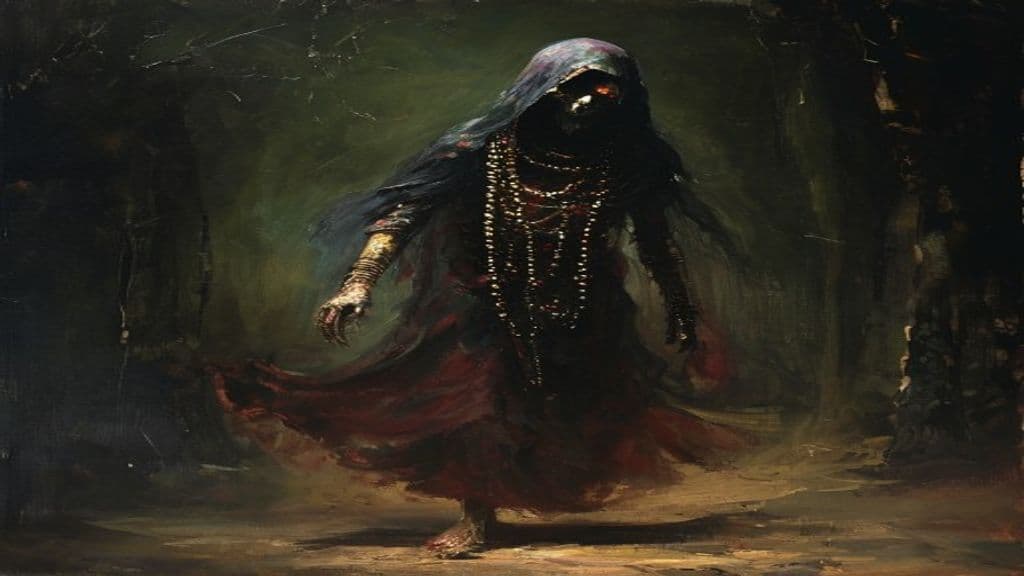
Bhoot (bhoota)
A bhoot (also bhoota, bhoot, bhut) is the culturally specific term across parts of the Indian subcontinent for a perturbed, restless spirit generally understood to be the ghost of a deceased person. Sources describe bhoots as arising when a person's death or post-death circumstances prevent them from moving on — for example violent death, unresolved affairs, or failures in funerary rites — and the term appears frequently in modern South Asian media and discussions.
Knull
Knull is a primordial godlike being from Marvel Comics who predates the current (seventh) iteration of the universe, creator and would-be sovereign of the symbiote race known as the Klyntar, and wielder of the ancient weapon All-Black the Necrosword. He functions as a cosmic antagonist whose aims center on darkness and the destruction or domination of created light.
Kobold
The German household and mine spirit — a mischievous but potentially helpful small being who attaches to a household, bringing luck or disaster depending on how it is treated.
Koka and Vikoka (Hindu tradition)
Asura brothers, twin generals serving their brother Kali in battle against the 10th avatar of Vishnu, Kalki. (Note: - Power tier should be Greater (deity-level strength as twin generals supporting their brother, a powerful deity) - No information about sensory cues or wards and weaknesses; these should be removed -)
Kokabiel
Kokabiel is a named Watcher in the Enochic tradition, whose name means roughly "star of God" and who is associated with astral knowledge. In the Book of Enoch he is listed among the two hundred angels who descended on Mount Hermon and bound themselves by oath, an act that led to the transmission of forbidden knowledge and human corruption.
Kokko
Kokko is an item name that appears in discussions of Finnish mythology but is not described in the single provided source. The available material situates Kokko within the broader corpus of Finnish pagan folklore without providing specific details about its nature, appearance, or associated practices.
Kokum (Grandmother spirit)
No information about Kokum (a grandmother spirit in Algonquin tradition) is present in the single provided source. The supplied source (a Wikipedia entry for Joshua Whitehead's novel Jonny Appleseed) does not mention Kokum, Algonquin beliefs, or any grandmother spirit, so no factual claims about Kokum can be drawn from it.
Kola kanda
Kola kanda is a traditional Sri Lankan herbal congee (porridge) used as a breakfast food and in folk medicinal practice. Sources provided do not support treating 'Kalu Kandha' as a supernatural being; instead the documented term in the sources is the culinary/medicinal preparation 'Kola kanda'.
Kolanthes (Kolanthes the Child)
Kolanthes is a late‑period Egyptian local child deity documented in the Akhmim/Athribis circle (ninth Upper Egyptian nome). Attested in Greek, Demotic and hieroglyphic inscriptions and a hymn, he appears as a member of a local patron triad and is identified with the divine child motif (Horus) and called 'the child of Osiris and Isis'.
Komainu
Komainu (狛犬) are paired lion- or dog-like guardian statues placed at thresholds of Shinto shrines (and sometimes temples, noble residences, or private homes) in Japan. As apotropaic architectural figures they ward off evil and mark liminal boundaries; their paired 'a-un' mouths symbolize beginning and end.
Komodo dragon (tradition)
The Komodo dragon (Varanus komodoensis) is a real, living species of large monitor lizard endemic to several Indonesian islands. In ethnolinguistic material recorded from the Komodo language the animal is called sebae ('twins'), a name that encodes a local belief tying island people and dragons through a shared spiritual motherhood; beyond this naming note the supplied sources treat the animal primarily in biological, conservation, and museum terms rather than as a spirit or supernatural agent.
Kompira (Konpira / Konpira Gongen)
Kompira (Konpira, Konpira Gongen) is a locally venerated Japanese protective deity associated primarily with the sea, sailors, and seafaring safety. Centered on the mountain Kotohira in Kagawa Prefecture, the cult is syncretic—embedded in Shinto shrine practice, Shugendō asceticism, and historically described in some texts with Buddhist identifications or foreign-origin narratives.
Komur Han
Komur Han is a named underworld functionary in Turkic myth, listed among the nine sons or subordinate 'hans' of Erlik. He is associated symbolically with coal/charcoal and darkness and is described in popular summaries as commanding evil entities and mediating between Erlik and 'dark shamans.'
Community Record
- [1]Kola Sanni Yaka (Kola Sanni Yaka ritual spirits) - Wikipedia. Wikipedia, 'Sanni yakuma' entry (Kola Sanni Yaka ritual spirits)wiki
- [2]Exorcism and spirit rituals in Sri Lanka | Facts and Details. Facts and Details, 'Exorcism and spirit rituals in Sri Lanka' (discussion of belief in evil eyes, demons and bad spirits)folk