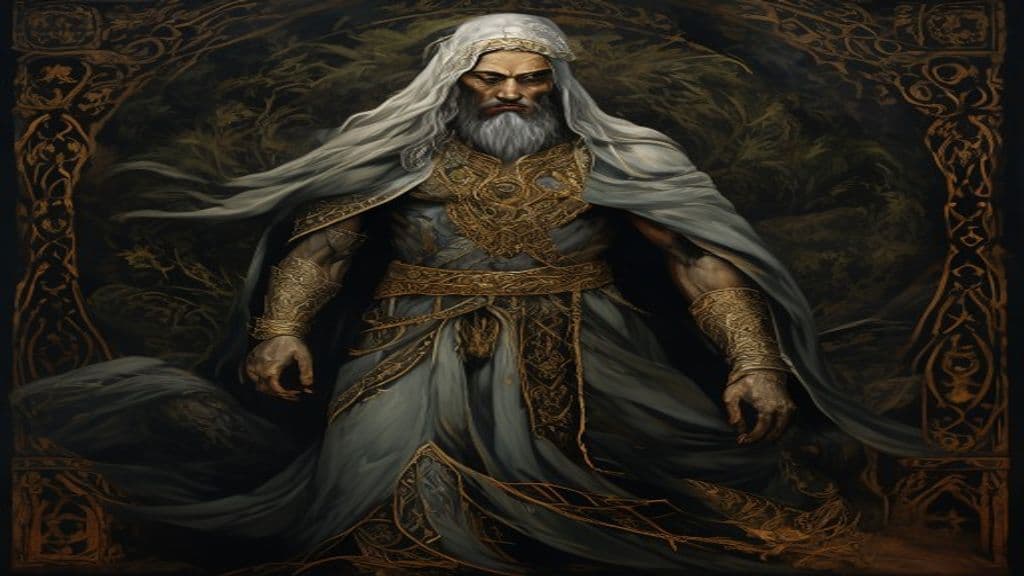
Kopala's story reflects the worldview of ancient Georgian highlanders, where strength, strategic thinking, and divine assistance are valued traits.
Kopala possesses exceptional strength, as evidenced by his ability to throw boulders across valleys and mountains. He also exhibits strategic thinking, as demonstrated by his decision to combine two boulders for a longer throw, and uses Kviria's aid to surpass the ogres' throw.
Weaknesses
Wards
Amirani
In the Georgian tradition, Amirani is a Demiurge figure who defied God by introducing metalworking to humanity. (Note: - Power tier: Greater (not Primordial), as Amirani's abilities are more focused on introducing metalworking and defying God than cosmic-scale powers. - Weaknesses: not just "by God", but specifically )
Gatsi and Gaim (Georgian Deities)
Pre-Christian Georgian deities associated with the chief idol Armazi, believed to govern all mysteries. (Note: 1. Power tier should be Primordial (as they are associated with the chief idol Armazi). 2. Specific abilities mentioned in the sources include governing all mysteries, but no further specifics are pro)
Samdzimari
A fertility and oracular goddess in the Georgian tradition, associated with beauty, prophecy, and protection. (Note: - Power tier: Primordial (given her association with fertility and oracular abilities) - Appearance: Already accurately described as a beautiful blond-haired seductress - Abilities: No new information)
Komodo dragon (tradition)
The Komodo dragon (Varanus komodoensis) is a real, living species of large monitor lizard endemic to several Indonesian islands. In ethnolinguistic material recorded from the Komodo language the animal is called sebae ('twins'), a name that encodes a local belief tying island people and dragons through a shared spiritual motherhood; beyond this naming note the supplied sources treat the animal primarily in biological, conservation, and museum terms rather than as a spirit or supernatural agent.
Kompira (Konpira / Konpira Gongen)
Kompira (Konpira, Konpira Gongen) is a locally venerated Japanese protective deity associated primarily with the sea, sailors, and seafaring safety. Centered on the mountain Kotohira in Kagawa Prefecture, the cult is syncretic—embedded in Shinto shrine practice, Shugendō asceticism, and historically described in some texts with Buddhist identifications or foreign-origin narratives.
Komur Han
Komur Han is a named underworld functionary in Turkic myth, listed among the nine sons or subordinate 'hans' of Erlik. He is associated symbolically with coal/charcoal and darkness and is described in popular summaries as commanding evil entities and mediating between Erlik and 'dark shamans.'
Konaki-jiji
Konaki-jiji (子泣き爺) is a yōkai from Japanese folklore, originating in the mountain regions of Tokushima Prefecture on Shikoku and later recorded in national yōkai collections. It is known for luring compassionate travelers by imitating the cry of an infant and then suddenly becoming a crushing heavy weight that kills the carrier.
Kongamato
A pterosaur-like creature said to be a fearsome entity capable of causing large wounds, reportedly seen in the Jiwundu Swamps in western Zambia, Angola, and Democratic Republic of the Congo. (Note: 1. Power tier: Primordial seems too high given the limited abilities described (causing large wounds, aggressive behavior). Lesser would be more plausible. 2. Sensory cues: Add that witnesses report s)
Korean Creation Narratives
A category of shamanic stories that recount the mythological beginnings of the universe, including tales from mainland Korea and Jeju Island. (Note: - Power tier should be Ancient (deity-level), as the creation narratives describe mythological beginnings of the universe. - Origin story is not entirely unclear; specific stories from various regions)
Korean Mythological Pantheon
A diverse pantheon of deities and spirits in Korean mythology, worshipped through shamanic rituals. (Note: - Power tier is too high; a Primordial/Cosmic power tier typically implies entities that create or govern the universe, but Korean mythology doesn't describe such roles for its deities. - Abilities an)
Kormos
Kormos (also Kormoz; Tuvan: кормос; Turkish: Körmöz/Körmös) is a Turkic category of spirit-entities encompassing a range of post-mortem conditions — ancestral or beneficent sky-spirits, wandering suffering souls on earth, and demonic underworld spirits — variously described as helpful, harmful, or ambivalent depending on subtype and allegiance.
Koromodako
A coastal yōkai from northern Kyoto Prefecture folklore described as a small octopus-like creature that can expand like a piece of clothing or blanket to enwrap and sink boats and people. The lore is localized to promontory areas of the Tango (Yosa) Peninsula and Wakasa Bay.
Community Record
- [1]Wikipedia: Kopala. 1.wiki