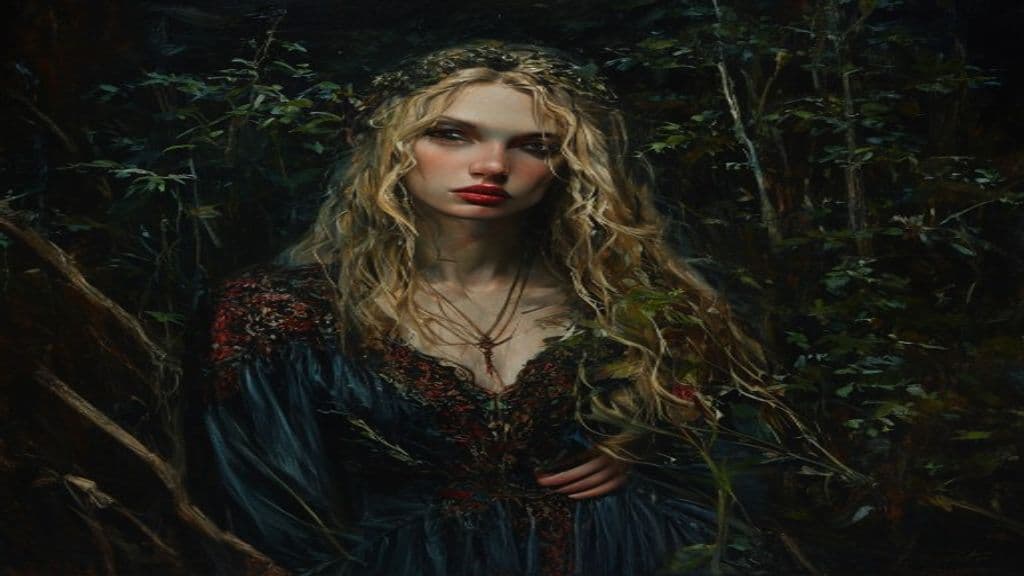
There is no information on the mythological origin of Samdzimari.
Traditionally depicted as a beautiful blond-haired seductress, dominion over wild spaces.
Associated with fertility, oracular abilities, and protection. Her relationship with Giorgi suggests she may also be connected to guardianship.
Amirani
In the Georgian tradition, Amirani is a Demiurge figure who defied God by introducing metalworking to humanity. (Note: - Power tier: Greater (not Primordial), as Amirani's abilities are more focused on introducing metalworking and defying God than cosmic-scale powers. - Weaknesses: not just "by God", but specifically )
Gatsi and Gaim (Georgian Deities)
Pre-Christian Georgian deities associated with the chief idol Armazi, believed to govern all mysteries. (Note: 1. Power tier should be Primordial (as they are associated with the chief idol Armazi). 2. Specific abilities mentioned in the sources include governing all mysteries, but no further specifics are pro)
Kopala
In Georgian tradition, Kopala is a hero or demigod with exceptional strength and strategic thinking, revered in the highlands of Pshavi. (Note: - Power tier: Lesser (Kopala is a demigod/hero, not Primordial) - Abilities: While Kopala's strength and strategic thinking are evident, there's no mention of Kviria's aid surpassing the ogres' throw;)
Samandar (Jewish tradition)
No documentation in the supplied sources identifies Samandar as a supernatural being in Jewish tradition. The term appears in the provided corpus primarily as a toponym — a medieval city (capital) of Khazaria — and in various modern secular or personal-name usages. Claims about a Jewish spirit named Samandar are unsupported by the given material.
Samantabhadra
Samantabhadra is a sacred name used across Indian-origin traditions. In Mahāyāna Buddhism it denotes a major bodhisattva associated with practice, vows, and the transfer of merit; in Tibetan Buddhism the name (Tibetan: Kuntu Zangpo) is also used for an Adi‑Buddha or primordial principle in Dzogchen contexts; separately, Samantabhadra is the name of a historical second‑century Digambara Jain monk and author of works such as the Ratnakaranda Gaurav.
Samantabhadri
Samantabhadri is a female Buddha and dakini in the Vajrayana (Tibetan) Buddhist tradition, described as the primordial Mother Buddha and the dharmakaya dakini aspect of the Trikaya. She functions doctrinally as the feminine, non-dual ground of awakening and is identified as the consort and counterpart of Samantabhadra.
Sambation
In Jewish tradition, the Sambation is a metaphorical concept representing the boundaries beyond which the Ten Lost Tribes of Israel were exiled. (Note: * Power tier should be Lowered to Lesser or Minor Spirit since there's no attributed powers or behaviors. * Summary should be revised for accuracy: The Sambation is a river in Jewish tradition marking)
Sambhavanātha
Sambhavanātha is the third tīrthaṅkara (ford-maker, supreme spiritual teacher) of the current cosmic age in Jainism; born in the Ikshvaku (Solar) dynasty at Shravasti, he renounced royal life, attained omniscience beneath a Sala tree, and achieved mokṣa on the sacred peaks of Mount Shikharji.
Samebito
A shark-like humanoid sea-being from Japanese literary and folkloric sources most familiar from Lafcadio Hearn's retelling "The Gratitude of the Samebito" (based on Kyokutei Bakin's tale "Kōjin"). Described as frightening in appearance but gentle in temper, the Samebito is notable in the tale for shedding tears that turn into precious gems.
Samhain
Celtic festival marking the end of harvest season and beginning of winter. (Note: 1. Power tier should be "Ancient" instead of "Primordial", as Samhain is a festival or time of transition, not an entity with cosmic powers. 2. Abilities need to be rephrased to reflect that the blurr)
Samia
Samia is a name attested in modern reference works for two closely related senses within Greek mythic tradition: (1) a mythic woman, described as daughter of Maeander and wife of Ancaeus; and (2) an epithet of the goddess Hera. The attestations provided in the available sources are limited to brief lexical/gazetteer notices rather than surviving narrative or cult texts.
Samodiva
A South- and West-Slavic (especially South Slavic/Balkan) female nature spirit and personification of wild places. Samodivas are ambivalent supernatural women associated with mountains, springs, trees, songs and dances; they can grant healing knowledge or punish humans who offend the landscape.
Community Record
- [1]Wikipediawiki