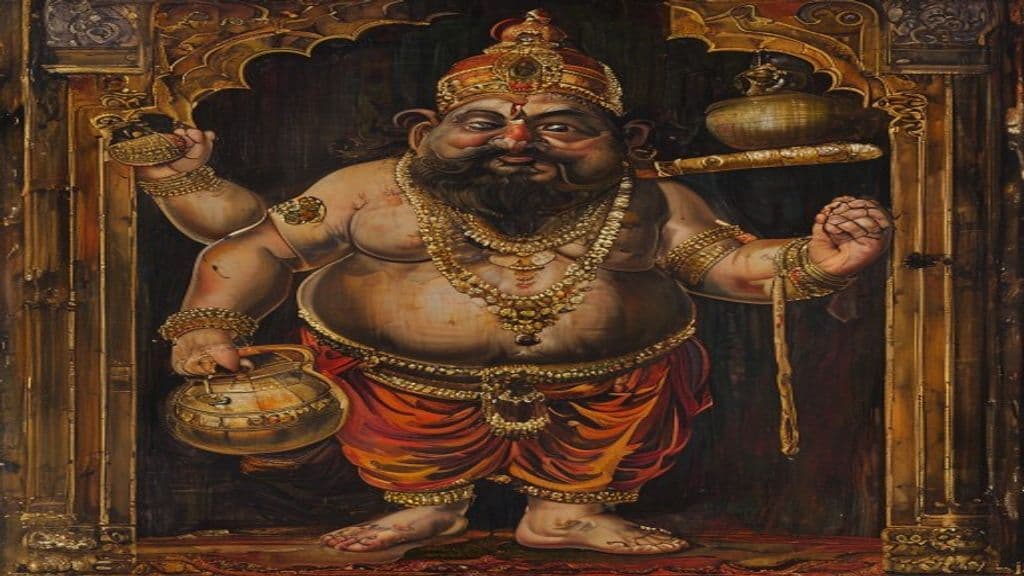
Sources present variant genealogies: in some Vedic and Brahmanic texts Kubera appears as a spirit-chief and is called son of Vaishravana (patronymic usage), while later Puranic and epic accounts incorporate him into divine-sage genealogies (linked to Pulastya/Vishrava lines) and relocate him as ruler of the city of Alaka in the Himalayas after episodes such as being overthrown in Lanka. The textual record thus shows an evolution from a chief of evil or dark spirits in early layers (Atharvaveda, Shatapatha Brahmana) to a deva and protector in Puranic tradition.
Kubera is commonly depicted as a plump, dwarf-like figure adorned with jewels, carrying a money-pot and a club (gada). Later Puranic descriptions add distinctive deformities: examples include three legs, only eight teeth, one eye, and—in some Puranic passages—three heads and four arms. Iconographic variants show him holding a mace, a pomegranate, a money bag, a sheaf of jewels, or a mongoose; he may be shown seated on a goat (Agni Purana) or riding an elephant named Sarvabhauma. Tibetan/Buddhist images frequently depict him with a mongoose symbolizing victory over nāgas; Jain portrayals may depict him holding a nectar vessel.
Kubera is described as the owner of the treasures of the world and the god-king of the yakshas, with epithets that also name him lord of rakshasas, guhyakas, kinnaras and related classes—titles that mark his princely authority over semi-divine retinues in the textual record. He functions as a dikpala (regent) of the north and a lokapala (protector of the world). Iconographic attributes (tusks, club) are interpreted as markers of his powers both to punish and to bestow favors. Early texts additionally portray him as leader of spirits of darkness and as associated with thieves and criminals, a morally ambivalent role that shifts in later literature toward patronage of merchants and ritual veneration.
Weaknesses
None recorded.
Wards
- ritualpropitiatory invocation at the end of sacrifices
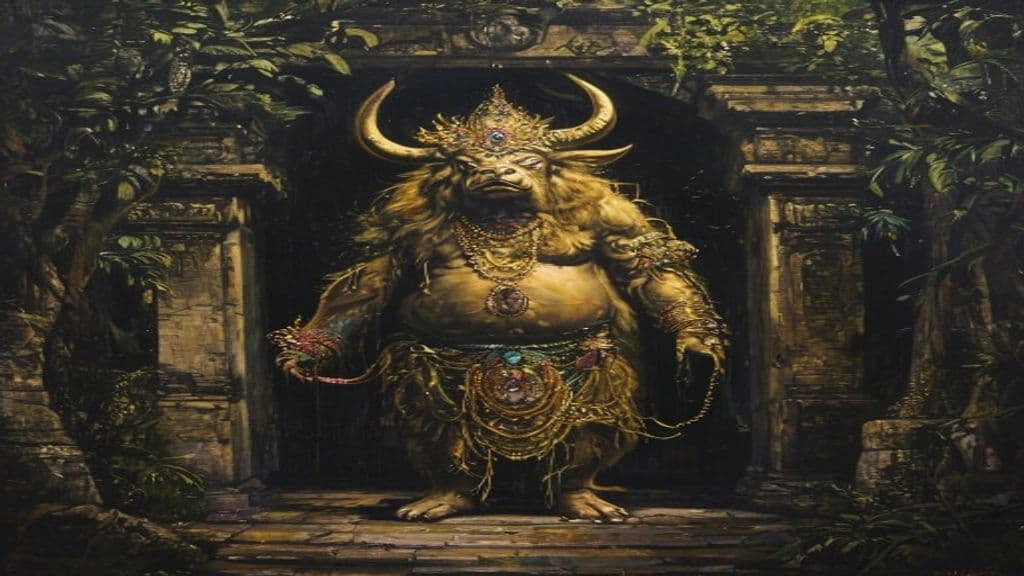
Yaksha
Nature spirits of Hindu, Buddhist, and Jain cosmology — guardians of forests, treasures, and wilderness. Ambivalent beings, capable of great benevolence to the respectful and terrible harm to the greedy.
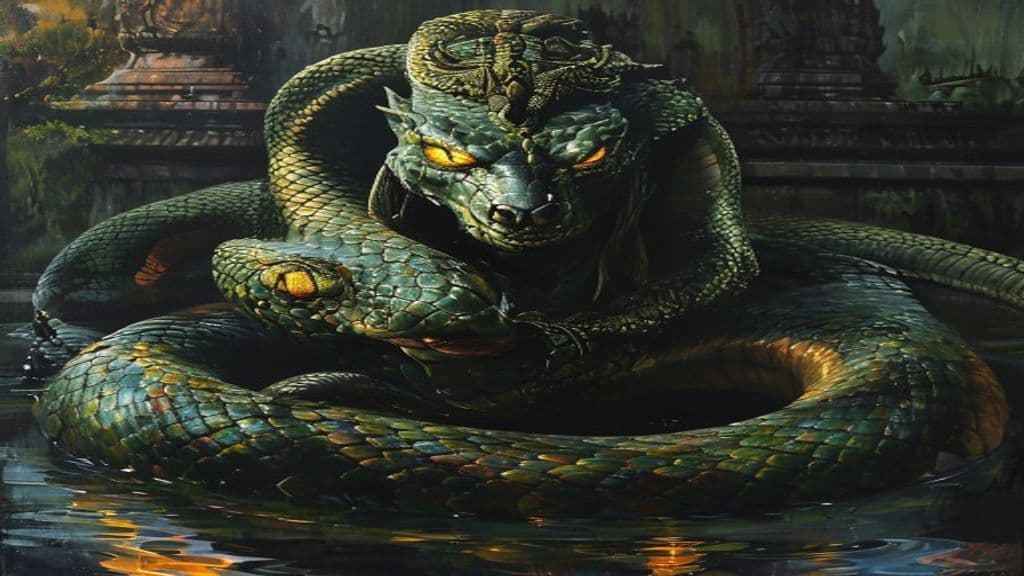
Naga
Divine serpent beings of Hindu, Buddhist, and Jain cosmology — powerful guardians of water, earth, and underground treasures. Revered as deities in South and Southeast Asia.

Rakshasa (Himalayan variants)
A Himalayan reception of the pan-Indian rakshasa motif: hostile or disruptive non‑human beings known from Sanskrit epic and Puranic literature, here noted where Himalayan sources and discussions intersect with the broader epic tradition. The supplied sources do not document distinct, well‑attested Himalayan folklore variants; the entry therefore presents primarily the epic/legendary profile as transmitted into Himalayan contexts in general references.
Community Record
- [1]Kubera. Wikipedia, entry 'Kubera'. Retrieved material summarizing textual sources and iconography.wiki
- [2]Kubera (Wikidata). Wikidata summary entry for Kubera.wiki