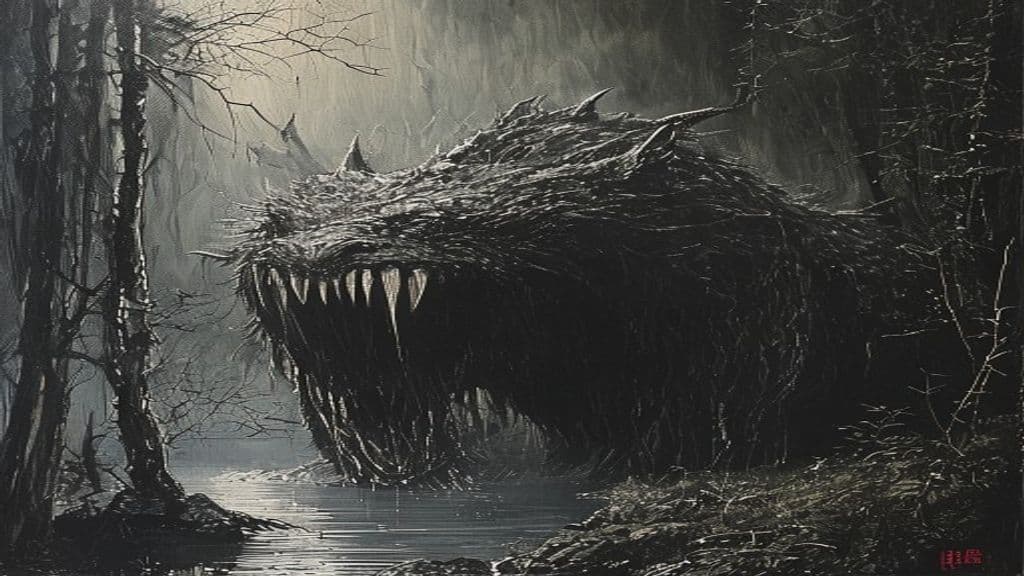
Available sources present Kussie as a modern, place‑linked cryptid whose English/romanized name 'Kussie' (クッシー) is ostensibly inspired by 'Nessie', the nickname of the Loch Ness Monster in Scotland. The creature is named for and associated with Lake Kussharo; the lake’s place‑name itself derives from the Ainu word 'Kuccharo' (rendered in sources as meaning 'The place where a lake becomes a river and the river flows out'). The sources emphasize Kussie’s role in contemporary local folklore and tourism and do not record a traditional Ainu mythic origin for the creature in the supplied material.
Sources describe Kussie only generically as a 'lake monster' or 'cryptid' and provide no consistent, detailed physical description (no reliable records of size, shape, coloration, or distinctive anatomical features are given in the available material). The creature is commemorated in local culture by a shore statue at Lake Kussharo, indicating a public visual depiction used for cultural identity and tourism rather than an authoritative morphological account.
The consulted sources do not attribute specific supernatural powers, behaviors, or human interactions to Kussie. There are no documented reports in the provided material of attacks, distinct behaviors, or paranormal abilities. Kussie’s recorded role is folkloric and touristic — a named lake cryptid associated with a particular place — rather than a being with clearly recorded agency or powers in the available sources.
Kuraokami
Kuraokami is a classical Japanese kami associated with rain and snow, named in the Kojiki and Nihon Shoki genealogies as one of the deities produced from the violent aftermath of the fire-deity Kagu-tsuchi's death. The name combines kura (闇, "dark") with the uncommon logograph okami (龗/淤加美), a character and set of associations linking rain, supernatural power, and later commentator identifications with snake/dragon imagery.
Kuruppa
No information about an entity called Kuruppa is present in the provided source. The sole source supplied discusses England at the 2022 Commonwealth Games and contains no references to Kuruppa, its nature, traits, rituals, or cultural context.
Kush Nama
Supernatural being in Persian epic poem with unknown nature and abilities. (Note: - Power tier: Unknown/Unspecified should be changed to Primordial, as it is part of a mythical history of Iran and has unknown nature and abilities. - Summary: Inaccurate. The Kush Nama is a Persian e)
Kusha
Kusha (Sanskrit: कुश, IAST: Kuśa) is the elder of the twin sons of Rama and Sita in the Hindu epic the Ramayana. Presented in canonical Uttara Kāṇḍa material as a human prince raised at Valmiki's ashram, he functions as an heir and founder-king who preserves dynastic continuity and helps transmit the Ramayana as a cultural text; a small number of later or regional variants give alternate birth legends or expanded territorial claims.
Kushiel
Kushiel is an angel in Judeo-Christian folkloric and Hebrew‑writing contexts described as a punitive agent of divine justice. He is named among a group of seven angels associated with punishment and is variously described as operating from a heavenly layer and as linked to infernal punishment.
Kusibanda
Kusibanda (also spelled Kusigbanda; older disputed reading Guškinbanda) is a Mesopotamian deity who functions as the tutelary god of goldsmiths and silversmiths. He is associated with the preparation of statues and is attested in temple contexts (notably the temple of Ninimma in Nippur) and in documents from Seleucid-period Uruk.
Kusu
Kusu is a Mesopotamian deity associated with purification and the removal or mitigation of ritual pollution. The available sources identify Kusu primarily by this functional role; detailed mythic biography, iconography, or ritual prescriptions are not provided in the supplied material.
Kut (mythology)
No evidence for a mythological entity named 'Kut' appears in the supplied sources. The materials provided instead reference a city named Al-Kut in Iraq, unrelated archive items, and a festival name containing the substring 'Kut.' This entry records the absence of documented mythic material in the provided source set.
Kuttichathan
Kuttichathan is a Malabari (Kerala) folk-deity/kshetrapala figure presented in local Hindu and theyyam contexts as a juvenile, ambivalent spirit who can both bless households and harass them with trickery. In parts of northern Malabar he is identified with or represented by Vishnumaya Chathan and is invoked in theyyam ritual-performance and small-scale household propitiation.
Kuttichathan (Chathan)
Kuttichathan (also written Chathan) is presented in the supplied sources as a supernatural figure depicted in Malayalam popular cinema. In the cited film My Dear Kuttichathan (1984) the being is described as a "mystical indigenous goblin" who is placed under a sorcerer's spell, later released by three children, and then befriends them.
Kuutar
Kuutar (lit. "Lady Moon") is a Finnish mythic-poetic lunar feminine figure attested in Kalevalaic and regional runic-song tradition who owns and spins the moon's gold, weaves luminous garments, and is petitioned in songs for protection, adornment, and health at the new moon.
Kuyang
A Southeast Asian nocturnal female spirit motif, described as a floating disembodied woman's head with internal organs trailing beneath the neck; attested in English-language summaries and contemporary creative and tourism writings that reference the broader Krasue motif.
Community Record
- [1]Kussie. Wikipedia, 'Kussie' (accessed from provided research notes)wiki
- [2]Kussie (Wikidata). Wikidata entry for Kussie (referenced in research notes)wiki
- [3]Kussie | Cryptid Wiki. Cryptid Wiki / Fandom entry for Kussie (referenced in research notes)folk