
The provided sources do not include a specific etiological origin tale for Kuyang. English-language summaries treat it as part of the broader Krasue motif of Southeast Asian folklore (Source: Wikipedia: Krasue) but do not record a localized mythic origin in the supplied materials.
Described as the floating, disembodied head of a woman, usually young and beautiful, with internal organs still attached and trailing down from the neck (Wikipedia: Krasue). Poetic and contemporary accounts emphasize a feminine visage and long dark hair visible in moonlit, humid nights (poem excerpt).
Sources characterize Kuyang primarily by its nocturnal, floating appearance; the encyclopedic summary describes it as a nocturnal spirit manifesting as a disembodied head with trailing organs (Wikipedia: Krasue). The supplied materials do not provide a detailed catalogue of additional powers, feeding behaviors, or specific victim-affecting abilities.
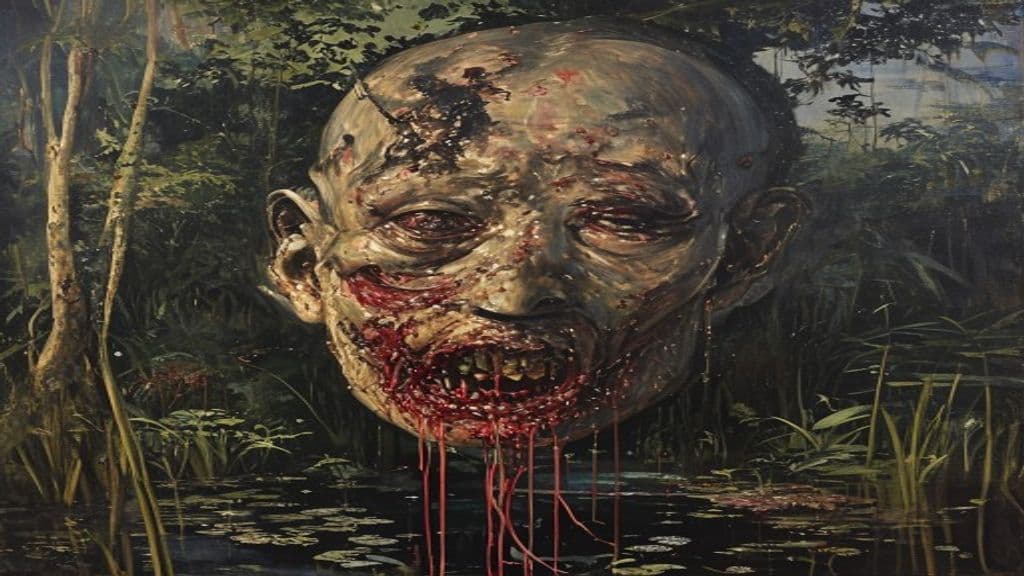
Hantu Bongkok
A bloodthirsty ghost or evil spirit from pre-colonial-era Indonesian folklore in Palembang, South Sumatra. (Note: * Summary: Accuracy confirmed, but it's worth noting that a brief mention of its bloodthirsty nature could be added. * Power tier: Should be "Ancient" since Hantu Bongkok is described as an evil spiri)
Malin Kundang
A figure from an Indonesian folktale, transformed into stone as a result of his disobedience and retribution. He represents the consequences of one's actions, emphasizing filial piety and obedience. (Note: 1. Power tier should be assigned based on the entity's abilities; since it doesn't have any mentioned abilities, this might not be applicable. 2. Appearance should be added to describe Malin Kundang's)
Nyi Roro Kidul (Queen of the Southern Sea)
Nyi Roro Kidul is a supernatural female figure in Sundanese and Javanese tradition identified as the Queen of the Southern Sea off the coast of Java. She functions as a regionally significant sea sovereign connected in local narratives and place‑based traditions (for example Pelabuhan Ratu) and appears in contemporary poetic and popular media.
Orang Pendek
Orang Pendek is a figure from Sumatran tradition and modern cryptozoology described either as a short, ground-dwelling bipedal primate inhabiting remote forests of Sumatra or, in some indigenous accounts, as a supernatural 'short ghost' (Hantu Pendek) used in oral lore and cautionary tales.
Suanggi
A malevolent spirit from Indonesian folklore, known for its harmful intentions towards humans. (Note: * Power tier should be Lesser, as it's only described as a "malevolent spirit" without any indication of regional or deity-level power. * Sensory cues, weaknesses, and wards are not mentioned in the s)
Kut (mythology)
No evidence for a mythological entity named 'Kut' appears in the supplied sources. The materials provided instead reference a city named Al-Kut in Iraq, unrelated archive items, and a festival name containing the substring 'Kut.' This entry records the absence of documented mythic material in the provided source set.
Kuttichathan
Kuttichathan is a Malabari (Kerala) folk-deity/kshetrapala figure presented in local Hindu and theyyam contexts as a juvenile, ambivalent spirit who can both bless households and harass them with trickery. In parts of northern Malabar he is identified with or represented by Vishnumaya Chathan and is invoked in theyyam ritual-performance and small-scale household propitiation.
Kuttichathan (Chathan)
Kuttichathan (also written Chathan) is presented in the supplied sources as a supernatural figure depicted in Malayalam popular cinema. In the cited film My Dear Kuttichathan (1984) the being is described as a "mystical indigenous goblin" who is placed under a sorcerer's spell, later released by three children, and then befriends them.
Kuutar
Kuutar (lit. "Lady Moon") is a Finnish mythic-poetic lunar feminine figure attested in Kalevalaic and regional runic-song tradition who owns and spins the moon's gold, weaves luminous garments, and is petitioned in songs for protection, adornment, and health at the new moon.
Kuśadhvaja
Kuśadhvaja is a human royal figure in the Ramayana tradition, described as the younger brother of King Janaka of Mithila, husband of Chandrabhaga, and father of Mandavi and Shrutakirti. He is named as King of Samkasya after Janaka defeats Sudhanvan and appears in the narrative context of the Sita–Rama marriage.
Kwaku Ananse
Kwaku Ananse (Anansi, Ananse) is a central spider-associated trickster and culture-bearing figure from Akan (including Ashanti) folklore of southern Ghana. Presented in oral tale cycles, songs, children’s literature, and modern media, he embodies wisdom, wit, cunning, and mischievousness and functions as a narrative teacher who both questions and ultimately reinforces social norms.
Kwoth
Kwoth (also Kuoth, Kuoth Nhial) is the supreme, omnipresent creator deity of the Nuer people of South Sudan and Gambella. Regarded as the 'Spirit of the Sky', Kwoth is the originator of humans, sovereign over celestial bodies and natural phenomena, and the ultimate divine presence invoked in life-cycle and funerary rites.
Community Record
- [1]Krasue. Wikipedia entry 'Krasue' (describing the Krasue/Kuyang motif as a nocturnal female spirit manifesting as a floating disembodied head with trailing organs).wiki
- [2]Haunted Ubud, Indonesia (archived travel/paranormal writeup). Archived 'Haunted Ubud' piece describing Bali/Ubud as places considered haunted and noting local seriousness about ghost stories.other
- [3]One Poem by Sora Anindya — 'Local Crip Yearns for Kuyang Sighting' (poem excerpt). Poem excerpt describing a floating feminine figure: 'She floated through the humid night. Jet black long hair gleamed under the moonlight.'literary
- [4]Kuyang (D&D/NPC page — creative adaptation). Creative/roleplaying adaptation page referencing the Kuyang motif (included among provided materials).other
- [5]Uma Kuyang - The Orangutan's House (Dorafilms). Film/article reference containing the name 'Uma Kuyang' included among provided materials; cited here as part of contemporary cultural references to the term.other