
Canonical Uttara Kāṇḍa accounts present Kusha as born to Sita at the hermitage of the sage Valmiki after Sita is left there pregnant; he and his twin brother Lava are raised and educated in that ashram. A distinct folktale variant recorded in the Kathāsaritsāgara tradition relates that Valmiki created Kusha from kusha grass (kusa grass) when Lava was absent; this grass-origin account is a later or regional variant rather than the mainstream Uttara Kāṇḍa birth narrative.
Provided sources do not supply a fixed iconography for Kusha; descriptions emphasize kinship resemblance rather than detailed features. Several accounts note that Kusha and Lava resembled their father Rama, and some sources remark on a whitish-golden complexion attributed to the twins, indicating continuity of parentage and royal appearance. Overall the texts foreground his familial identity and role as heir rather than a standardized physical portrait.
Kusha is trained in military arts and educated under the sage Valmiki at the ashram; he and his twin are the first audience for Valmiki's recitation of the Ramayana and later popularize the epic by traveling and performing it. In some versions (and in the Padma Purana) Kusha and Lava capture the sacrificial horse of Rama's ashvamedha and defeat Rama's brothers and army, demonstrating notable martial prowess. After the events of the epic he becomes a king — founding Kushasthali and ruling parts of southern Kosala — and in some secondary accounts (e.g., Ānanda Rāmāyaṇa) organizes forces to restore Ayodhya to its former splendour; certain traditions extend his dominion further as a variant claim.

Valmiki
Valmiki is a legendary maharṣi (great sage) and poet in the Hindu textual and cultural tradition, traditionally credited as the author of the Rāmāyaṇa and revered as Ādi Kavi ('first poet'). He is a canonical literary-religious figure and cultic exemplar rather than an adversarial supernatural being.
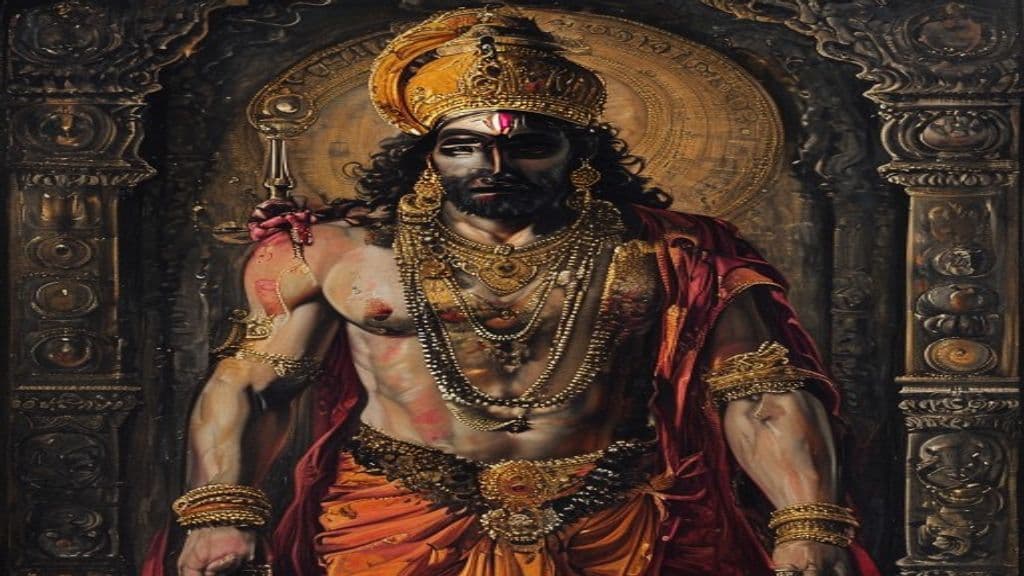
Rāma
Rāma is a major divine-hero in Hindu tradition, worshipped as the seventh avatar of Viṣṇu and the central protagonist of the Ramayana. He is portrayed both as the ideal man (maryāda puruṣottama) and, in Rama-centric sects, as the Supreme Being; his life-story (birth in Ayodhyā, 14-year exile, Sītā's abduction, and the defeat of Rāvaṇa) functions as a primary exemplar of dharma.
Añjanā
Añjanā (Sanskrit: अञ्जना; also Anjani, Anjali) is a semi-divine figure of the Ramayana cycle, described as an apsara reborn among the vanaras and the mother of the hero Hanuman. She figures both in pan-Indian epic narratives (as wife of Kesari and devotee of Vayu) and in regional cultic practice (notably a temple tradition in Himachal Pradesh) and is adapted in Javanese wayang as Dewi Anjani.
Kuśadhvaja
Kuśadhvaja is a human royal figure in the Ramayana tradition, described as the younger brother of King Janaka of Mithila, husband of Chandrabhaga, and father of Mandavi and Shrutakirti. He is named as King of Samkasya after Janaka defeats Sudhanvan and appears in the narrative context of the Sita–Rama marriage.
Lakshmana
Lakshmana is the younger half-brother and devoted attendant of Rama in the Ramayana tradition. Portrayed as an ideal companion and protector during Rama’s fourteen-year exile and the war with Ravana, the Puranas also describe him as an incarnation (avatara) of the serpent Shesha, linking him to the divine order surrounding Vishnu.
Nila
Nila (Sanskrit: नील, Nīla; also spelled Neela) is a vanara chieftain in the Ramayana epic, described as commander‑in‑chief of the vanara army under Sugriva who leads troops in the war against Ravana and participates in the search for Sita and the building of the Rama Setu in some traditions.
Kurangaituku
Kurangaituku is a part-woman, part-bird supernatural being from Māori oral traditions of Te Arawa and Raukawa in the Rotorua / central North Island region. Accounts vary between portrayals of her as a fearsome ogress or witch and as a nurturing, creative guardian of birds; she is most famously linked in narrative to the human figure Hatupatu and to specific landscape sites.
Kuraokami
Kuraokami is a classical Japanese kami associated with rain and snow, named in the Kojiki and Nihon Shoki genealogies as one of the deities produced from the violent aftermath of the fire-deity Kagu-tsuchi's death. The name combines kura (闇, "dark") with the uncommon logograph okami (龗/淤加美), a character and set of associations linking rain, supernatural power, and later commentator identifications with snake/dragon imagery.
Kuruppa
No information about an entity called Kuruppa is present in the provided source. The sole source supplied discusses England at the 2022 Commonwealth Games and contains no references to Kuruppa, its nature, traits, rituals, or cultural context.
Kush Nama
Supernatural being in Persian epic poem with unknown nature and abilities. (Note: - Power tier: Unknown/Unspecified should be changed to Primordial, as it is part of a mythical history of Iran and has unknown nature and abilities. - Summary: Inaccurate. The Kush Nama is a Persian e)
Kushiel
Kushiel is an angel in Judeo-Christian folkloric and Hebrew‑writing contexts described as a punitive agent of divine justice. He is named among a group of seven angels associated with punishment and is variously described as operating from a heavenly layer and as linked to infernal punishment.
Kusibanda
Kusibanda (also spelled Kusigbanda; older disputed reading Guškinbanda) is a Mesopotamian deity who functions as the tutelary god of goldsmiths and silversmiths. He is associated with the preparation of statues and is attested in temple contexts (notably the temple of Ninimma in Nippur) and in documents from Seleucid-period Uruk.
Kussie
Kussie (クッシー, Kusshī) is a modern local lake‑monster/cryptid associated with Lake Kussharo in eastern Hokkaidō, Japan. Presented in contemporary sources as a place‑linked folkloric creature, Kussie functions largely as a component of local identity and tourism rather than as a well‑documented traditional spiritual being.
Kusu
Kusu is a Mesopotamian deity associated with purification and the removal or mitigation of ritual pollution. The available sources identify Kusu primarily by this functional role; detailed mythic biography, iconography, or ritual prescriptions are not provided in the supplied material.
Community Record
- [1]Kusha (Ramayana) — Wikipedia. Wikipedia entry 'Kusha (Ramayana)'wiki
- [2]Valmiki Ramayana - Bala Kanda (sarga 32, 34). Valmiki Ramayana, Bala Kāṇḍa, sarga 32 and 34 (translations/online edition)literary
- [3]Kathāsaritsāgara variant (reported). Summary note citing Kathāsaritsāgara variant that Valmiki created Kusha from kusha grass (as reported in source compilation)folk
- [4]Hinduism StackExchange: 'Was Kusha born from grass?'. Question and answers discussing the kusha-grass origin variant and its status as noncanonical/variantother
- [5]Ānanda Rāmāyaṇa and Padma Purana references (summary in compiled notes). Secondary/traditional accounts summarized in compiled sources referencing Ānanda Rāmāyaṇa (restoration of Ayodhya) and Padma Purana (ashvamedha episode variants)literary
- [6]Lava (Ramayana) — Wikipedia. Wikipedia entry 'Lava (Ramayana)' (context on twin brother and shared descriptions)wiki
- [7]Boloji article: 'Rama’s Acceptance of Lava-Kusha'. Article summarizing narrative of the twins' recitation and refusal of monetary reward during the ashvamedha episodeother