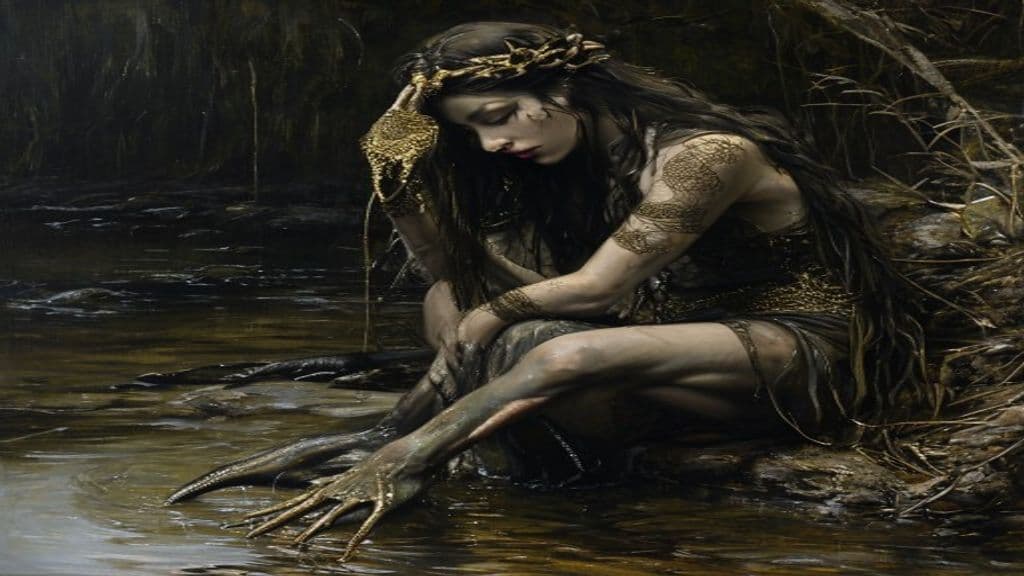
The Lamia is described as a beautiful woman with long hair and webbed duck feet, often found brushing its hair at the river shore using a golden comb.
The Lamia seduces men, implying power over human emotions possibly through enchantment or allure.
Lamaria (Georgian Tradition)
In Georgian mythology, Lamaria is a goddess associated with the hearth, cattle, women, and fertility of grain fields. (Note: 1. The article states Lamaria is associated with cattle and women, but the source does not specify her association with women, only protecting them during childbirth. 2. Power tier: Less specific abil)
Lamashtu
The most feared demoness of ancient Mesopotamia — a divine daughter of Anu who preyed on pregnant women, caused miscarriages, and killed infants by nursing them with venom.
Lamassu
Lamassu are protective tutelary beings of ancient Mesopotamia, represented both as a Sumerian mediating goddess (Lama) and later as hybrid monumental guardian figures (human-headed, winged bulls or lions) placed at thresholds, gates, and palaces to protect households and polity.
Lamb of God
A Christological title applied to Jesus (the Christ) within Christian scripture and theology that emphasizes his role as sacrificial redeemer who 'takes away the sin of the world' and, in eschatological texts, as the worthy agent of divine judgment and victory.
Lamia
In ancient Greek mythology, Lamia is described as a child-eating monster who, in later tradition, came to be regarded as a type of night-haunting spirit or 'daimon'. The supplied sources do not provide a full physical description or detailed mythic genealogy, and some modern fictional portrayals recast her with serpentine features which are not attested in the provided classical summary.
Lamia
A child-devouring demon of Greek mythology — once a queen of Libya and lover of Zeus, driven mad by Hera's destruction of her children and transformed into a monstrous hunter of other women's children.
Lamiai
Lamiai (singular Lamia) are a class of malignant, night‑haunting female phantoms in Greek tradition, originally attested as a child‑devouring monster and later generalized into a type of daimon or spectre associated with seduction and the predation of young men and children.
Lamias (Caucasian / Georgian — entry constrained)
This entry concerns lamia-like female supernatural figures as requested for the Caucasian/Georgian context. The only supplied source discusses the Arthurian 'Lady of the Lake' and contains no direct information about lamias in Georgian or broader Caucasian tradition. The entry therefore records what the supplied source does state, and documents the absence of primary material for Georgian lamias in the provided research.
Lampago
A heraldic beast depicted with the body of a tiger or lion and the head of a man, used as a charge on coats of arms rather than as an agent of narrative folklore. Best known from English heraldry, notably the arms of the Radford family of Plymstock, Devon.
Lampetia
Lampetia is a figure in ancient Greek myth, described as a daughter/attendant of the sun-god Helios who, with her sister Phaethusa, guards Helios's sacred herd on the island Thrinacia. She functions as a divine herdswoman and reporter of transgressions against divine property in Homeric narrative and appears in variant genealogies in later mythography.
Lampus / Lampos
Lampus (Ancient Greek: Λάμπος) is not a single mythic being but a personal name applied across a range of classical Greek mythic figures — human and animal — whose name evokes 'brightness' or 'shine.' Attestations in classical mythographic and epic materials include royal mortals, hounds, and named horses associated with dawn and sun deities and with heroes.
Landvættir
Landvættir are place-bound spirits or 'land-beings' in Old Norse and Icelandic tradition whose favor was linked to the fertility and safety of particular locales. Attested in saga literature, law codes, and later folk practice, they are localized guardians or presences dwelling in stones, hills, skerries, and other landscape features and were addressed by offerings and social regulations.
Community Record
- [1]Wikipediawiki