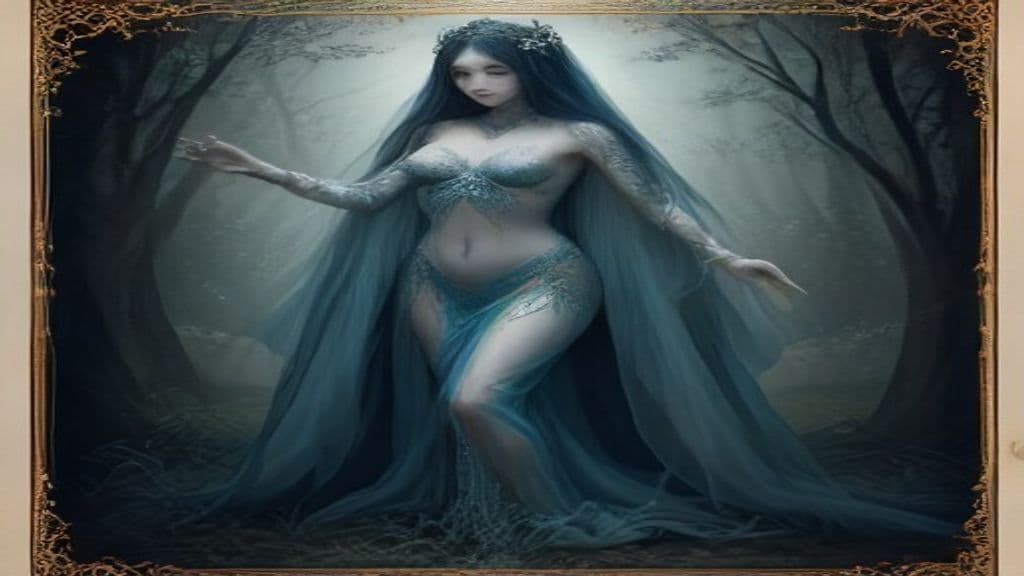
No origin story for lamias in the Georgian or Caucasian context is present in the supplied source. The single provided source describes the Lady of the Lake—an exemplar of a European female supernatural figure—but offers no genealogies, creation accounts, or origin myths applicable to lamias in the Caucasus. Any specific origin narrative for Georgian lamias must be drawn from additional primary or scholarly sources not included here.
The provided source does not describe lamias from the Caucasus or Georgia. It only indicates that the Arthurian 'Lady of the Lake' appears as a fairy-like or human enchantress. No reliable physical descriptions for Georgian lamias are present in the supplied material; therefore no appearance details for Caucasian lamias can be asserted from these notes.
From the supplied Arthurian source (not a Caucasian source) the Lady of the Lake is credited with granting Excalibur, removing Merlin, raising Lancelot, and conveying Arthur to Avalon—examples of agency by a female supernatural figure in European legend. The supplied source contains no documentation that Georgian or Caucasian lamias possess these abilities. Any claim about lamias' powers in Georgia would require independent sourcing and is not supported by the provided material.
Lamassu
Lamassu are protective tutelary beings of ancient Mesopotamia, represented both as a Sumerian mediating goddess (Lama) and later as hybrid monumental guardian figures (human-headed, winged bulls or lions) placed at thresholds, gates, and palaces to protect households and polity.
Lamb of God
A Christological title applied to Jesus (the Christ) within Christian scripture and theology that emphasizes his role as sacrificial redeemer who 'takes away the sin of the world' and, in eschatological texts, as the worthy agent of divine judgment and victory.
Lamia
In ancient Greek mythology, Lamia is described as a child-eating monster who, in later tradition, came to be regarded as a type of night-haunting spirit or 'daimon'. The supplied sources do not provide a full physical description or detailed mythic genealogy, and some modern fictional portrayals recast her with serpentine features which are not attested in the provided classical summary.
Lamia
A child-devouring demon of Greek mythology — once a queen of Libya and lover of Zeus, driven mad by Hera's destruction of her children and transformed into a monstrous hunter of other women's children.
Lamia (Basque mythology)
In Basque mythology, the Lamia is a siren-like creature associated with rivers and seduction. (Note: - Power tier should be adjusted to Ancient (deity-level) or Greater (powerful regional), as there is no indication that Lamia has cosmic powers. - No information on wards, weaknesses, or sensory cues )
Lamiai
Lamiai (singular Lamia) are a class of malignant, night‑haunting female phantoms in Greek tradition, originally attested as a child‑devouring monster and later generalized into a type of daimon or spectre associated with seduction and the predation of young men and children.
Lampago
A heraldic beast depicted with the body of a tiger or lion and the head of a man, used as a charge on coats of arms rather than as an agent of narrative folklore. Best known from English heraldry, notably the arms of the Radford family of Plymstock, Devon.
Lampetia
Lampetia is a figure in ancient Greek myth, described as a daughter/attendant of the sun-god Helios who, with her sister Phaethusa, guards Helios's sacred herd on the island Thrinacia. She functions as a divine herdswoman and reporter of transgressions against divine property in Homeric narrative and appears in variant genealogies in later mythography.
Lampus / Lampos
Lampus (Ancient Greek: Λάμπος) is not a single mythic being but a personal name applied across a range of classical Greek mythic figures — human and animal — whose name evokes 'brightness' or 'shine.' Attestations in classical mythographic and epic materials include royal mortals, hounds, and named horses associated with dawn and sun deities and with heroes.
Landvættir
Landvættir are place-bound spirits or 'land-beings' in Old Norse and Icelandic tradition whose favor was linked to the fertility and safety of particular locales. Attested in saga literature, law codes, and later folk practice, they are localized guardians or presences dwelling in stones, hills, skerries, and other landscape features and were addressed by offerings and social regulations.
Langsuir
A Malay banshee-vampire — the spirit of a woman who died in childbirth, transforming into a beautiful owl-woman who sucks the blood of infants through a hole in the back of her neck.
Langsuyar
A female revenant in Malay and related archipelagic traditions said to be the ghost of a woman who died in connection with pregnancy or childbirth. The langsuyar is described variously as a beautiful long‑haired woman or as a floating head with trailing entrails; she is vampiric in behavior, associated with night‑birds and certain trees/ferns, and managed by corpse‑preparations, charms, and exorcistic measures.
Community Record
- [1]Lady of the Lake. Wikipedia contributors. "Lady of the Lake." Wikipedia, The Free Encyclopedia. https://en.wikipedia.org/wiki/Lady_of_the_Lakewiki