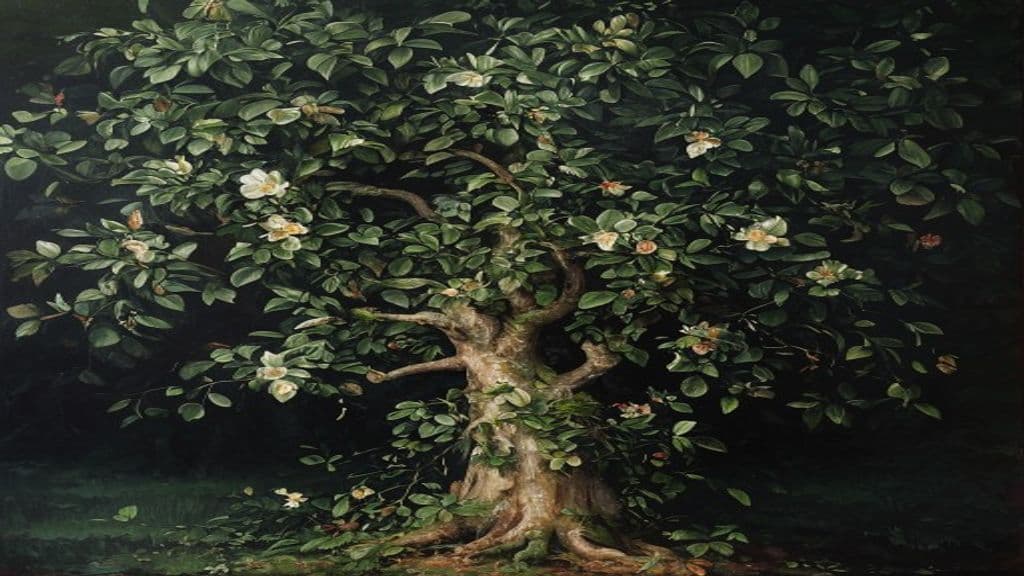
There is no specific origin story for the lime tree in Germanic tradition.
The lime tree's appearance is not typically described in folklore or mythology, but its calming flowers and leaves are mentioned as having a soothing effect on humans.
The lime tree is said to have the ability to promote peace, tranquility, and healing. It is also associated with protection from harm, evil spirits, or negative energies, and its presence is often seen as a protector. Additionally, it is believed to promote wisdom and good dreams.
Weaknesses
- noneThe lime tree has no known weaknesses in folklore.
Wards
- ritualUsing the lime tree's flowers or leaves in rituals for purification and protection
Alberich
In Germanic heroic legend, Alberich is a dwarf associated with elven qualities and power. (Note: 1. Power tier: Reduce to Ancient as Alberich's abilities are not described beyond being a dwarf with elven qualities. 2. Origin story: Clarify that Alberich is mentioned in multiple Germanic texts, bu)
Altgermanische Religionsgeschichte
A historical survey of Germanic religious history, providing an overview of the pantheon of gods and goddesses. (Note: - Power tier is not applicable to historical surveys - The article should reflect that it's a historical survey, not an entity with abilities or appearance - Consider adding information on the signifi)
Anglo-Saxon Deities
A list of deities from the Anglo-Saxon pantheon, likely derived from Old English and other Germanic languages. (Note: 1. Power tier: Primordial seems too high given the sparse written record and limited information on abilities. 2. Appearance: Delete statement as no physical descriptions are provided in available sou)
Chamrosh
Supernatural bird entity inhabiting the summit of Mount Alborz in Persian mythology. (Note: 1. Remove "Origin story" section since no origin story is provided in the source material. 2. Add a statement about the lack of specific abilities or behaviors under the "Abilities" section to clarify)
Eotenas
Eotenas (Old English eotenas) are a race-class of other-than-human beings attested in Anglo-Saxon poetic contexts, notably Beowulf, where they appear among a catalogue of hostile or monstrous stocks. Philological traditions link the term to Old Norse jötnar/ettins (often rendered "giants" in modern summaries), but primary Old English lines give little concrete physical description.
Garshasp-nama (Persian tradition)
A Persian epic poem featuring semi-divine characters and legendary figures, part of the cultural and literary traditions of the time. (Note: 1. Factual claims: The draft lacks specific information on the semi-divine characters' appearance, sensory cues, wards, and weaknesses. 2. Power tier: Given that the main hero, Garshasp, and his famil)
Hamr (Norse)
In Norse mythology, Hamr is a manifestation of one's mental or spiritual essence that can take shape outside the body, enabling magical transformation and disguise. (Note: 1. Power tier: Downgrade to Lesser (local spirit) - Primordial implies cosmic or universal power, which doesn't match the description. 2. Origin story: Add "According to some interpretations" or rephr)
Leđan (Slavic tradition)
An ancient and magical city from Croatian mythology and folklore. (Note: 1. Power tier: downgrade to Greater (since Leđan is described as an "ancient" city, but its magical nature and lack of explicit abilities suggest it may be less powerful than Ancient). 2. Appearance: )
Mannus
Central figure in Germanic creation myths, entrusted with starting humanity; abilities and characteristics unknown. (Note: 1. Power tier should be Ancient (deity-level) as it's implied that Mannus has a significant role in the creation myth and is entrusted by the gods. 2. No information on appearance, sensory cues, wards)
Mummy (undead) (Egyptian tradition)
In Egyptian folklore, a mummy is an undead creature believed to be the reanimated corpse of a deceased person. (Note: * Power tier: Should be Primordial, given the association with cosmic entities and magical powers tied to ancient Egyptian rituals. * Abilities: Clarify that supernatural abilities refer to those on a)
Neck (water spirit)
A class of humanoid water spirits in Germanic mythology and folklore, often described as shapeshifting; names include nixie, nix, nixy, neck, and nicker. The provided sources give only a brief classificatory statement without extended ethnographic detail.
Nixie
A category of water spirit from Germanic and neighbouring European folklore associated with lakes, streams, ponds and waterfalls. Commonly described as shapeshifting and linked to enchanted music, nixies may be helpful or dangerous to humans depending on local tales.
Community Record
- [1]