
In the Mabinogion tale 'Lludd and Llefelys' Lludd is presented as son of Beli Mawr and the ruler of Britain who calls on his brother Llefelys (ruler in Gaul) to help cure three plagues on the island. Philological and comparative commentary in the sources identifies an earlier form of the name, Nudd Llaw Ereint, cognate with the Irish Nuada Airgetlám and associated with the Romano‑British deity Nodens; scholars cited in the sources treat this as evidence that Lludd preserves memories of a pre‑Roman divine figure even as he appears as a legendary king in medieval narrative.
Direct physical description in the narrative sources is minimal; Lludd is chiefly identified by his byname 'Llaw Ereint' ('of the Silver Hand' or 'Silver‑handed'), an epithet that evokes the motif of a notable silver hand/arm found in cognate traditions (Irish Nuada, Romano‑British Nodens). The supplied materials do not record further bodily details or a canonical visual depiction within the Mabinogion summary.
In the Mabinogion account Lludd functions as an effective, resourceful ruler: he measures the island to find its centre (reported as Oxford in the summary), devises and executes remedial schemes for three plagues (notably a trap to capture two battling dragons), resists a soporific enchantment by means of a cold‑water countermeasure, and personally overcomes a nocturnal intruder in combat before granting mercy and incorporating him as a vassal. Comparative sources link the name to deity‑figures associated with sea, healing, and warfare, but those attributes are interpretive associations with Nudd/Nuada/Nodens rather than explicit feats described of Lludd in the core tale.
Weaknesses
- conditionexhaustion ( exploited by trapmakers )
- conditionsoporific effect can be countered by repeated immersion of the head in cold water (as Lludd employed)
Wards
- ritualdragon containment pit with satin covering and cauldron of mead
- conditionfrequent dipping of the head into cold water to resist soporific illusions
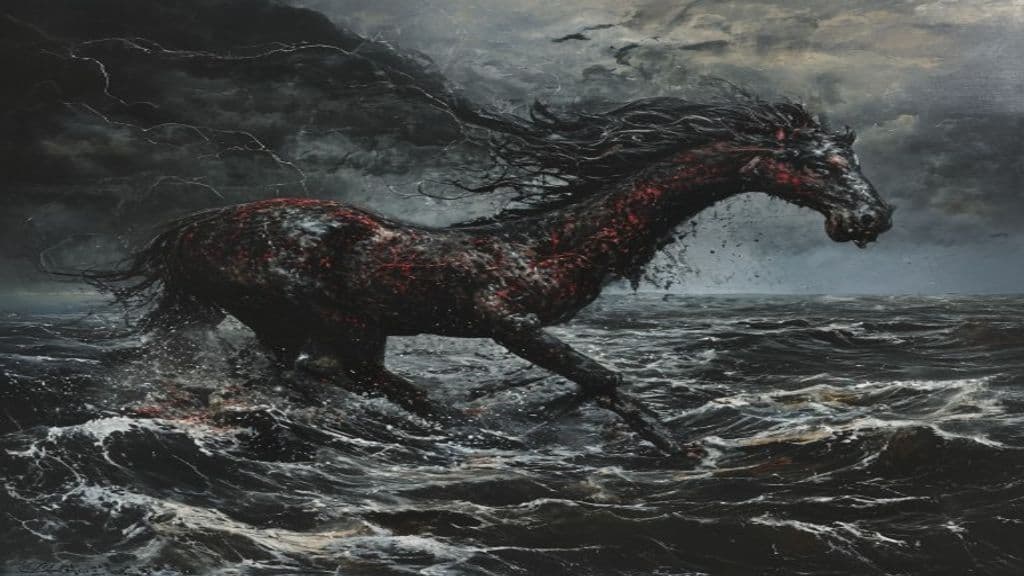
Nuckelavee
The most terrifying creature of Orcadian folklore — a skinless, horse-headed demon of the sea whose breath spreads plague and whose presence causes crops to wither. It cannot cross fresh water.
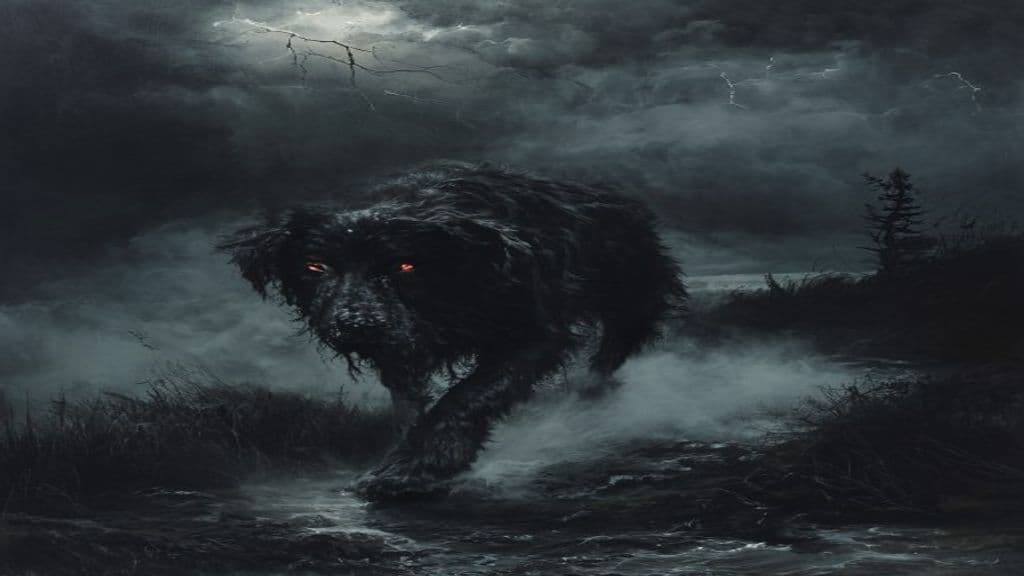
Black Shuck
A spectral black dog of East Anglian legend, with glowing red or green eyes. Its appearance is an omen of death. Its howl has been heard on clifftops during storms for centuries.
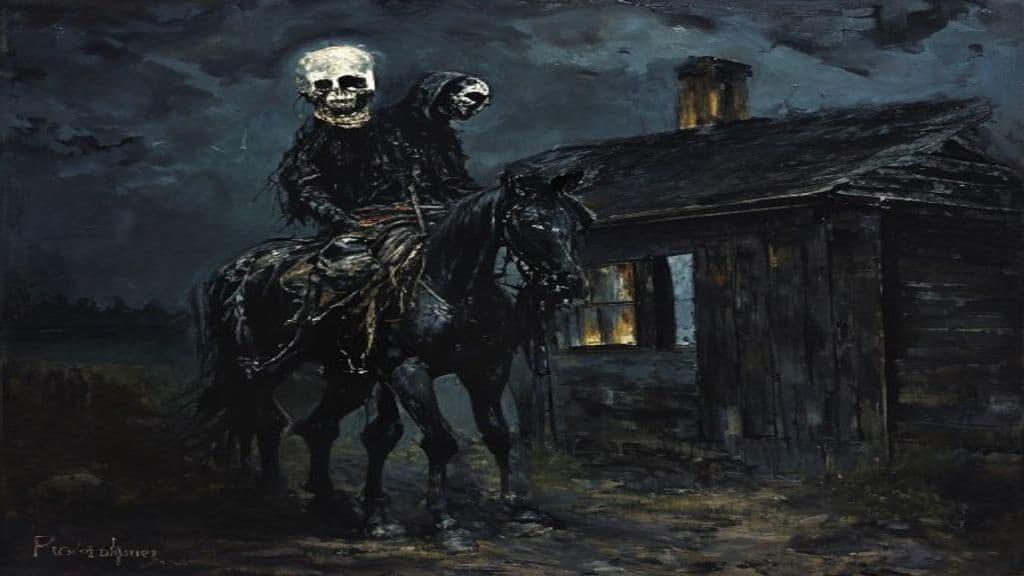
Dullahan
The headless horseman of Irish legend who carries his own rotting head under one arm, stops at the door of those about to die, and cannot be kept out by any lock.
Adar Llwch Gwin
Legendary large, intelligent birds from Welsh tradition said to understand human speech and obey their master's commands; best known for tearing their master Drudwas ap Tryffin to pieces when bound by a literal order in an Arthurian battle narrative. The term later came to be applied to raptors and metaphorically to brave men in medieval Welsh poetry.
Afagddu
Afagddu (also Avagddu, Y Fagddu) is a figure in Welsh tradition noted for extreme ugliness and associated darkness. He appears in the Taliesin/Ceridwen narrative as the intended recipient of Ceridwen's cauldron of inspiration, and functions as a narrative catalyst within bardic origin material and Welsh triadic/name-list contexts.
Afanc
A named monstrous lake-being from Welsh tradition, the afanc is associated with specific lakes and functions as a dangerous localized supernatural hazard that appears in medieval narrative cycles and later antiquarian and local legends.
Caradoc
Caradoc is a semi-legendary heroic/ancestral figure from Welsh and Arthurian tradition, remembered in medieval genealogies and romances as a ruler of Gwent and as a Knight of the Round Table. He is treated in the sources as a human hero whose life is affected by wondrous events (enchantment, serpent-affliction, knightly tests) rather than as an independently supernatural being.
Cath Palug
A monstrous, unusually large cat from Welsh myth later adapted into continental medieval romance (Anglo‑Norman/Old French) as Chapalu/Capalu. Associated with islands, lakes, bogs, and shoreline liminal zones, it functions as a localized animal horror that confronts named heroes (Welsh Cai/Kay; continental sources often transfer the opponent to King Arthur).
Conan Meriadoc
Conan Meriadoc is a legendary ancestral founder and early medieval royal leader credited in Welsh and Breton tradition with founding Brittany (Llydaw). Presented in medieval literary and genealogical sources as a historicized king or prince associated with Magnus Maximus/Macsen Wledig, he functions primarily as a dynastic progenitor and a figure in brittonic prophetic expectation rather than as a supernatural spirit.
Creiddylad
Creiddylad is a named figure from early medieval Welsh narrative tradition, presented in Culhwch ac Olwen as a noblewoman of Arthur's court and daughter of King Lludd (Lludd Llaw Ereint). In the surviving tale she is the object of rivalry between two warriors whose annual May Day combat for her possession has been interpreted by later writers as a seasonal or 'May Queen' motif.
Cyhyraeth
A Welsh spirit whose groaning, sighing wail presages the death of a family member — heard but never seen, specifically associated with the families of Welsh descent.
Drudwas ap Tryffin
A human warrior and knight associated with Arthurian and medieval Welsh tradition, noted chiefly for possessing three supernatural birds (Adar Llwch Gwin) given to him by his fairy wife; a late tale records that his literal command to those birds led to his death.
Drudwyn
A fabulous wild boar figure attested in Arthurian/Welsh tradition; the sources provided identify the well-known monster Twrch Trwyth as a 'fabulous wild boar' whose hunt is narrated in the Welsh prose romance Culhwch and Olwen. The name 'Drudwyn' appears in the query but is not attested in the supplied source excerpts.
Elffin ap Gwyddno
Elffin ap Gwyddno is a human figure in medieval Welsh tradition, presented as the son of Gwyddno Garanhir and the foster-father who finds and raises the poet-seer Taliesin. He functions as a noble household member whose misfortunes and courtly trials provide the narrative context for Taliesin's prophetic and poetic demonstrations.
Geraint son of Erbin
Geraint son of Erbin (Middle Welsh: Geraint uab Erbin / Geraint mab Erbin) is a medieval Welsh legendary hero celebrated in early Middle Welsh englynion for his deeds at the Battle of Llongborth and later as the protagonist of the prose romance "Geraint and Enid," an adaptation of Chrétien de Troyes' Erec and Enide. He functions in the Welsh literary tradition as a martial exemplar situated in the heroic past rather than as a supernatural being.
Community Record
- [1]Lludd Llaw Eraint. Wikipedia: Lludd Llaw Eraint (summary of the Mabinogion tale 'Lludd and Llefelys' and philological notes)wiki
- [2]Wikidata: Lludd Llaw Eraint. Wikidata entry for Lludd Llaw Eraintwiki
- [3]Clas Merdin: Tales from the Enchanted Island (selection of blog posts). Clas Merdin (blog): materials discussing Welsh tales and toponymic notesother
- [4]Clas Merdin: Lludd's City. Clas Merdin blog post discussing Lludd and place‑name associationsother
- [5]The Celtic Journey: Nuada of the Silver Arm. Comparative account linking Nuada/Nuada Airgetlám to the 'silver arm' motif and to Lludd/Nuddother
- [6]Under the influence!: The Prophecy of Merlin: The Two Dragons. Blog summary treating the two dragons motif and connections to Welsh traditionother
- [7]Eye Opening Truth: THE HUNT – NODENS – The First will be Last.. Popular secondary page linking Nodens/Nuada to later legends (used in comparative notes)other