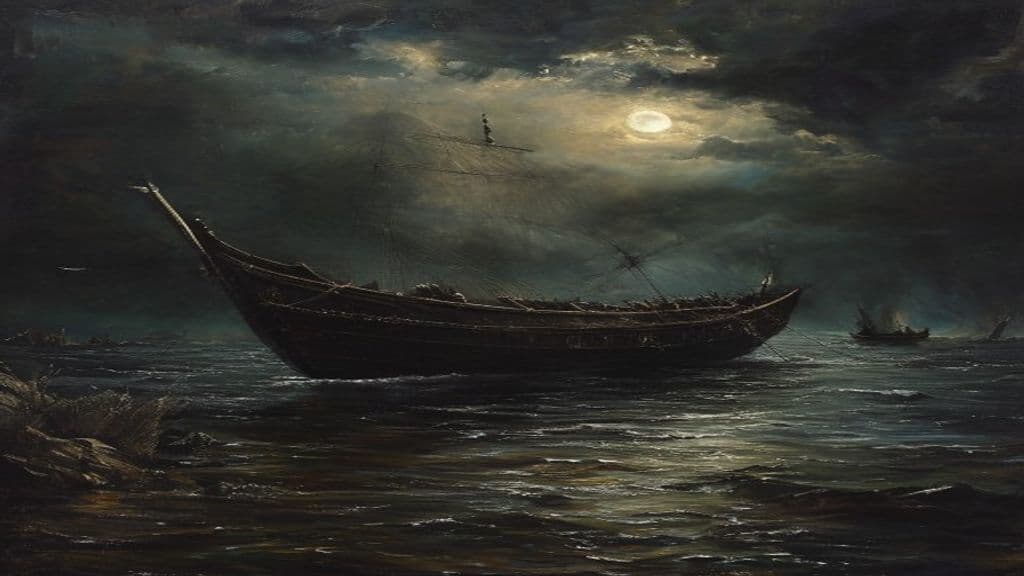
The Magilum Boat is associated with the god Ninurta's conquests, and its name is Sumerian in origin.
No physical description of the Magilum Boat is available.
The boat 'sinks' when all living creatures on board have passed away, indicating a transition to death.
Abzû
Abzû (Sumerian abzû; Akkadian Apsû) is the primordial freshwater abyss in Sumerian–Akkadian cosmology: the deep fresh waters that underlie and surround the earth, source of springs, rivers and ritual holy waters, and a creative principle whose mingling with the salt sea (Tiamat) figures in Mesopotamian cosmogony.
Ashnan (Ezina)
Ashnan (Sumerian Ezina) is the Mesopotamian divine personification of grain: a goddess whose being is identified with the cereal harvest and the category 'grain' itself. Attested from the Uruk and Early Dynastic periods, she appears in hymns, cult lists and disputation literature and is invoked in civic and medical contexts.
Damu
Damu is a Mesopotamian deity attested from the Ur III period onward whose character shifts over time from an early 'dying/vegetation' figure to a later, better-documented role as a healing god associated with medicine-goddesses and cult centers such as Isin.
Enki (Ea)
Enki, also known by the Akkadian form Ea, is a major Mesopotamian deity associated with wisdom, crafts, magic and incantations, and the freshwater deep called the Abzû. Centered at the cult-city Eridu (temple E‑Abzû), he functions in myths as a crafty counsellor, culture‑hero and creator figure who aids humans and orders aspects of the world.
Enlil
Enlil is a principal deity of ancient Mesopotamia, originally preeminent in the Sumerian pantheon as a supreme lord who orders the world by separating heaven (An) from earth (Ki). His principal cult center was the E-kur temple at Nippur, and his cult practices focused on daily offerings and priestly care of his cult statue; mythic traditions portray him as both benefactor and punisher in the administration of cosmic and social order.
Gidim / Eṭemmu (Mesopotamian ghost)
The gidim (Sumerian) or eṭemmu (Akkadian) is the shade or continuing personal spirit of a deceased person in Mesopotamian religion. Created at death and received into the ordered netherworld (Irkalla) by the Anunnaki court, these spirits depend on funerary offerings and are implicated in a Mesopotamian causal world where neglect can produce illness and misfortune among the living.
Gugalanna
Gugalanna is a named figure in Sumerian religion associated with the Mesopotamian underworld, attested as the first husband of Ereshkigal and as the deceased whose funeral occasion motivates the poem Inanna's Descent into the Underworld. Modern scholarship sometimes links the name to administrative titles or equates the figure with Ennugi or with the Bull of Heaven motif from the Gilgamesh cycle, though these identifications are interpretive.
Hendursaga
Hendursaga (Sumerian Dḫendur-saŋ) is a Mesopotamian deity described in hymnic and god-list sources as a divine night watchman who patrols city streets, bears an insignia (staff or torch), and protects nocturnal travelers from hostile supernatural beings. He is attested in connection with the state of Lagash and is equated with the Akkadian Išum in later bilingual contexts.
Inanna
Inanna is a major ancient Mesopotamian goddess, primarily worshipped in Sumer and later identified with the Akkadian Ishtar. Her domains include love, sex, war, political power, divine law and procreation; she is a principal cult figure of Uruk and bearer of the mes, the decrees of civilization.
Inanna of Zabalam
A city-tutelary manifestation (hypostasis) of the Mesopotamian goddess Inanna/Ishtar associated with the city of Zabalam (Sumerian Sugal). Attested from the Uruk period through later Mesopotamian historical phases, she appears in temple hymns, royal inscriptions, and theophoric names and could be treated either as a distinct local goddess or as a local aspect of the pan-regional Inanna.
Ki
Ki is the Sumerian personification of the Earth, the terrestrial consort of the sky god An (Anu) and mother in theogonic genealogies whose relationship with An and the birth of Enlil underpins the separation of heaven and earth.
Mušḫuššu
The Mušḫuššu (Sumerian MUŠ.ḪUŠ; Akkadian mušḫuššu) is a named Mesopotamian hybrid creature — a composite serpentine monster — attested in Sumerian and later Babylonian art and myth. It functions primarily as a sacred emblem and mythic adversary-turned-attendant of major gods (notably Marduk) and appears in cultic, monumental, and astral contexts (e.g., the Ishtar Gate and the Bašmu/Hydra constellation).
Community Record
- [1]Wikipediawiki