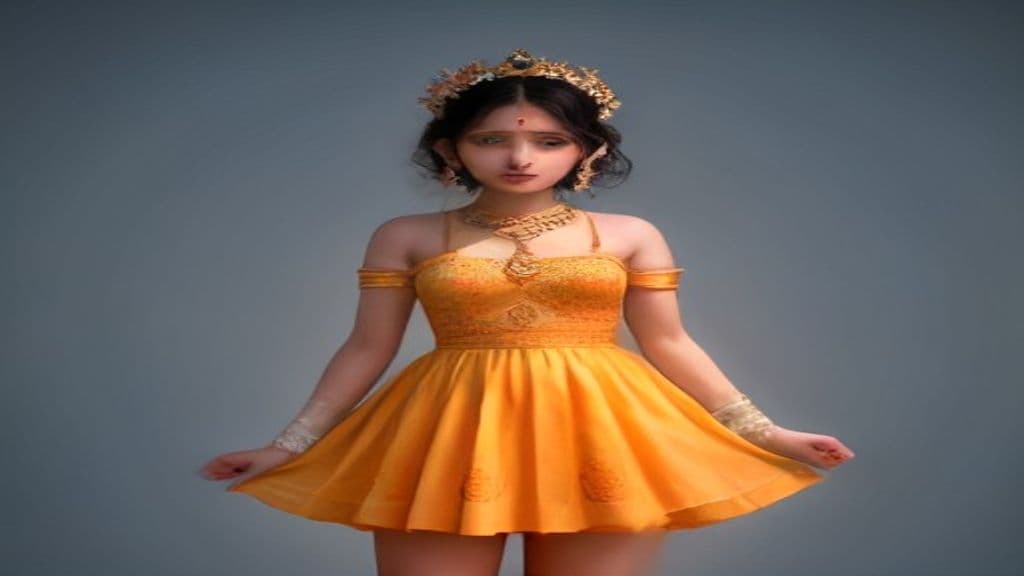
Mandavi is presented in the Ramayana-cycle material as a princess of Videha (Mithila). She is one of four sisters who marry the four sons of Dasharatha; Mandavi's marriage to Bharata results from the diplomatic and dynastic arrangements linking Mithila and Ayodhya. Narrative accounts identify her as the daughter of Mithila's royal household (linked in the tradition with Sunayana / Chandrabhaga lineage in modern summaries) and report that the wedding ceremony was conducted under the guidance of the officiant Shatananda. In devotional-identificatory layers she is also described as an incarnation of Lakshmi's shankha (conch), which situates her as a human figure bearing a devotional correspondence to the goddess rather than as an autonomous deity.
The supplied sources do not provide a detailed classical textual description of Mandavi's physical features (complexion, height, dress). Modern visual representations in film, television, and at a temple shrine (a Telangana shrine that includes statues of Bharata and Mandavi) portray her according to contemporary artistic conventions for epic royal women, but those portrayals are adaptations rather than sourced textual descriptions. Sources emphasize her social role and status as a princess and consort rather than distinctive bodily attributes.
Primary sources, as represented in the supplied material, do not attribute supernatural powers to Mandavi beyond her identification as an incarnation of Lakshmi's conch (shankha) in some traditions. Her notable qualities are ethical and social: piety, perseverance, domestic devotion, sacrifice, and fidelity. Narrative behaviors recorded include remaining in Ayodhya to care for her husband's aging parents during Bharata's residence at Nandigram, refraining from meeting her husband for the duration of Rama's fourteen-year exile at Bharata's request, and being the mother of two sons—Taksha and Pushkala—credited in tradition with founding cities. In Tulsidas's Ramcharitmanas an alternate/late retelling reports that Mandavi (with her sister Shrutakirti) became Sati with her husband and died after his samadhi; this is a narrative variant about her eventual destiny rather than an account of active supernatural agency.
Manaia (legendary chief)
In Māori mythology, Manaia is a legendary chief and ancestor figure who led a great fleet to attack Ngātoro-i-rangi in New Zealand. (Note: 1. Power tier: Greater (not Primordial) - as Manaia is an ancestor figure with significant military prowess, but not a cosmic or deity-level being. 2. Abilities: While Manaia exhibited fierce rivalry )
Manananggal
A terrifying Philippine vampire who severs its own upper body from its lower half at night, sprouting bat wings to fly out and feast on sleeping pregnant women's fetuses.
Manasā
Manasā is a Hindu goddess associated primarily with snakes, widely worshipped across large parts of India as a protector against snakebite and as a source of fertility and prosperity. In mythic genealogies she is a daughter of the sage Kaśyapa, sister of the nāga king Vasuki, wife of the sage Jaratkaru, and mother of the sage Aṣṭaka/Astika.
Manaul
Manaul is a birdlike mythic figure in multiple Philippine indigenous traditions, variously portrayed as an omen-bearing bird sent by Bathala or Amihan, a king who guides destinies and instigates cosmic conflict, and a rebellious/cosmogonic agent who creates islands.
Manco Cápac
Manco Cápac is the foundational ancestral figure and culture‑founder of the Inca (Quechua) tradition: remembered as the first ruler (Sapa Inca) and progenitor who, according to origin legends, established Cusco after emerging with Mama Ocllo from Lake Titicaca. Sources treat him variably as mythic ancestor, legitimizing founder, and a possibly historical early ruler.
Mandanu
Mandanu (also Madanu) is a Mesopotamian deity primarily attested after the Old Babylonian period who functions as a divine judge and court official in the entourage of the god Marduk. He is associated with judicial functions, temple-topography in Babylon (notably the temple E-rabriri), and appears in god lists and ritual/topographical texts.
Mandodari
Mandodari is the principal queen-consort of Rāvaṇa in the Rāmāyaṇa tradition: a beautiful, pious, and morally clear-sighted royal woman of mixed supernatural parentage who functions as a counselor, protector, and ritual exemplar (one of the Pancha-kanyā). Her story appears in multiple regional retellings with variant origin accounts.
Mandrake (plant/tradition)
A human-shaped root (primarily Mandragora spp.) treated in classical and later European tradition as a toxic, psychoactive pharmakon whose anthropomorphic form and powerful alkaloids generated ritualized harvesting rules and medicinal prescriptions. It is a botanical substance invested with magical and medical significance rather than an independently volitional spirit in the provided sources.
Manes
In ancient Roman religion the Manes (Latin: mānēs) are a collective class of chthonic divine dead — the subterranean spirits of deceased persons — who are propitiated in household, funerary, and civic rites (e.g., Parentalia, Feralia, and foundation rites involving the lapis manalis). They appear in inscriptions (D.M., Dis Manibus) and literary commentary as an institutionalized category of the dead rather than as a single named being.
Mangindusa
Mangindusa is a deity figure in Tagbanwa (Tagbanuwa) cosmology of Palawan. Sources variably present Mangindusa as a creator or as a high god within a layered indigenous cosmos, but ethnographic reports conflict about the exact status and functions of the figure.
Manibandh Shaktipeeth
A sacred site in Hindu tradition associated with the mythological story of Goddess Sati's self-immolation, marking the spot where her wrists are believed to have fallen. (Note: 1. Power tier: Change "Lesser Spirit" to "Primordial" since Manibandh Shaktipeeth is a sacred site associated with the mythological story of Goddess Sati's self-immolation, implying a powerful and cos)
Manipogo
Manipogo is a named lake‑monster figure in Manitoba folklore, described in local oral tradition and modern reports as a large serpentine creature inhabiting Lake Manitoba. The modern name was coined in 1960 by analogy with Ogopogo and the creature functions as a regional folkloric emblem referenced in sightings, local media, and community events such as the St. Laurent Manipogo Festival and Manipogo Provincial Park.
Community Record
- [1]Mandavi - Wikipedia. Wikipedia, 'Mandavi' article (accessed via provided research notes)wiki
- [2]Mandavi - Mythology/folklore entry. Myth & Folklore online encyclopedia summary (as cited in research notes)folk
- [3]Wikidata: Mandavi. Wikidata entry summarizing relationships (noting 'female cousin of Goddess Sita')wiki