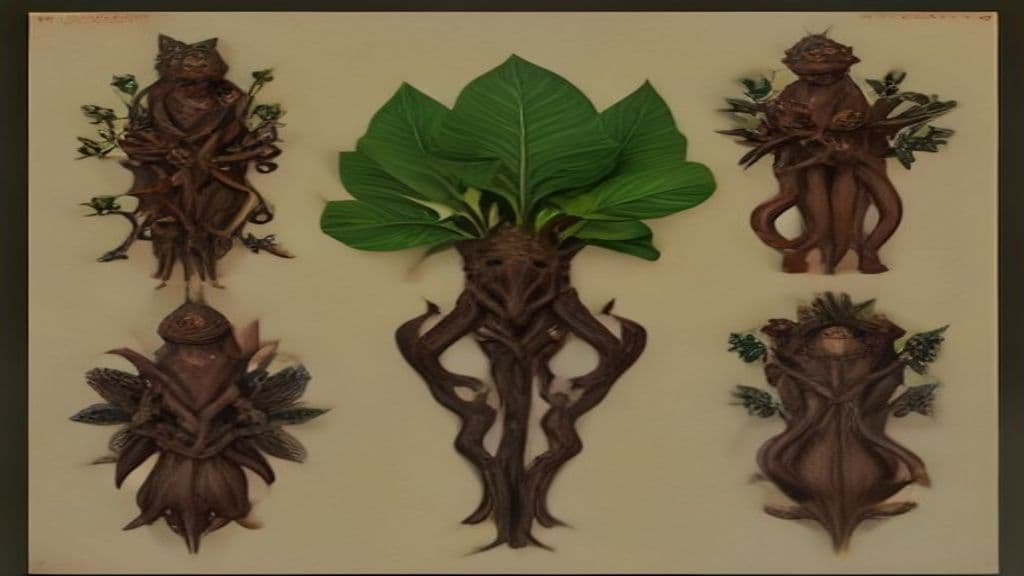
In classical sources the mandrake is treated botanically: Mandragora species native to the Mediterranean produce anthropomorphic roots and are described by authors such as Theophrastus, Dioscorides, and Pliny within materia medica traditions. Later vernacular folk etymologies and popular beliefs attached transgressive origins to the root, claiming it grew from places or substances connected to executed criminals (examples in German and Dutch names like Galgenmännlein and pisdiefje) or from the remains or droppings of hanged thieves (Icelandic þjófarót), reflecting a later folkloric layering atop the classical botanical account.
Botanically the mandrake refers mainly to Mandragora species (Solanaceae) whose roots often take on an anthropomorphic, 'man-shaped' form; classical materia medica also note a strong smell. Ancient authors and summaries cite a popular distinction of 'male' (white) and 'female' (dark) types reported by Pliny. Other unrelated plants with similar humanlike roots (e.g., Bryonia alba, Podophyllum peltatum) are sometimes called 'mandrake' in folk usage and enter the same conceptual space.
Mandrake roots contain tropane alkaloids with anticholinergic, hallucinogenic, narcotic properties; reported physiological effects in clinical summaries include dry mouth, blurred vision, mydriasis, difficulty urinating, dizziness, headache, vomiting, flushing, tachycardia, hyperactivity, and hallucinations, and in sufficient doses can induce unconsciousness—hence historical use as an analgesic and anesthetic. Classical and folk authors attribute magical properties such as use in love potions or aphrodisiac efficacy (e.g., Pliny's notes on phallic roots), but in the provided sources these are presented as folkloric/classical claims rather than empirical proofs. The sources do not describe the mandrake as an independently acting spirit; its potency is located in shape and substance and in ritualized handling.
Weaknesses
- conditionDose-dependent toxicity and variable alkaloid concentration
- otherRequires controlled preparation and dosing by trained practitioners (risk of poisoning if mishandled)
Wards
- ritualClassical harvesting precautions (draw three circles and cut facing west)
- ritualRitualized second-extraction practice (dance around it while speaking lewd sexual talk to obtain a second piece)
Manasā
Manasā is a Hindu goddess associated primarily with snakes, widely worshipped across large parts of India as a protector against snakebite and as a source of fertility and prosperity. In mythic genealogies she is a daughter of the sage Kaśyapa, sister of the nāga king Vasuki, wife of the sage Jaratkaru, and mother of the sage Aṣṭaka/Astika.
Manaul
Manaul is a birdlike mythic figure in multiple Philippine indigenous traditions, variously portrayed as an omen-bearing bird sent by Bathala or Amihan, a king who guides destinies and instigates cosmic conflict, and a rebellious/cosmogonic agent who creates islands.
Manco Cápac
Manco Cápac is the foundational ancestral figure and culture‑founder of the Inca (Quechua) tradition: remembered as the first ruler (Sapa Inca) and progenitor who, according to origin legends, established Cusco after emerging with Mama Ocllo from Lake Titicaca. Sources treat him variably as mythic ancestor, legitimizing founder, and a possibly historical early ruler.
Mandanu
Mandanu (also Madanu) is a Mesopotamian deity primarily attested after the Old Babylonian period who functions as a divine judge and court official in the entourage of the god Marduk. He is associated with judicial functions, temple-topography in Babylon (notably the temple E-rabriri), and appears in god lists and ritual/topographical texts.
Mandavi
Mandavi (Sanskrit: Māṇḍavī) is a princess of Videha (Mithila) in the Ramayana tradition, wife of Bharata, and is regarded in some retellings as an incarnation of the shankha (conch shell) of goddess Lakshmi. She functions as an exemplary pativrata (dutiful wife) noted for sacrifice and perseverance and figures in narratives that link Mithila and Ayodhya through dynastic marriage.
Mandodari
Mandodari is the principal queen-consort of Rāvaṇa in the Rāmāyaṇa tradition: a beautiful, pious, and morally clear-sighted royal woman of mixed supernatural parentage who functions as a counselor, protector, and ritual exemplar (one of the Pancha-kanyā). Her story appears in multiple regional retellings with variant origin accounts.
Manes
In ancient Roman religion the Manes (Latin: mānēs) are a collective class of chthonic divine dead — the subterranean spirits of deceased persons — who are propitiated in household, funerary, and civic rites (e.g., Parentalia, Feralia, and foundation rites involving the lapis manalis). They appear in inscriptions (D.M., Dis Manibus) and literary commentary as an institutionalized category of the dead rather than as a single named being.
Mangindusa
Mangindusa is a deity figure in Tagbanwa (Tagbanuwa) cosmology of Palawan. Sources variably present Mangindusa as a creator or as a high god within a layered indigenous cosmos, but ethnographic reports conflict about the exact status and functions of the figure.
Manibandh Shaktipeeth
A sacred site in Hindu tradition associated with the mythological story of Goddess Sati's self-immolation, marking the spot where her wrists are believed to have fallen. (Note: 1. Power tier: Change "Lesser Spirit" to "Primordial" since Manibandh Shaktipeeth is a sacred site associated with the mythological story of Goddess Sati's self-immolation, implying a powerful and cos)
Manipogo
Manipogo is a named lake‑monster figure in Manitoba folklore, described in local oral tradition and modern reports as a large serpentine creature inhabiting Lake Manitoba. The modern name was coined in 1960 by analogy with Ogopogo and the creature functions as a regional folkloric emblem referenced in sightings, local media, and community events such as the St. Laurent Manipogo Festival and Manipogo Provincial Park.
Manitou
Manitou is the pervasive spirit-power in Algonquian/Wabanaki cosmology, variously manifesting as a supreme creator spirit (Gitche Manitou) and as multiple lesser spirits that inhabit persons, animals, places, and natural phenomena. It functions as the animating force of the natural world and the recipient of prayers, songs, and teachings in Wabanaki traditions.
Mannus
Central figure in Germanic creation myths, entrusted with starting humanity; abilities and characteristics unknown. (Note: 1. Power tier should be Ancient (deity-level) as it's implied that Mannus has a significant role in the creation myth and is entrusted by the gods. 2. No information on appearance, sensory cues, wards)
Community Record
- [1]Mandrake - Wikipedia. Wikipedia contributors, 'Mandrake', Wikipedia, https://en.wikipedia.org/wiki/Mandrakewiki
- [2]Wikidata: Mandrake (Q1930117). Wikidata entry Q1930117, Mandrake, http://www.wikidata.org/entity/Q1930117other